Buddhism

The Buddha’s Last Words

As he lay on his deathbed between the twin Sal Trees, the Buddha’s parting words were: “Be your own light, be your own refuge, the Dharma is your light and refuge. Things naturally decay: win through by mindfulness!”

After reading Jayarava’s very thorough discussion of the last sentence above, from the Pali words given in the Mahāparinibbāna Sutta, I thought I would produce my own re-rendering, designed for accessibility and usefulness.  Jayarava raises many points about the meanings of the various terms, and his suggested translations are different from the above; he has not checked my rendering.  It is well worth reading his whole blog entry.


Notes on right livelihood from Buddhist sources

Right livelihood is ethical livelihood (the Buddha)

1200px-Mancunian_Bees“And how is right view the forerunner? One discerns wrong livelihood as wrong livelihood, and right livelihood as right livelihood. And what is wrong livelihood? Scheming, persuading, hinting, belittling, & pursuing gain with gain. This is wrong livelihood…

“One tries to abandon wrong livelihood & to enter into right livelihood: This is one’s right effort. One is mindful to abandon wrong livelihood & to enter & remain in right livelihood: This is one’s right mindfulness. Thus these three qualities — right view, right effort, & right mindfulness — run & circle around right livelihood.” (MN 117, Thanissaro trs)

Monks, these five trades ought not to be plied by a lay-disciple… Trade in weapons, trade in human beings, trade in flesh, trade in spirits [intoxicants] and trade in poison. (Gradual Sayings, AN 5.177)

The Buddha’s advice on working

To a Householder

“We, Lord, are laymen who enjoy worldly pleasure. We lead a life encumbered by wife and children. …We deck ourselves with garlands, perfume and unguents. We use gold and silver. To those like us, … let the Exalted One preach the Dhamma, teach those things that lead to weal and happiness in this life and to weal and happiness in future life.”

Four conditions, Vyagghapajja, conduce to a householder’s weal and happiness in this very life. Which four?

The accomplishment of persistent effort (utthana-sampada), the accomplishment of watchfulness (arakkha-sampada), good friendship (kalyanamittata) and balanced livelihood (sama-jivikata).

  1. Herein, Vyagghapajja, by whatsoever activity a householder earns his living, whether by farming, by trading, by rearing cattle, by archery, by service under the king, or by any other kind of craft — at that he becomes skillful and is not lazy. He is endowed with the power of discernment as to the proper ways and means; he is able to carry out and allocate (duties). This is called the accomplishment of persistent effort.
  2. Herein, Vyagghapajja, whatsoever wealth a householder is in possession of, obtained by dint of effort, collected by strength of arm, by the sweat of his brow, justly acquired by right means — such he husbands well by guarding and watching so that kings would not seize it, thieves would not steal it, fire would not burn it, water would not carry it away, nor ill-disposed heirs remove it. This is the accomplishment of watchfulness.
  3. Herein, Vyagghapajja, in whatsoever village or market town a householder dwells, he associates, converses, engages in discussions with householders or householders’ sons, whether young and highly cultured or old and highly cultured, full of faith (saddha), full of virtue (sila), full of charity (caga), full of wisdom (pañña). He acts in accordance with the faith of the faithful, with the virtue of the virtuous, with the charity of the charitable, with the wisdom of the wise. This is called good friendship.

Herein, Vyagghapajja, a householder knowing his income and expenses leads a balanced life, neither extravagant nor miserly, knowing that thus his income will stand in excess of his expenses, but not his expenses in excess of his income.

Just as the goldsmith, or an apprentice of his, knows, on holding up a balance, that by so much it has dipped down, by so much it has tilted up; even so a householder, knowing his income and expenses leads a balanced life, neither extravagant nor miserly, knowing that thus his income will stand in excess of his expenses, but not his expenses in excess of his income.

(From the Dighajanu Sutta, Anguttara Nikaya VIII.54, translated by Narada Thera.)

To Sigalaka

And how, young householder, does a noble disciple, cover the six quarters?

The following should be looked upon as the six quarters. The parents should be looked upon as the East, teachers as the South, wife and children as the West, friends and associates as the North, servants and employees as the Nadir, ascetics and brahmans as the Zenith….

In five ways should a master minister to his servants and employees as the Nadir:

(i)     By assigning them work according to their ability, (ii)     By supplying them with food and with wages, (iii)    By tending them in sickness, (iv)    By sharing with them any delicacies, (v)    By granting them leave at times.

The servants and employees thus ministered to as the Nadir by their master show their compassion to him in five ways:

(i)     They rise before him, (ii)     They go to sleep after him, (iii)    They take only what is given, (iv)    They perform their duties well, (v)    They uphold his good name and fame.

The servants and employees thus ministered to as the Nadir show their compassion towards him in these five ways. Thus is the Nadir covered by him and made safe and secure.

[From another part of the Sutta:] … There are, young householder, these six evil consequences in being addicted to idleness: he does no work, saying:

  1. That it is extremely cold
  2. That it is extremely hot
  3. That it is too late in the evening
  4. That it is too early in the morning
  5. That he is extremely hungry
  6. That he is too full.(From the Sigalavada Sutta, DN 31, translated from the Pali by Narada Thera.)
  7. Living in this way, he leaves many duties undone, new wealth he does not get, and wealth he has acquired dwindles away….

The Four Appropriate Happinesses

“Herein, householder, these four kinds of happiness are appropriate for one who leads the household life and enjoys the pleasures of the senses. They are the happiness of ownership, the happiness of enjoyment, the happiness of freedom from debt, and the happiness of blamelessness.

“What is the happiness of ownership (atthisukha)? A son of good family possesses wealth that has been obtained by his own diligent labour, acquired through the strength of his own arms and the sweat of his own brow, rightly acquired, rightly gained. He experiences pleasure, he experiences happiness, thinking, ‘I possess this wealth that has been obtained by my own diligent labour, acquired through the strength of my own arms and the sweat of my own brow, rightly acquired, rightly gained.’ This is the happiness of ownership.

“And what is the happiness of enjoyment (bhogasukha)? Herein, a son of good family consumes, puts to use, and derives benefit from the wealth that has been obtained by his own diligent labour, acquired through the strength of his own arms and the sweat of his own brow, rightly acquired, rightly gained. He experiences pleasure, he experiences happiness, thinking, ‘Through this wealth that has been obtained by my own diligent labour, acquired through the strength of my own arms and the sweat of my own brow, rightly acquired, rightly gained, I have derived benefit and performed good works.’ This is called the happiness of enjoyment.

“And what is the happiness of freedom from debt (ananasukha)? Herein, a son of good family owes no debt, be it great or small, to anyone at all. He experiences pleasure and happiness, reflecting. ‘I owe no debts, be they great or small, to anyone at all.’ This is called the happiness of freedom from debt.

“And what is the happiness of blamelessness (anavajjasukha)? Herein, a noble disciple is possessed of blameless bodily actions, blameless speech, and blameless thoughts. He experiences pleasure and happiness, thinking, ‘I am possessed of blameless bodily actions, blameless speech, and blameless thoughts.’ This is called the happiness of blamelessness.

“When he realizes the happiness of being free from debt, he is in a position to appreciate the happiness of owning possessions. As he uses his possessions, he experiences the happiness of enjoyment. Clearly seeing this, the wise man, comparing the first three kinds of happiness with the last, sees that they are not worth a sixteenth part of the happiness that arises from blameless behaviour.” (A.II.69, from a Ven. Payutto Web Page.)  These four can be applied to your work, and summarised as: Joy in what you’ve got (enjoying the career and work that you already have, and the benefits you get from them, including financial); Joy in what you do with it (this is enjoying the products of your work — creativity and as well as material productivity); Joy in non-dependency; and Joy in a free heart.  See the Jack Kornfield talk, reference below.

Working in Buddhist teams

Defining TBRL

‘Team-Based Right Livelihood Businesses’ (TBRL) “were team-based because they consisted of a number of Buddhists working together. They worked together along broadly co-operative lines. And they were right livelihood businesses, because they operated in accordance with Buddhist ethical principles.”

(Sangharakshita, The integration of Buddhism into Western Society, 1992)

” Team based right livelihood businesses have four distinguishing characteristics.

  1. They provide those who work in them with a means of support. They do not pay wages or salaries, and they give each worker what he or she needs according to their individual circumstances.
  2. They engage only in such activities that are ethical, ie. in accordance with the precepts. Morover, the team based right livelihood businesses are run in an ethical manner, and the workers treat one another ethically.
  3. They provide opportunities for the development of spiritual friendship within the work situation. [enumerated as number 2 in The integration of Buddhism into Western Society (1992): “they enabled Buddhists to work with one another”.] This is particularly the case where the workers not only work together, but live together in a community.
  4. Profits of the business are distributed as dana, for the benefit of FWBO/TBMSG activities of various kinds.” [In The integration of Buddhism into Western Society: “they gave financial support to Buddhist and humanitarian activities”.]

(Sangharakshita, Looking Ahead a Little Way, 1999 and The Six Emphases of the FWBO.)

“If anything is to be added [to the above four] it should be something to the effect that a right livelihood business would be one in which all the skills necessary for the success of the business were present – managerial and other skills.” (1987 Men’s Order Convention Questions)

Cooperative working

“If you have a co-op you’ve got a group of people who have equal responsibility in principle.  That doesn’t mean… that they’re interchangeable in terms of skills, but… there are no employers and no employees regardless of the specific functions the individual members of the co-op are performing. So you’ve got a situation in which people all accept responsibility, and that isn’t easy, because one usually finds within a group of people working together, that some … take on less responsibility, which means that the others have to take on a bit more responsibility to take up the slack… Usually those who take on more responsibility are in the minority, those who take on less responsibility are in the [majority]. Then those who take on less responsibility for the same reason that they take on less responsibility are resentful that other people have taken on more responsibility … In this way resentment develops, all sorts of criticism develops and so on. So you need really, to have a co-op at all, a group of really mature and responsible people.” they need to be concerned for the co-op as a whole, not just their job (at least full-timers).  So probably only order members should work in our ‘co-ops’…

“If you have to think in terms of a career, well think of it as a career within the Movement as a whole.”

(Sangharakshita, 1987 Women’s Convention.)

It’s not difficult to start an FWBO centre, it’s more difficult to start a single-sex community, but the most difficult and demanding of all is to start a TBRL.  “But it’s also perhaps the most worthwhile of all because, …in some cases you not only work with other people but you live with those same people and living with them and working with them, you can develop a very close spiritual friendship.”

“You work best on your relationships within the Team by all of you, more and more devotedly co-operating for the fulfilment of the aims and objects of the business.”

“I regard the [FWBO] housewife as, in a way, working, you might say, in a Team Based Right Livelihood project, perhaps on a rather small scale, depending on the number of children.” (Sangharakshita, Dhanakosa Opening Questions, 1993)

Also, ” the work situation is very important for developing a more virile kind of spiritual friendship.”

“Unless they are manned entirely by stream entrants, all organisations and Movements will have an in-built tendency to degenerate. So err on the side of adherence to the ideal, if you have to err at all.”

(Sangharakshita, Windhorse Trading Right Livelihood Questions)

Subhuti’s five categories of right livelihood

  1. Doing work that is not unethical.
  2. Having contact with Buddhists in the same line of work.
  3. Working with other Buddhists.
  4. Setting up a Buddhist business, paying normal wages.
  5. Team-based right livelihood with a semimonastic lifestyle.
  6. (Summarised in: Working Life, an Exploration of Right Livelihood, Talk by Jnanavaca, London Buddhist Centre. I would add number 1a, Vocational work, which might be altruistic or artistic.)

Historical spiritual communities, especially in the 19th century in America

“Some of these communities developed business enterprises, and these business enterprises were quite successful, but they ended up absorbing all the energies of the people involved, and the spiritual communities became, sometimes officially and legally, business corporations; one or two of which, I think, continue still. And the whole spiritual community side of [things was lost. Broadly, they failed because there was] no common way of life, no common spiritual practice, and no real emphasis on individual growth and development and on helping one another to grow and evolve; and no emphasis on the community as a situation with a structure which helps the individual to evolve.”

(Sangharakshita, Tuscany 82 Q&A)

Team-Based Right Livelihood as spiritual practice

“If the work is ethical it’s a spiritual practice. If the business is generating funds for dharma projects, for dana, obviously that’s a spiritual practice. One might even say that if it’s providing its workers with support, that’s a spiritual practice. It’s again a form of dana. And if it provides kalyana mitrata well certainly it’s a spiritual practice.” And you get your energies going through working hard.  (Sangharakshita, 1987 Men’s Order Convention Questions)

Mindfulness and insight through working

Mindfulness is important, but would you necessarily develop more mindfulness, say, at Vajraloka that at work?  “In your work there is an objective check up. You’re made more quickly aware if you have been unmindful.”  “There is a constant means of checking, objectively, how well you are doing. Not only in business terms, but even to some extent in spiritual terms. You may not get that in a more relaxed and, as it were, spiritual situation, unless you have a very fiery Zen type master perhaps.”

Insight at work?  By its nature, insight doesn’t depend on any particular set of conditions: it arises in dependence on non-Insight.  The Indian  tradition in particular says that Shamatha is most conducive, but Zen provides many examples of insight in different situations.  Nevertheless, an extreme situation, pushing you to the edge, is most likely to give rise to insight, whether you are meditating or not.  Are you sometimes pushed to the edge at Windhorse Trading? “Maybe there are financial problems, and you tell yourself well yes there are these problems, but what is the challenge? Not to be disturbed, and just face the possibility of total failure with equanimity. … That’s the edge towards which you are being pushed. That you are not deep down really, ultimately concerned about success or failure. At least not in a personal sense.”  You can cultivate all the spiritual faculties at work, but to keep them healthy there are probably more specialised situations such as Puja and meditation and retreat and study which are also necessary, and are allowed for at Windhorse.  Sangharakshita would take a daily meditation practice, the weekly chapter meeting, and one month of retreats each year as a minimum.  If Windhorse was really a complete situation, why not commit yourself to it for life, as the Benedictines did in their monastery?  Those not suited to it could found other kinds of right livelihood businesses, especially those involved with providing the essentials of life, especially food, clothing and housing. (Sangharakshita, Windhorse Trading Right Livelihood Questions)

Jack Kornfield’s five aspects of right livelihood

  1. Non-harming

Avoiding livelihoods that, for example, involve weapons, exploitation, drugs, or whatever hurts people; and helping others avoid them, too.

  1. Appropriate happiness

(See above)

  1. Growth and Awareness

‘Waking up’ in your livelihood.  Practising mindfulness, and facing reality in your work.

  1. Simplicity

Keeping your work uncomplicated and straightforward, using it to support a simple life, not consumerist.

  1. Service

Seeing your livelihood in terms of offering benefit to others, acting in a loving and selfless way.

[I would add:  6. Fellowship: communication, friendship, kalyana mitrata, co-operation, empathy, Sangha etc.]

http://www.cheraglibrary.org/buddhist/kornfield/jkliveli.htm

Dogen on the Tenzo

The job of cook is an all-consuming pursuit of the way. If one lacks the way-seeking mind, it will be nothing but a vain struggle and hardship, without benefit in the end.

When washing rice, preparing vegetables, and so on, do so with your own hands, with close attention, vigorous exertion, and a sincere mind. Do not indulge in a single moment of carelessness or laziness. Do not allow attentiveness to one thing to result in overlooking another….

The ancients said that cooks regard [rolling] up their sleeves as the way-seeking mind.

Treat utensils such as tongs and ladles, and all other implements and ingredients, with equal respect; handle all things with sincerity, picking them up and putting them down with courtesy….

Do not argue with the store officers over the amount of ingredients you have received. Without worrying about their quality, simply make the best of what you have. …

Even when, for example, one makes a soup of the crudest greens, one should not give rise to a mind that loathes it or takes its lightly; and even when one makes a soup of the finest cream, one should not give rise to a mind that feels glad and rejoices in it.

…When we work attentively, therein lies the principle that makes it possible to surpass our predecessors.  That you still do not grasp the certainty of this principle is because your thinking scatters, like wild horses, and your emotions run wild, like monkeys in a forest. If you can make those monkeys and horses, just once, take the backward step that turns the light and shines it inward, then naturally you will be completely integrated. This is the means by which we, who are [ordinarily] set into motion by things, become able to set things into motion. …

Harmonizing and purifying yourself in this manner, do not lose either the one eye [of transcendent wisdom] or the two eyes [of discriminating consciousness]. Lifting a single piece of vegetable, make [yourself into] a six-foot [Buddha] and ask that six-foot body to prepare a single piece of vegetable. Those are [the cook’s] spiritual penetrations and magical transformations, his Buddha-work and benefiting of living beings. …

Harmonizing and purifying yourself in this manner, do not lose either the one eye [of transcendent wisdom] or the two eyes [of discriminating consciousness]. Lifting a single piece of vegetable, make [yourself into] a six-foot [Buddha] and ask that six-foot body to prepare a single piece of vegetable. Those are [the cook’s] spiritual penetrations and magical transformations, his Buddha-work and benefiting of living beings. … (Dogen, Advice to the Cook, http://www.stanford.edu/group/scbs/sztp3/translations/eihei_shingi/translations/tenzo_kyokun/translation.html )

And an unsourced quote from Dogen: ” when the cook takes the vegetable stems, it must be with the same power with which the Buddha turned the wheel of the Dharma…”

Right livelihood reading list

Author Title Subtitle Publisher
Date
Notes
Badiner, Allan Hunt (ed) Mindfulness in the Marketplace Compassionate responses to consumerism Parallax 2002 Essays on consumerism etc, mainly by various American Buddhists
Buchan, James Frozen Desire An Inquiry into the Meaning of Money Picador 1997 Nature and history of money and its illusory nature.  Not Buddhist.
Carroll, Michael Awake at Work 35 practical Buddhist principles for discovering clarity & balance in the midst of work’s chaos Shambhala 2006 Based on Tibetan mind training, using slogans
Dalai Lama and Howard Cutler The Art of Happiness at Work Hodder and Stoughton 2003 Conversations with the Dalai Lama on job satisfaction etc
Inoue, Shinichi Putting Buddhism to Work A New Approach to Management and Business Kodansha Internation’l 1997 Japanese businessman, mainly on Buddhist economics, a little on RL
Kinder, George Seven Stages of Money Maturity Understanding the Spirit and Value of Money in Your Life Random House 1999 Vaguely Buddhist angle on understanding spiritual and psychological issues around money.
Kulananda & Dominic Houlder Mindfulness and Money The Buddhist Path to Abundance Broadway Books 2002 By two Order Members
Lamont, Georgeanne The Spirited Business Success stories of Soul-friendly companies Hodder and Stoughton 2002 Transforming your workplace to be more spiritual, with many case histories
Lewin, Roger and Birute Regine The Soul at Work Unleashing the power of complexity science for business success Orion Business Books 1999 Business organisational dynamics, prioritising genuine relationships and mutual respect, connecting people to values.
Low, Albert Zen and Creative Management Charles Tuttle 1976this ed 92 Solving management problems using Zen ideas
Maitland, Arnaud Master Work Master of time Dharma Publishing 2000 Disciple of Tarthang.  Communication, cooperation, responsibility, awareness & concentration; caring; mastering the flow of time.


Padmasuri Transforming Work An experiment in Right livelihood Windhorse Publicat’ns 2003 On Windhorse Trading
Payutto, P A Buddhist Economics A Middle Way for the Marketplace Buddha Dharma foundation 1994 (2nd edn) Ethics of making money
Pratley, Peter The Essence of Business Ethics Prentice Hall 1995 Study text for managers
Richmond, Lewis Work As a Spiritual Practice How to bring depth and meaning to the work you do Piatkus 1999 Buddhist approach, including the energy wheel, dealing with stress, worry, anger, boredom, failure etc and developing positive qualities.
Roach, Geshe Michael The Diamond Cutter The Buddha on managing your business and your life Doubleday 2000 Business strategies from the Diamond Sutra
Simpson, Liz Working from the Heart A practical guide to loving what you do for a living Vermilion 1999 Making work more fulfilling, vaguely Buddhist
Tarthang Tulku Mastering Successful Work Skilful means: wake-up Dharma Publishing 1994 Making work into a path of realisation and transformation
Tarthang Tulku Ways of Work Dynamic action Dharma Publishing 1987 Accounts of working for Dharma Publishing etc
Whitmyer, Claude (ed) Mindfulness and Meaningful Work Explorations in Right livelihood Parallax Press 1994 Essays based on the eightfold path applied to work, mainly by American Buddhist teachers.
Witten, Dona and Akong Tulku Rinpoche Enlightened Management Transforming yourself — and then your team — for maximum success Rider 1998 Applying Buddhist principles to managing

Compiled by Ratnaprabha

Mind in Buddhism

Mind in Buddhism: Finding the Mind interview

CoverHow would you introduce Finding the Mind in just a few words?

Being aware is the most important part of our experience as human beings, so in Finding the Mind I wanted to explore what it means to be aware, and what you can do with this awareness. Buddhists have been looking into the issue for over two and a half thousand years so my book draws on the whole of the Buddhist tradition, as well as looking at some modern ideas.

I also put a few exercises in the book so that readers can do some of the things that Buddhist meditators have been doing down the ages and see what results they come up with themselves. I wanted to make the book accessible and also quite interactive because ultimately what is important is your own experience, not what somebody else says your experience ought to be. So I hope that Finding the Mind will give people a few avenues into exploring their own minds.

Why is the project of finding our minds so important?

In a way, experiences are all that we have got, so exploring the nature of experience is, I think, basic to our humanity. Also basic to our humanity are our unwelcome experiences – we suffer, we experience pain, and we wish things were different – and Buddhism has some very effective strategies for coping with these unwelcome experiences. Not just coping with them, in fact, but actually seeing through the issues that cause them in the first place.

The Buddha taught that suffering springs from our own minds, and mostly from the fact that we don’t know our own minds, so we end up making the same mistakes in life, over and over again. This is why I think that finding our minds is such an important project.  We become familiar with the way our minds normally work, firstly so that we can then work out how to change our minds, and secondly so that we can also empathize with the experience of other people. Because people’s minds do work in very similar ways, and if we can understand our own minds, we can understand more about what it’s like to be a human being in general.

So finding our minds is not only important but also quite fascinating and exciting – lots of unexpected insights emerge when we start to look at our minds. Imagine that you didn’t have repeated disappointments with life and that you’d found the confidence to engage with the world and leave it a better place! This is what I think engaging with the Buddhist view of the mind can offer.

You dedicate a whole chapter to the subject of compassion. What relevance does compassion have as far as finding the mind is concerned?

Well firstly I think that it’s very important that any discussions of Buddhism include the subject of compassion because compassion is such a crucial part of Buddhism in general. Obviously meditation is also crucial – it allows us to make our experience as simple and straightforward as possible so that we can notice what’s actually going on in our minds and make subtle little adjustments. However, what is equally important is what happens during the rest of the day: how we go to sleep, how we eat, how we behave at work, how we deal with the people we live with. All of this stuff is real – it’s our mind actually responding. So finding the mind is not just about self-discovery, it’s also about connecting with our capacity to respond to life in a more compassionate way.

And as I mentioned earlier, our experience of suffering is something that we share with all human beings. More specifically, it’s a common human experience to feel embattled, for example, or needy, or that there’s something missing. One way through these experiences is through awareness of others – in other words through compassion – because compassion expands our awareness from the narrow perspective of the self, leaving us more relaxed and happier. So, even from a selfish point of view, compassion really works! But of course it is also about something much bigger than that. Other people are just as real as we are, they are just as important. So not to care about other people I think is running away from something.

Does Buddhism point to objective and universal laws that govern the workings of our minds, or does it simply encourage us to explore our own subjective experience?

I think it’s definitely best if our exploration of Buddhism starts from our own experience – from basic mindfulness – but of course with mindfulness we start to notice patterns in our experience and patterns between people as well. We discover that there are universal laws that govern the lives of conscious beings – all beings with a mind – because there’s something about mind which is, in a way, universal. When we see ourselves as a distinct subject in here, for example, we are inevitably going to experience problems with the separation between ourselves and the world around us.

So all conscious beings face similar problems, and finding solutions to these common problems is exactly what Buddhism is about. It’s something that ultimately we have to do for ourselves, but Buddhism gives us maps of the patterns that we’re likely to find in our experience to help us on our way.

In fact the Buddhist tradition has come up with a number of different maps because the underlying truths of life can never be fully summed up in one single conceptual way. And I think it’s helpful to be exposed to the widest possible range of approaches, so in my book I include visual images like the Tibetan wheel of life, along with Buddhist philosophical teachings, and I also recount stories – some narratives and some more mythic stories. I think that once you’ve found an approach or a map that works for you it means that you can change your mental responses by using the understanding that’s come through from other people, as well as from your own mindfulness and self-understanding.

Are there many individual minds or is there just one universal Mind?

Well usually we have a sense of some kind of division between an outer world that we share with others and an inner world that is ours alone. However, I do know that some people have had wonderful panoramic experiences of unity where they feel a very strong connection with everything outside them as well. I think those are really valuable experiences, but I would be very hesitant to turn them into an ideology and to insist that there is only one Mind because quite a lot of the time we experience ourselves very much as individuals – I’m sure that there is truth in both views.

In the author biography on the back of the book it says that you curtailed your career in science to train for ordination into the Triratna Order. Can you talk a bit about this process and the place that Finding the Mind has in the context of your own experience?

I’ve always had a lot of curiosity about the world around me, as well as curiosity about myself. I can remember when I was very young, at that time when self-awareness starts to dawn, just looking around me and finding it incredibly weird and wonderful to think that I was in the present moment which wasn’t ever going to happen again. It was this fascination with my own awareness which led me into science, I think.

Then I got quite stressed while I was studying science at university so I started to meditate, and meditation took me to Buddhism. And Buddhism led me back to that same fascination with awareness! So in Finding the Mind I really wanted, at least for my own satisfaction, to explore what it means to be an aware human being, and to do so with fidelity to both Buddhism as a personal path and to science as an objective discipline. I find it very interesting to try and bring Buddhism and science together, and in some ways Finding the Mind is an outcome of that.

So is Buddhism a science?

Buddhism is certainly like science in some ways. Both Buddhism and science are explorations of what is going on in life, but the big difference between them is that Buddhism deals specifically with human experience rather than the outside world. Science is very interested in the outside, so even when it looks at the mind it views it as an outside phenomenon – science is not an exploration of the mind of the scientist, but the mind of the person she or he is putting into the MRI scanner. Buddhism is interested primarily in exploring the scientist’s own mind – our own minds – how they produce suffering, and how they can free us from suffering. So I would say that Buddhism is scientific, but it’s not the same as science.

You say that ‘the results of neuroscience and of Buddhist insight are being compared, and there are signs of an exciting synthesis emerging.’ Can you expand on this statement?

This is something that I discuss in the last chapter of my book – I talk a bit about the interesting insights that came out of the Mind and Life conferences where a number of top-notch scientists engaged in dialogue with Tibetan teachers including the Dalai Lama. These conferences were really productive, to the extent that a large number of American neuroscientists now also have some kind of Buddhist training or background, which is fantastic.

Since both neuroscientists and Buddhists are trying to find the mind, there is much that they can learn from each other. One of the things that science can learn from Buddhism is the value of introspection – the value of looking at your own experience with a quiet mind and not assuming that that must be completely untrustworthy because it’s subjective. Through introspection you can work from the inside, not just from the outside.

There are also many things that Buddhism can learn from science. It can learn, for example, not to be too bound by the specific teachings of particular Buddhist traditions but to look at them all together in the light of modern findings. To take a rather crude example, until recently the Tibetans still believed that the earth was flat and that there was a great mountain called mount Meru right in the middle of it. Science has enabled them to realize that although the teaching may have great symbolic value, it shouldn’t be taken literally. So I think that Buddhism and science can be friends with each other – they definitely don’t need to attack each other.

Lastly, can we really find our minds?

I feel as if I’m giving it all away here, but I think the answer is no – you can’t find your mind. Still, you’ve got to look! Buddhism is all about looking for our minds and not finding them, and then turning to the centre of our experience to realize that we can’t tie anything down when we look at it. We tend to have quite a lot of views about our subjective experience – we say ‘I’m like this’, ‘I have this identity’, ‘I associate with this’, ‘I call myself this’, and they’re all just stories that we tell ourselves which, in one way or another, cause us suffering.

So the funny thing is that the more you look for the mind and don’t find it, the happier you become – you find a sort of liberation of the mind. I mean, I don’t really know what enlightenment would be like, but I get a sense that even a liberated mind wouldn’t think that it had tied everything down. It would still carry on looking – looking really, really openly.

Buy Finding the Mind here.

Interview by Hannah Atkinson of Windhorse Publications, August 2012

Gender in Buddhism

The songs of the sisters

The Therigatha of the Pali Canon is said to be the first spiritual text in the history of the world composed by women. Inevitably, some of its stories and poems confront the issue of gender and spirituality. For example, Mara, embodiment of distraction, approaches Kisa Gotami while she is meditating in the Forest.  He comes up to her with a grin, and says “what are you doing here crying in the forest, are you looking for a boyfriend?” But she sees through him at once:

Khmer Tara or Parjanaparamita

Tara from Cambodia

I know you, time waster, you are Mara.
I have finished looking for men.

I don’t grieve,
I don’t weep —
and I’m not afraid of you,
my friend.

The mass of darkness is shattered.

Having defeated the army of death,
free
of [longing] I dwell.

And Mara curses under his breath and flees.

[Kisa Gotami Sutta, SN 5.3, Thanissaro’s trs modified.]

The Therigatha tells of another Buddhist woman, Soma.  She was also meditating under a tree, and Mara comes up to her: “who do you think you are, a woman, thinking you can attain enlightenment.  No woman with her two fingered intelligence can possibly make spiritual progress!” Apparently “two fingered intelligence” refers to the ability to tell whether the rice is cooked or not by rubbing it between your fingers.  He is trying to insult her by saying that she is only good cooking in the kitchen, although personally I think that getting the rice right is a pretty impressive achievement.  She replies “what difference should a woman’s state make, when the mind is well concentrated, when knowledge is rolling on, when she rightly has insight into the Dharma?  To one for whom the question arises, “am I a woman or am I a man in these matters?”… to such a one is Mara fit to talk!”

So with the first woman, Mara’s game was to try to interest her in sex.  She was concentrating on meditation, and he started talking about boyfriends.  But she would have none of it.  The second time, he tries to instil doubt in her about her ability to move towards Awakening, simply because she is a woman.  But she points out that Awakening has nothing to do with gender.

Gender

In this post I want to look a bit more deeply into gender in traditional Buddhism.  My main motivation for covering this topic was because I wanted to do a little bit of research myself, and understand it better.  Why was I interested?  Well, gender always seems interesting.  And we often have such strong opinions about it!  When I gave a talk on the topic, someone present said ‘yes, I’ve got extremely strong views about gender issues!’  The post has turned out to be predominantly about women in Buddhism.

Sometimes it seems that men and women are just human beings with slightly different shapes, and the issues that we face in life are very much the same, and what we can achieve is also very similar.  At other times it seems that there is a great distance between men and women, we seem to see things so differently, and we treat each other badly.  On a large scale, it seems in particular that women have been denied their rightful place in many spiritual traditions.

Women in early Buddhism

In ancient traditional India, women were strongly pushed into their roles as wives and mothers.  In fact the religious tradition that was gaining ground at the time of the Buddha was Brahminism, which later developed into what we now call Hinduism.  And that denied any spiritual role to women — they weren’t even allowed to listen to Brahminical teachings.

But some things were changing.  Many people were questioning the old ideas, and some of them left home to become wandering philosophers, looking for teachers and debating with each other, and practising all sorts of weird practices.  Some of the wanderers were women.  And amongst the wanderers, one new religion was starting called Jainism.  The founder of Jainism, Mahavira, formed an order of nuns, though many of the Jains denied that women could gain enlightenment.

While Mahavira was still alive, the Buddha started his teaching career.  He launched his two great legacies, the Dharma — a system of training towards awakening — and the Sangha, a spiritual network of people co-operating with each other.  Against the old-fashioned ideas of the time, his Sangha included women from its very early days.  But when he formed an order of full-time homeless celibate wanderers, the bhikkhus, it seemed that he was reluctant to also form an order for women.  Having said that, it does seem that some of his early women disciples were full-time wanderers, but this was probably before he had set up a systematic order of Bhikkhus with their rules, and ordination procedure and so on.

So there is a story about how the women’s order started.  It is very difficult to tell how much of this story is historical fact.  Some of it may well have been invented by misogynistic monks later.  I think these events are of interest and relevance to men as well as women.

Formation of the bhikkhuni Sangha

About five years after the enlightenment, the Buddha’s foster mother Prajapati, the woman who had brought him up after his mother died, came to see him.  She was very keen to become a celibate homeless wanderer, with a rulebook, like the monks, and a number of her friends and colleagues were also interested.  But the Buddha refused.

So Prajapati gathered together all the women she could find who wanted to become what we would now call a nun, and they went on a sort of protest march, already dressed in the robes stained with earth that the monks used to wear, and asked the Buddha again.  He continued to be reluctant, but his attendant and friend Ananda asked him whether women were capable of gaining enlightenment.  He said yes indeed they are, their spiritual potential is no different from men’s.  And he was persuaded to change his mind.  So he allowed an order of nuns (bhikkhunis) to form.  However he subordinated the nuns to the monks.  Monks as well as nuns always had to be involved in nuns’ ordination, the nuns had to defer to the monks, and at first they had to confess any transgressions to monks as well as nuns.

Prajapati happily accepted the special rules, and so many women were ordained as nuns, and left their homes to live the celibate life.  After a little while Prajapati got fed up with having to defer to the monks, and she asked the Buddha to change this rule, but he would not do so.  He said that in the same way that a household mainly consisting in women is in greater danger from robbers than one with plenty of men, he wanted to safeguard his order by having it dominated by men.  He doesn’t really explain what the problem is.  But I think it is fair to say that this male domination has been the case in most periods of Buddhist history.  This seems very strange to us today, I think.  It’s so difficult to consider it in an open way.  Would it be a problem if monastic Buddhism was dominated by women?  Would it even be an advantage?  Would it be a problem if women became dominant in our Triratna Buddhist Order?

It is very interesting that when Sangharakshita founded the Triratna Order, he decided not to follow the Buddha’s example.  He gave an equal ordination to both men and women, and he did not institute a mechanism to ensure that men will remain dominant.  However, I should say that he was untraditional in another important way as well.  The order he founded is not monastic — you do not have to be celibate to be an order member, and maybe that is a factor as well.

The traditional Buddhist monastic order actually has two separate orders, one for men and one for women, although they do interact, and when they do the men are allowed to dominate.  But in general they conduct their affairs separately.  I mentioned that at the beginning women had to confess any breaches of the rules to both men and women, but after a while this rule was changed, and confession just happened within the men’s or within the women’s order.  However, unlike monastic orders, the Triratna order is not divided into two, it is one single order, though quite often men and women order members will meet separately or have separate retreats.  And nearly always, the preceptors who ordain women are women, and the preceptors who ordain men are men.

Sexism in traditional Buddhism & the Pali Canon on women

The most important conclusion for me is that the Buddha agreed with what the nun Soma said when she defeated Mara — gender has no bearing at all on enlightenment.  It is not a spiritual issue.  This itself is perhaps controversial, in that some people feel that there is a special women’s spirituality and a special men’s spirituality.  Of course there may be some differences in what men and women most benefit from, differences in the best circumstances to go for, but the principles are the same. We are all self-aware human beings with the same kind of mind.

Karma Lekshe Tsomo, a western Tibetan nun, produced an excellent book called Sakyadhita: Daughters of the Buddha, and she says that “spiritual development is essentially an individual affair.  Institutions may limit women’s participation in the outer sphere, but no one can limit their inner development.”

Nevertheless, the Buddha did establish differences in the institution of the monastic Sangha, and these differences probably seem unfair to us now.  But in the Buddha’s time it was a wonderful innovation for women.  At last they could escape from the constrictions of their family lives, and be pretty much independent, pursuing their own spiritual practice and forming their own communities.  Indeed, several of the most prominent teachers during the Buddha’s lifetime were women, and their pupils and disciples included men. Women were involved in the spread of Buddhism and in the exploration and the teaching of the Dharma.  It is sometimes suggested that the bhikkhuni Dhammadinna played an important role in clarifying the whole area of conditionality, the most important philosophical principle of Buddhism.  Those women Buddhists who chose to continue living with their families also played an important and outspoken role in the development of Buddhism.

Disadvantages of being a woman?

So we’ve seen that spirituality is the same for women and men, and the differences in early Buddhism were differences in how the institutions were set up, not in how men and women were regarded.  However we do see two forms of sexism in early Buddhism, which persist to this day.  The first form of sexism seems to be the classic antagonistic feeling that some religious men have towards women, putting them down, even being rather afraid of them.  In some Buddhist countries this attitude became stronger after the time of the Buddha, and conservative views of male dominance were transferred from the societies where Buddhism travelled into Buddhism itself.

The second form is, in my opinion not really sexism, though it easily melds with the first form.  There are a number of texts in which monks are told to regard women as unclean, unattractive, dangerous and manipulative.  This sounds terrible!  But you will also find texts in which women celibate disciples are encouraged to regard men in the same way!  So what is going on here?  It seems rather extreme, but it is actually simply an attempt to help young celibate men and women dedicate themselves to their practice, and deal with the temptation to break their vows of celibacy or to get involved romantically with members of the opposite sex.

Now, is there any difference between how men and women might approach leading a Buddhist life?

It is quite often said in traditional Buddhist texts that there are significant disadvantages in being a woman.  For example, in his good wishes towards people practising Buddhism in the Bodhicharyavatara, Shantideva says that he hopes that all women will be able to become men in future lives.  He doesn’t even explain why — he just takes it for granted that that would be better!  I suppose that if you are encountering prejudice, you could say that it is better to be a man than a woman.  But apart from prejudice, the Buddha listed five specific disadvantages:

  • A woman has to leave her relatives when she joins her husband’s family
  • she has to suffer menstruation
  • pregnancy
  • and childbirth
  • and “she waits upon a man” (Samyutta, IV, 239).

Note that three of these are biological.  Two of them are socially conditioned, but until recently we had our own versions of them in Western society.  A woman might not have to move in with her husband’s family, as was the norm in the Buddha’s society, but she used to be expected to sacrifice her own aspirations for the sake of her husband’s career and ambitions; and also be subject to him in some respects.

The traditional view that women are generally at a disadvantage in trying to commit to a Buddhist life is still held by some Western Buddhists, including Sangharakshita and some influential members of the Triratna Order, though most in Triratna would disagree with this, I think.  (Once committed, Sangharakshita’s opinion is that there is no disadvantage.)

However, if you are an independent, celibate woman like one of the Buddhist nuns, only one of the five issues (menstruation) will apply to you, and that one only up to the menopause.  Nevertheless, for many women, as well as men, it must have been a very hard decision to renounce the possibility of having children and a family in order to lead a full-time spiritual life.  Many made the decision after their children had grown up, and that is still often the case amongst Western women practising Buddhism.  Is this is still a bigger issue for women than for men?

Karma Lekshe Tsomo, who did decide on the celibate option, is very grateful to the Buddha for setting up a celibate order for women.  “Out of compassion, the Buddha created an alternative community for women which freed them from familial constraints and encourage their spiritual pursuits.”  [p23]  She says that childbearing reduces one’s options in life: “the major disadvantage of a female rebirth [is] a vulnerability to pregnancy and the responsibilities of parenting which falls largely on the mother”, and makes meditation quite limited for 15 to 20 years.  And she concludes that “ordination is even more advantageous for women than for men.  Asian Buddhist nuns are well aware of this and candidly say ‘we are so lucky to be nuns.  We don’t have to have babies.'” [pp20-21]

So the Buddha lists these five disadvantages of being a woman, including pregnancy, childbirth, and the restrictions of married life; but what are the comparable disadvantages in being a man?  Suggestions have included sexual obsession, competitiveness, recklessness, poor communication skills, unawareness of emotions, and inconsistency.

Is gender fixed and definite?

We saw that when Kisa Gotami sent Mara packing, she told him that gender has no bearing on spiritual practice.  Nevertheless, we see some Buddhists believing that it is preferable to be a man.  This debate seems to have been a live issue in many Buddhist societies.

Once a ruler came to see the Buddha with his new baby girl, lamenting that he hadn’t had the boy he had hoped for.  The Buddha told him that in many ways it is better to have a daughter than a son.

Later, a number of Mahayana sutras feature impressive enlightened females.  I say females rather than women, because some of them are said to be goddesses!  Shariputra asks one of them in the Vimalakirti Nirdesa Sutra why on earth she had not been reborn as a man given that her spiritual attainment is so high.  She doesn’t answer him in words she simply waves a sort of magic wand, so that he finds himself in her body, and she occupies his body, much to his dismay.  The changing of sex is to demonstrate that gender has no fixed existence.  She says that she has sought femaleness for many years but has not found it, and emphasises that being male or female is only a matter of appearances and convention.  There is no need to transcend femaleness to reach spiritual excellence, nor is there any need to be attached to femaleness.

IMG_1633

Green Tara by Devaraja

In another story, the Bodhisattva Tara is advised that she would be better taking the form of a man.  But she replies that there is no such thing as a man, a woman, a self or a person, and she took a vow to remain female in all her lives as a bodhisattva, because of the scarcity of female teachers and role models.

Tara challenges the very labels ‘man’ and ‘woman’, and indeed when I gave a talk on this topic in Stockholm, one person in the audience said that scholars have identified fourteen different genders!  There are examples in early Buddhist texts of trans-gendering: people who changed gender, man to woman or woman to man, and this was no obstacle to spiritual progress.  There are also examples of people of intermediate or undefined gender.

The Mahayana examples of the danger of identifying with one’s gender too strongly go right back to the Buddha’s own early teachings.  Once he said that he wanted to talk about bondage and lack of bondage:

A man attends inwardly to his masculine faculties, masculine gestures, masculine manners, masculine poise, masculine desires, masculine voice, masculine charms. He is excited by that, delighted by that. Being excited & delighted by that, he attends outwardly to feminine faculties, feminine gestures, feminine manners, feminine poise, feminine desires, feminine voices, feminine charms. He is excited by that, delighted by that. Being excited & delighted by that, he wants to be bonded to what is outside him, wants whatever pleasure & happiness that arise based on that bond. Delighting, caught up in his masculinity, a man goes into bondage with reference to women. This is how a man does not transcend his masculinity.”  And the Buddha says exactly the same with regard to women, and says this is how they do not transcend their femininity.  But if you don’t want to get bonded to what is outside you and derive your satisfaction from that bond, then you need to try not to get caught up in your masculine or feminine side, and not to get excited by the features of the opposite gender in other people.  Thus a man does not go into bondage with reference to women, and a woman does not go into bondage with reference to men, and each can transcend their masculinity or femininity.  [Saññoga Sutta: Bondage, translated Thanissaro Bhikkhu, condensed.]

Single sex activities: advantages and problems

I personally think that this difficulty of identifying too much with one’s gender is the main advantage of single sex activities.  This may seem strange — it might seem that the best way to transcend one’s own gender would be to ignore it and freely mix men and women together.  I think that definitely should be a part of one’s experience — it would be dreadful to spend one’s whole life only with one’s own gender.  But have you ever spent time just with women or just with men?  Did that have a different flavour to it?  I find that I can be more myself, and forget about being a male.  Recently I led a retreat in Sweden which was just for men.  One guy said he thought it was not in any way different from a mixed retreat.  But several of the others said they really valued being just with men sometimes.

If you practise the Dharma, it is worth considering how you personally have found trying to practise with different mixes of people, especially on retreat.  Have people’s views on gender got in the way?  Do you find yourself holding fixed views on gender issues?  And can you rejoice in your masculine or feminine characteristics, something I think we probably need to do before going on to transcend gender in the way that Tara suggested?

However, men also need to learn to relate to women simply as human beings, and women need to learn to relate to men in the same way, I would suggest.  This sounds so straightforward, but it is more difficult than it seems.  One of the reasons is that when we are with the opposite gender we tend to shrink back into our own gender sometimes, as if we are playing a role.  Sexual attraction, if any, is only a part of this.  So why not try celebrating your gender, and spending some of your time in male or female only company?  If there turn out to be no benefits, then you can stick to mixed groupings when the experiment is over.

Audible sex

16th KarmapaLast week’s post on Sex in Buddhism was based on a talk on sex and gender that I gave a while ago in Stockholm.  You can listen to it here.

Here are some other recordings of my talks and led meditations, from the Freebuddhistaudio site, with their blurbs:

Working Together – the Buddhist Tradition

This is a very useful and, as ever, entertaining talk by Ratnaprabha on bringing Buddhist values and ideals …

Ratnaprabha 2007
A System of Spiritual Development

Here’s a talk by Ratnaprabha on leading the spiritual life, particularly in the context of preparing …

Ratnaprabha 2002
Grabbing a Firebrand

An appropriately pithy talk by Ratnaprabha looking at the sometimes controversial aphorisms of Sangharakshita. …

Ratnaprabha 2006
In the Maw of the Beast – the Ethics of Eating

Ratnaprabha‘s talk is a fascinating enquiry into the ethics of eating – a challenging and complex subject, …

Ratnaprabha 2009
Hare In the Moon

Ratnaprabha tells the Jataka of the Bodhisattva Hare and his animal friends, and how the Hare’s supreme …

Ratnaprabha 2011
A True Story

How can stories be more valid than collections of facts or advice-based teaching? Ratnaprabha looks at the …

Ratnaprabha 2011
Gender and Sexuality In Buddhism

In this very rich and well researched talk at the Stockholms Buddhistcenter (13 June 2011) Ratnaprabha traces …

Ratnaprabha 2011
A Straight Talk On the Heart Sutra

Ratnaprabha takes us through this great, but short, Buddhist text, using his own re-rendering, and inspired …

Ratnaprabha 2012
The Story of Hatthaka

A brilliantly told story from the Pali Canon, about Hatthaka, who used the 4 sangrahavastus, the four means of creating …

Ratnaprabha 2007
The Four Sangraha Vastus

A lively and inspired talk at Stockholms Buddhistcenter in 2007, companion talk to The story of Hatthaka. Ratnaprabha

Ratnaprabha 2007
Finding the Mind

The story of Ananda and the outcast girl introduces a talk on Buddhist views of the mind and subjective experience, to launch …

Ratnaprabha 2012
What Do Buddhists Think – The Mind

The last in our series of talks ‘What do Buddhists think…?’ Ratnaprabha, author of ‘Finding …

Ratnaprabha 2012
Finding the Mind

Talk given at the launch of Ratnaprabha‘s book of the same title at the LBC’s Dharma Night Class …

Ratnaprabha 2012
Ananda and The Outcast Maiden

Ananda falls in love with a young maiden and realizes he is not in control of his mind. The Buddha then instructs him to …

Ratnaprabha 2012
How Genuine Sangha Can Be Created

A WlLBC Sangha Day talk: Ratnaprabha about the origins of Sangha.

Ratnaprabha 2012
Hand Me Downs

A talk given by Ratnaprabha at Sangha Night, Sheffield Buddhist Centre on 22nd January 2008 about Sangha …

Ratnaprabha 2008
The Fifth Precept

In a series on Buddhist Ethics at the WLBC in September 2013, Ratnaprabhatalks about the fifth precept, …

Ratnaprabha 2013
Footsteps of Truth; Following the Trackless One

Ratnaprabha talks about the Dhammapada at the WLBC on Dharma Day 2013.

Ratnaprabha 2013
Good Friends. Kalyana Mitrata In Early Buddhism and Today

Irst talk in series on Kalyana Mitrata, recorded at the WLBC in October 2013. Kalyana Mitrata is spiritual friendship, even …

Ratnaprabha 2013
The Star of Healing

In a talk for Buddha day, Ratnaprabha takes us through the realisations that came to the Buddha during his …

Ratnaprabha 2014
The Urban Buddha, Restoring the Ancient City

The Buddha described his project as being like following an overgrown path, and restoring the ruined city he finds. Ratnaprabha

Ratnaprabha 2014
How to Be a Buddhist

How did people join the Buddhas own Sangha 2500 years ago? What makes people decide to follow Buddhism and how do they choose …

Ratnaprabha 2015
Manjushri

Ratnaprabha introduces the Bodhisattva of Wisdom, and explains the way he breaks the chains of karma. He …

Ratnaprabha 2015
The Hare In the Moon

An engaging talk on a well konwn Jataka story, the hare in the moon. Given at the 25-year jubilee retreat (of FWBO activities …

Ratnaprabha 2005
How to Have Fun

Looking at the Buddhist path in terms of happiness, engagement, interest and delight. A new take on the positive nidana

Ratnaprabha 2010
The Wheel of Life

The audio from a slideshow on the Tibetan Wheel of Life.

Ratnaprabha 2010
The First Chick Hatches

A talk on the Buddha as ‘the elder brother of mankind’, given on Buddha Day at the West London Buddhist Centre.

Ratnaprabha 2010
Vajra Slideshow — the Audio

This is the commentary to a slideshow on the Vajra, the tantric symbol of reality and breakthrough. It is comprehensible …

Ratnaprabha 2010
Mandala of the Five Buddhas Slideshow

This is the commentary to a slideshow on the mandala and associated symbolism. It is comprehensible without the slides.

Ratnaprabha 2010
Metta Bhavana Into and Lead-Through

A session of loving kindness meditation, with an introduction and body awareness followed by a led session lasting about …

Ratnaprabha 1994
Mindfulness of Breathing Intro and Lead-Through

A full lead-through and introduction to the Mindfulness of Breathing (anapanasati) meditation. Note the sound quality is …

Ratnaprabha 2010
The Life of Milarepa – Milarepa Talk 1

First talk in a series of 3 talks on ‘Milarepa’.

Ratnaprabha 2010
Milarepa, Singing the Dharma – Milarepa Talk 2

Second talk in a series of 3 talks on ‘Milarepa’.

Ratnaprabha 2010
The Heart Sons of Milarepa – Milarepa Talk 3

Third talk in a series of 3 talks on ‘Milarepa’.

Ratnaprabha 2010
Stupa Sideshow, the Audio

A comprehensive overview of the symbolism of the Buddhist Stupa. The talk was given with slides, but is comprehensible without …

Ratnaprabha 2011
Saluting the Sangha

A talk for Sangha Day at the West London Buddhist Centre (Nov 2011), taking us through the Sangha Section of the Tiratan

Ratnaprabha 2011
The Structure of Buddhism

An introduction to the structure of Buddhist teaching: why so many lists? Do you have to be an intellectual to get the Dharma? …

Ratnaprabha 2012
Citta

A talk for the West London Buddhist Centre Sangha night on the third Satipatthana, the mind. Includes quotations from the …

Ratnaprabha 2012
The Six Elements

An introduction to earth, water, fire, air, space and consciousness, the mystery of human experience, and how to use the …

Ratnaprabha 2012
The Mandala of the Five Buddhas – Talk 3 – Ratnasambhava and the Mandala

The third talk of Padmaloka’s 2012 Winter Retreat on the Mandala.

Ratnaprabha 2012
The Mandala of the Five Buddhas – Talk 5 – Amoghasiddhi; Courage and Creativity

The fifth talk of Padmaloka’s 2012 Winter Retreat on the mandala of the five Buddhas. Now we enter the realm of story …

Ratnaprabha 2013
The Mandala of the Five Buddhas – Talk 8 – Ratnasambhava and the Path of Beauty

Eighth talk of Padmaloka’s 2012 Winter Retreat. Each Buddha presents us with what can be a complete path or an aspect …

Ratnaprabha 2012
The Mandala of the Five Buddhas – Talk 10 – Amoghasiddhi and Harmonious Action

Tenth talk of Padmaloka’s 2012 Winter Retreat. Amoghasiddhi is the Buddha of action and also spiritual rebirth, he shows …

Ratnaprabha 2013
How the Buddha Taught Mindfulness

Ratnpaprabha explains this practice and understanding of the Sutta of ‘Being mindful of the in- and out-breaths’ …

Ratnaprabha 2013
Sowing Seeds In the Soil of the Mind – The Alaya

The alaya or storehouse consciousness is the Buddhist equivalent of the unconscious mind. It is like a garden, in which every …

Ratnaprabha 2014
Life of Milarepa

The amazing story of Tibets great mountain yogi, Milarepa. His black-magic driven crimes, his ordeals under his Buddhist …

Ratnaprabha 2014
Universes Colliding – The Meeting of Science and Buddhism

A lively talk in conjunction with the Cambridge Science Festival and part of the Cambridge Buddhist Centre Open Day.

Ratnaprabha 2015

Sex in Buddhism

Celibacy

The Buddha seems to have seen sex and sexuality as being a big issue, even a problem.  He offered one solution to it for thos41 WLBC Nidanas WofL (5)e who are prepared to renounce family life — to join a celibate order of men or women.  Then you spend most of your time in single sex situations, and when you are with members of the opposite sex, you are very careful because you have taken a vow not to get sexually involved, and if you break that vow you will be thrown out of the monastic order.  Of course this does not work so well if you are sexually attracted to members of your own gender, and I will come back to that later.

Some people say that the main reason that the Buddha asked his monks and nuns to be celibate was simply because he wanted them to be free to wander, to practise meditation, to teach the Dharma, without any family responsibilities.  In those days, men and women having sex meant almost certainly having children.  So for the monks and nuns, sex is not an ethical issue, but it is one of defining the institution of the monastic Sangha.  It is a legal point, and even if the sex involves no craving, it is still banned.  This is a point made by Janet Gyatso in a survey of sex in Buddhism  [in Lopez, Critical Terms in Buddhism, 2005].

If you are not a monk or nun, it would be assumed that you would eventually find a partner and have children, and there is plenty of advice for people in that situation, which I will come on to below.  But it is interesting that the Buddha strongly encouraged people, if they could, not to have a family, and devote all their energies to practising and spreading the Dharma.  This may be unique amongst the world religions, most of which encourage family life; the Buddhist attitude is called ‘anti-natalism’.  People are often shocked when they hear of the Buddha himself leaving home when his son was still a tiny baby.

Nowadays, contraception means that you can be sexually active and still probably not have children, if you want to.  So is monastic celibacy a thing of the past?  There is a new kind of Buddhist, who David Loy describes as “less than monastic in lifestyle…  More devoted to practise than the laity have usually been” [Money, Sex, War, Karma, 2008].  David Loy is an American scholar, and he says that monasticism is not attractive to most Buddhists in America, but many are practising very sincerely.  In fact this is the model adopted in the Triratna Buddhist Order, which is described as “neither monastic nor lay”.  For example, I am trying my best to be a full-time practitioner and teacher of Buddhism, and yet I do have a partner: and I’m glad to say that she is also very dedicated to her Buddhist practice.

Nevertheless, maybe we should not write off monasticism too quickly.  Because I am not celibate, I definitely do feel a tension.  Bonding together as a couple is such a strong pull.  And in some ways that pull can compete with one’s attempts to have an open network of connections in the Sangha, and to be with one’s own gender.  At the moment I’m living alone.  But part of me would love to set up a home with my partner, and if we had been younger I expect we would have considered children.  Yet I would love even more to set up a men’s community, since we don’t have one in West London where I live.

This is a tension, and of course if you gave up sex altogether, you would have to face other tensions.  But as well as tensions there are potential negative difficulties in the Sangha if there are a lot of sexual relationships.  Most Sanghas have been affected by this.  In the Triratna Order, the founder of the order gave up being a celibate Buddhist monk and started being sexually active.  Perhaps inevitably, his love affairs happened mainly with his own disciples, and this has caused some quite serious problems in the order, because it seems quite dangerous for a teacher to be sexually and romantically involved with his own disciples.

Can sex be spiritual?

On the other hand, Miranda Shaw, in her book Passionate Enlightenment says that Tantric Buddhism does not take this view of relationships in the Sangha. Even in the early days of Tantric Buddhism, which started in India about 1500 years ago, most practitioners found a sexual partner, lived a simple village life, made pilgrimages, and meditated intensively. “The seekers pursued a distinctive religious path that finds its most characteristic and nuanced expression in an intimate and sexual relationship.”  So a woman alongside a man is (writes Shaw) the ideal Tantric pattern.  Tantric practice could only get into the Tibetan monastic system by sublimating the imagery and practices, so that for Tibetan monks and nuns, the sexual themes of Tantric practice are regarded as symbolic.

But for some branches of tantra, sexual activity became a carefully regulated spiritual practice.  Before you get too excited about this, I should say that usually it was very important not to come to a climax, and the man had to ensure he did not ejaculate.  The intense pleasure had to be let go of, as one saw that like everything else it dissolves into complete openness.  The sexual energy was thus supposed to be sublimated into a spiritual energy which brings alive the subtle visionary body of the practitioner.  You arouse intense sexual desire, and then try to emulate the spacious calm of Nirvana by not acting on that desire.

Incidentally, Miranda Shaw says that the crucial role of women in the rise of Tantric Buddhism has not been recognized because “the study of other cultures continues to be undertaken from the perspective of providing documentation of the universality of oppression against women”  — to legitimate current male dominance.  Tantric Buddhism shows a society in which women were not necessarily being oppressed. (Passionate Enlightenment, 195-6.)  I will try to publish something on gender in Buddhism soon.

Sexual ethics for those who are sexually active?

Celibacy for monks and nuns is a rule, even a law, to preserve the institution. But if you are not a monastic, is it unskilful to have sex?  Skilfulness is the word that applies to ethics in Buddhism.  It says that ethics itself is not a matter of rules and regulations, it is a matter of the mental state that your behaviour comes from, and what effects your behaviour has on others.  You try to make sure that you act from mental states of love, clarity, stillness of mind, generosity, awareness and so on.  And you try to make sure that you bring benefit rather than harm to other people through your actions.

How does sex fit with this?  Does sex benefit other people or is it entirely selfish?  Can it come from these skilful mental states or can it only come from longing, inner emptiness, frustration and craving?  Well, traditional Buddhism definitely sees that sex is a normal part of life, and it tells you about skilful and unskilful sex.  The third precept says: “I undertake as a part of my training to abstain from sexual misconduct”.  Any sex involving violence or coercion is obviously extreme sexual misconduct.  But the most widespread kind is to endanger an existing relationship through your sexual behaviour.

There is no condemnation of sex outside marriage, it’s sex inside marriage when you’re not the married person that is the problem!  I mean coming between a committed couple by having sex with one of them.  Also being unfaithful to your own partner breaks the third precept.  And marriage doesn’t mean having gone through a particular ceremony; it means having made some kind of a commitment to another person, even if it’s only for one night.  So it would be sexual misconduct to sleep with someone else who you know had made even the briefest commitment to another partner, because of the hurt and confusion you cause.

The great Buddhist teacher Nargarjuna says: “the pleasure of husband and wife is to be two bodies but one flesh; to take away one who another loves and destroy this deep sentiment is a crime.”  (Peter Harvey, Introduction to Buddhist Ethics, 71.) Anyway, it seems quite reasonable to look carefully at your sexual life, and to see whether you can make it less self-centred, and more considerate of your effect on others.

Sex and negative mental states

For myself, I still do come back to this rather uncomfortable question, as to whether it is possible to have sex without unskilful mental states being involved, even if you are being very careful not to hurt the other person.  Is sex primarily a selfish activity?  That is an excellent introductory book on Buddhism by Roger Corless called The Vision of Buddhism, and he says: “Sex is an all-consuming passion.  When we are involved in it our minds become muddy and confused. This precept warns us to watch out for the mental turbulence which often attends sex and, when in doubt, to refrain from it.” He goes on to suggest that ordinary life, with all its wants and fears, which is known as Samsara in Buddhism, is a drug we are addicted to.  We can easily mistake a samsaric phenomenon for a means of escaping Samsara, and hence bind ourselves to the decay, disappearance and repetitive meaninglessness of that phenomenon.  Perhaps sex can be rather like this. In fact traditionally it is seen as potentially strongly addictive.  The middle way is to ask how liable one is to becoming addicted to sex if one indulges in it; remembering that a part of the addiction is denying that we are addicted (delusion, avidya).  So strong self-interest, and overpowering craving are things to look out for in sex.

I think even Roger Corless’s view does not go far enough, because sex is not just about the slightly messy and potentially addictive things that go on under the bed covers.  It is also about bonding together with another person in a romantic couple relationship.  Nowadays we see sex as necessary for happiness, and we expect personal fulfilment through romance and sexual intimacy.  Buddhism questions this expectation.  It is quite hard to consider the possibility that sex is mainly an appetite driven by biology, not a marvellous and sacred thing!  Because my bond with my partner feels unique, it floats me above my isolation, or so it seems.  But then very often eventually the relationship is not as satisfying and fulfilling as we expect, and when it goes wrong we become very bitter and disillusioned.  In fact, nobody else can make us feel complete.  David Loy calls romance a “delusive cycle of infatuation and disappointment followed by a different infatuation” — when we look again for the right person.  Of course committed relationships can be a great joy, but it’s important not to expect what they cannot give: they cannot fill our sense of lack. But I do believe that the Buddhist path shows how it is possible to fill that sense of lack in a far more effective way.

Exactly the same points about unskilful sex and the dangers of romantic entanglements apply to homosexual sex.  As far as I can see, early Buddhism doesn’t see anything wrong with sexual attraction within one’s own gender.  Highly sexed gay men sometimes tried to join the order of monks for the wrong reasons, and there were rules to try to stop that.  Later on, different Buddhist schools took different approaches.  The Dalai Lama’s school of Tibetan Buddhism, at least in theory, was rather intolerant, but he is very open-minded about talking things through with other people, and gay men and women have talked to him about it, and he feels that his school should relax its position.

I will give the last word to Karma Lekshe Tsomo, a Western Tibetan nun, who has no regrets about giving up sex. She loves being a celibate, saying that it avoids the cycle of “clinging, unfulfilled expectation, the pain of separation… [in relationships, where] often, the longing for a companion is a wish to complement one’s missing or undeveloped qualities… Celibacy, on the other hand, represents the decision to rely on one’s own inner authority.  It is an attempt to achieve a balance and wholeness within, independent of the feedback of another person…. [and enables one to go beyond sexual attachment,] the major force that propels beings from one rebirth to the next ”  (Tsomo, 1988, in Sakhayaditha, 55-6).

Homage pleasing to the protector Manjushri

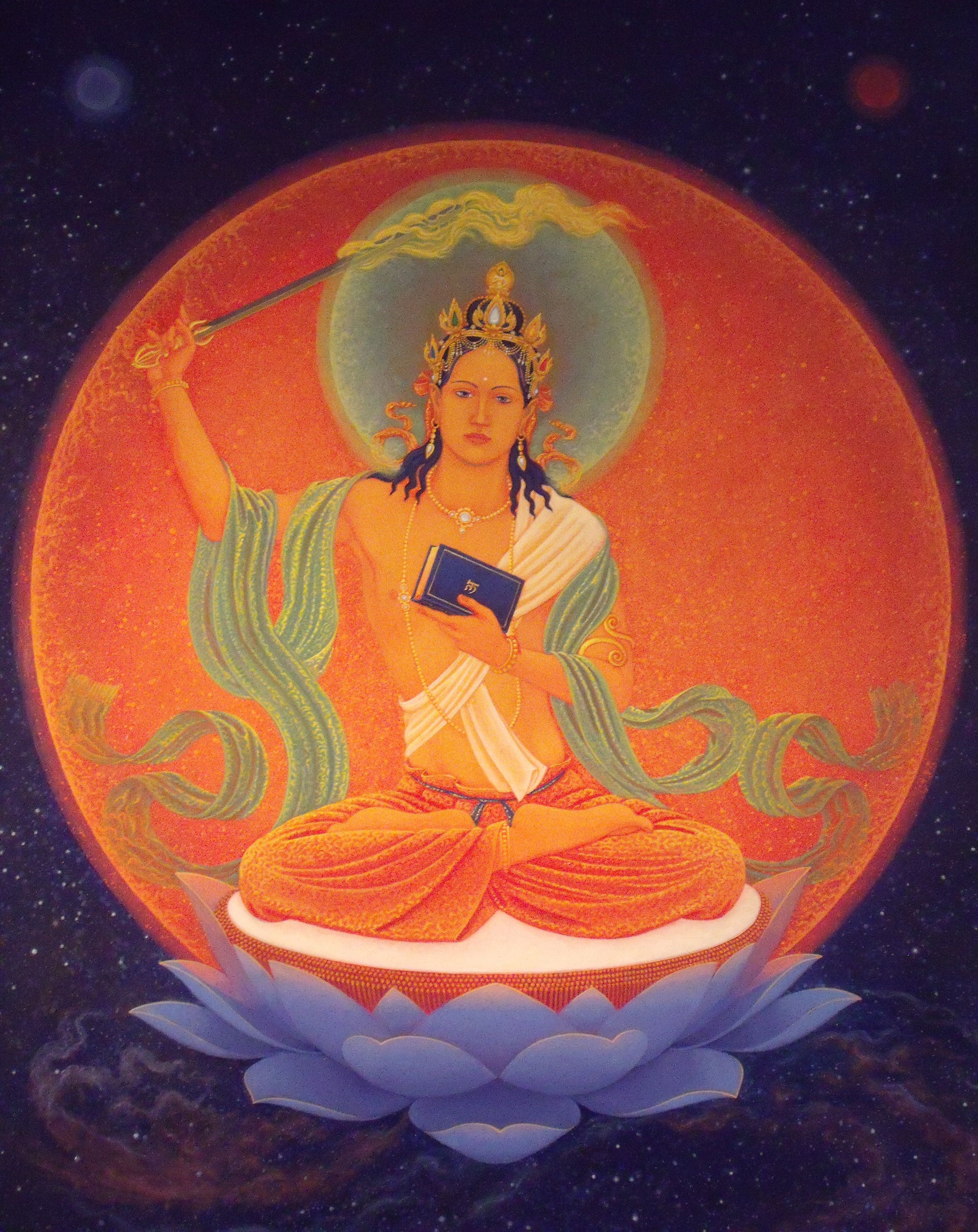
Chintamani Manjughosha Jnanavaca 212I give my homage to you, Manjushri of the gentle heart.
Like the sun freed from the mists, your clear understanding bursts through
The clouds of my self-clinging and my reckless views;
So you press to your heart the book of perfect wisdom.

I give my homage to you, Manjushri of the sweet voice.
Beings are trapped in the dungeons of time;
With the kindness of a parent for their only child, you strive to liberate them.
There they suffer in the darkness of ignorance, but your sixty four Dharma voices boom like the thunder,
Rousing from the sleep of self-clinging and sundering the iron chains of past mistakes.
There you brandish your flaming blade, and dark delusion is illuminated, the sprouts of anguish are severed at the root.

I give my homage to you, Manjushri of the bright body.
You are the Buddha, your form perfected by ages of skilfulness.
You are the Bodhisattva, already perfected, yet working through stages of practice.
Your appearance shines with a hundred qualities and adornments
So the darkness of our mind
Is finally dispersed!

This is a freely re-rendered version of the stuti from the traditional Manjughosha Stuti Sadhana, by Ratnaprabha, 23 June 2015.  The sadhana was given to Urgyen Sangharakshita by Jamyang Khyentse Rimpoche.

Sangharakshita’s seminar on the text is here.  Another version of the homage is here.

Buddhism and Science: a book edited by Alan Wallace

Wallace Buddhism and ScienceBuddhism and Science: Breaking New Ground
Alan Wallace (editor) Columbia University Press, New York, 2003

Review by Ratnaprabha (Robin Cooper)

First Published in The Western Buddhist Review, Vol. 4 (2003).

The great Marxist sinologist Joseph Needham blamed Buddhism for stifling science and technology in China while they flourished in Europe.  In claiming that everything is an illusion, Buddhism “played a part in strangling the development of Chinese science”.  Zen Buddhism, in “rejecting all philosophy” was also unfavourable to a scientific view.  Since the Buddha refused to speculate, Buddhism discouraged scientific research. Above all, its main object is to escape from this world, not to try to understand it.  A “despairing” and “perverse” philosophy, he concludes.[1]  Needham’s analysis stands in marked contrast to all the sixteen contributors to this book, and indeed to the prevailing view today that of all the religions Buddhism is the most compatible with science.

It is certainly a fact of history that a great surge in systematic scientific research, followed by technologies with overwhelming effects, took place in Europe from the 18th Century on.  Despite its sophisticated civilisations, science in Asia had to await influence from Europe before it was able to make comparable advances.  A common view has been that there was a religious factor in this difference, that something in Protestant Christianity favoured science.  However, an excellent essay in this volume by Jose Ignacio Cabezon indicates that the conditioning factors were far more complex, and that when Western science did arrive in Asia, it was treated by Buddhists in an open and welcoming way, in contrast to the responses to science of many European churchmen.

When science did arrive, some South Asian Buddhist monks were tempted either to detect prefigurings of scientific discoveries in Buddhist texts, or to laud Buddhism as the most scientific of religions, and the Buddha as the first scientist.  They were supported, from Victorian times onwards, by westerners’ responses to Buddhism.  Cabezon points out that human beings have at first a tendency to treat what is culturally very different in terms of the culturally familiar, so a host of compatibilities between Buddhism and science were discerned.  Buddhism was seen as undogmatic, giving authority to the individual, critical in spirit, with a universal impersonal causal law (like science), and with a scientific ethics.  Colonel Olcott, a Theosophist instrumental in the revival of Buddhism in Sri Lanka, pointed out around 1889 that Buddhism shared an evolutionary vision with science, both teaching: “that man is the result of the law of development, from an imperfect lower, to a higher and perfect condition” (p. 44).  (I have explored this connection elsewhere.[2])

Cabezon argues that the unsophisticated view of compatibility, or even identity, between Buddhism and science is now being replaced by one of complementarity.  Each has something to offer the other.  The contributors to this volume point out a number of such cross-fertilisations, concentrating on two areas in which Buddhist thought may be able to advance scientific understanding: cognitive science and modern physics.

There is one man in particular who should be credited both with stimulating Western scientists to investigate Buddhism, and with reassuring Buddhists that they have nothing to fear from science — the Dalai Lama.  As an inquisitive boy-Lama roaming around in the vast Potala Palace, he loved to investigate exotic Western mechanical devices, as well as quizzing his tutors on science.  Somewhere, he relates how, as he turned a globe in his hands, it gradually dawned on him that this was a representation of our spherical world, and the flat cosmology of the ancient Indian texts had now been superseded.  He has never lost his eager fascination for science, and he instigated a continuing series of biennial meetings with groups of Western scientists, in which a number of topics have been freely explored.  (The meetings are organised by the Mind-Life Institute, and an appendix in the book lists those which have been published so far.)

Thus many of the contributors have been involved in the Mind-Life conferences, and have to varying extents practised or studied within the Dalai Lama’s Gelugpa School of Tibetan Buddhism. Alan Wallace, the editor, is one of his translators as well as being a writer on Buddhism and science; the Dalai Lama’s chief translator, Thupten Jinpa is probably the only Tibetan monk to have studied Western philosophy to a doctoral level, and offers an interesting essay on Tibetan responses to science.  Geshe Jinpa informs us that the Dalai Lama does more than encourage a dialogue between Buddhism and science.  He is prepared to let science change Buddhism, so that if a fact emerges that is incompatible with Buddhist theory, he says, “there is no doubt that we must accept the result of the scientific research” (p. 77).  He “believes that the dynamic encounter with scientific thought could help revitalise Buddhist analysis of the nature of objective reality and the mind” (p. 78).

After all, as the Dalai Lama writes in a short piece for this book explaining the nature of mind in Tibetan Buddhism for the benefit of scientists: “The mind is transformed when one ascertains and thoroughly acquaints oneself with fresh insights into the nature of reality that invalidate one’s previous misconceptions or false assumptions” (p. 96).  A Buddhist is interested in the way things are, not in clinging to any specific description, even descriptions hallowed by centuries of transmission in a Buddhist tradition.

The section on cognitive science includes a very stimulating paper by the neuropsychologist David Galin.  He engages thoroughly with Buddhist ideas on self, being cheerfully prepared to challenge them, without being dismissive.  It is well worth breasting the current of his sociological jargon for the sake of several gem-like insights on the human mind.  How do we deal with the complexity of experience?  Well, we “seek and find, or project, a simplifying pattern to approximate every complex field… by lumping (ignoring some distinctions as negligible) and by splitting (ignoring some relations as negligible).  Both… create discreet entities useful for manipulating, predicting and controlling… [but] may impose ad hoc boundaries on what are actually densely interconnected systems and then grant autonomous existence to the segments”  (p. 108).  Even the contents of our own consciousness have to be dealt with in this way, resulting in our array of fragmented self-concepts, and we just put up with the anomalies that arise.  Buddhism, he explains, agrees that discovering entities is conventionally indispensable, but attachment and aggression arise through reifying them, which violates the principle that all things are interdependent, and all entities are conditional approximations.

Galin is unhappy with Buddhism’s moral disapproval for these self-errors, since since they are “an essential evolutionary adaptation” (p. 132).  He applauds: “the Buddhist solution to the modern suffering of alienation and anomie… to completely contextualise self, not to simply erase it.” (p. 137)   He doesn’t, I think, have confidence in the possibility of an unmediated immersion in experience, making all self-views obsolete.  However, he recognises the importance of meditation.  We evolve to act in cumulatively more sophisticated ways on the environment, and have become able to model the states resulting from alternative courses of action (ie karma).  Sitting meditation eliminates physical action, and progressively limits mental action by interrupting the loop that connects action-observation-action.  Thus peripheral awareness has the space to grow, and to notice more and more facets of interrelatedness, allowing a more integrated mental structure to coalesce.

Historically, the schools of psychology in the West have sought to arrive at a final analysis of what the self actually is, and thus represent the operation of the first fetter that, according to the Buddha, prevents irreversible Insight: fixed self view (satkayadrsti).  However, the present contributors do not represent this trend, which may have run its course.  They recognise the fragmentary and contingent nature of the empirical self.  William Waldron connects the accounts of evolutionary psychology and Buddhism concerning the deeply rooted defensive predispositions erected around the sense of an independent ‘I’ .  Human evil and suffering are caused by attempts to secure constructed selves, often at the expense of others.

Waldron connects Buddhism and evolutionary psychology, claiming that both show that negative behavioural patterns (‘evil’) have a big influence over long periods of time in evolution, being present in ourselves as inherited capacities, active all the time as predispositions.  We can break such vicious, self-centred patterns by firstly understanding the human condition, and then working to overcome their influence.

Here, Waldron misses an opportunity to discuss the systematic teachings of Buddhist ethics, an astonishing lacuna in the whole book.  The simplest Buddhist formulation of the way to emancipating enlightenment outlines three trainings: the training in morality, in meditation, and in wisdom.  Buddhism and Science makes an excellent contribution to discussing the second and third in the light of modern scientific approaches, but hardly mentions the first — morality.  Yet the connection between morality and scientific enterprises is a live topic in current discussions of science, with very good reason.  New scientific developments almost always have implications for human well-being beyond the satisfaction of the curiosity of the researchers, and beyond the promise of technologies for entertainment or labour-saving.  For example, transport, agricultural (e.g. genetic modification) and power generation technologies can have major environmental impacts.  And medical technologies can involve potentially harming some beings (including experimental animals) to fulfil the wishes of others.  The book is rich in philosophical and psychological topics, but hardly mentions ethics.[3]

Another highly technical paper, again worth the effort, is by Francisco Varela and Natalie Depraz.  A Chilean neuroscientist who tragically died in 2001, Varela has for some years been making very fruitful connections between Buddhist non-dual understandings of the mind (informed by his ground-breaking work on brain states), and the work of the French phenomenologists.  Having established that actual experience and the states of the brain act reciprocally upon one another, so that it is incoherent to say that brain states simply cause mental events, he and Depraz show how perception can be regarded as subsidiary to the mental function of imagination.  Perception refers to what is present, imagination to what is not present, and the two mix so that in every moment they are emerging into awareness from an unconscious background, as a living present.

It is still the case that the dominant view among neuroscientists is, in effect, that processes in the body cause the mind.  But Varela and Depraz have shown that one’s state of mind can access local neural processes, so that neither can be reduced to the other.  The mental state corresponds to a particular neural state, and actively incorporates or discards any contemporary neural activity in the relevant brain region, evaluating many potential neural states, “until a single one is transiently stabilised and expressed behaviourally” (p. 213).  Mental states require both a phenomenological and a biological account.  The neural elements and the global cognitive subject are co-determined; the subject is emergent, not just from the neural base, but also from preceding mental states.  Buddhism extends this account by offering its pragmatic consequences, showing how the living present, with imagination active, is a means for human transformation.  The authors then describe empathy-enhancing Tibetan visualisation techniques that effect this process.

We can be dazzled by the power and scope of science into accepting the philosophical assumptions that many scientists live by.  But the materialist assumption, which includes the belief that the mind is only an epiphenomenon of the brain, is shown by analyses such as that of Varela and Depraz to be a very odd one.  After all, we know that we make free decisions to use our bodies in various ways: the mental is operating upon the physical, as well as being constrained by the limitations of the physical.  To suppress our knowledge of freedom of choice seems needless.  The difficulty is that notions of reciprocal and interweaving causal processes are comparatively new in the West, so a scientist would be afraid that granting causal efficacy to the mind would be to grant that the whole material universe came into being merely by the force of ideas.  A crucial contribution that Buddhism can make to science is to clarify the notion of dependent co-arising (pratitya samutpada).  When we observe a phenomenon, inner or outer, we can be confident that it arises and ceases through the coming together of innumerable cooperative conditions.  And that it forms an element in the complex of conditions out of which new phenomena are arising.  Consequently, no phenomenon exists independently, nor can it persist, since its conditions are inevitably changing.  The name that we give it does not refer to any real entity, but is rather a sort of focused torch beam selecting for our attention a little patch on the shifting cloudscape of experience.

Varela and Depraz are refusing to see brain and experience as isolated entities: “there is no gap to bridge, only traces to follow” (p. 226).  By allowing to experience a genuine causal agency, they are taking the subjective pole of reality seriously, something that is essential if we are to understand more fully the ways in which body and mind interact.  Continuing research need not exclude consideration of those mental states which are comparatively less closely jointed to a brain.  Buddhism at present diverges from science, in incorporating in its worldview various apparently out-of-body experiences, including the possibility of consciousness unlinking from a dying body, and relinking with a growing embryo — i.e. rebirth.  It is disappointing that this volume is almost completely silent on rebirth, despite the formidable investigations of Ian Stevenson[4].

Matthieu Ricard is a French-born Tibetan Buddhist monk with a background in science, whose published conversations with his philosopher father became a bestseller[5].  His article is on ‘Contemplative Science’, a vogue designation for Buddhism that is perhaps trying to appropriate some of the prestige of science.  However, the term does highlight the fact that meditation and other mental disciplines should be seen as valid methods for investigating the mind, complementing the objective techniques of brain scans and psychiatrists’ questionnaires.

Many centuries ago, the dialecticians of the Madhyamaka School of Buddhism (starting with Nagarjuna) tackled Indian philosophical positions that in some ways resemble the standpoints of modern scientists.  But it seems to me that Ricard shares with some of the other contributors to this book, notably Wallace, an unreflective overconfidence in the potency of these arguments against views that after all arise from a very different, and often very subtle, philosophical background.  Western thought already provides well-developed approaches to understanding reality, which have spotted the weaknesses of dualistic, mechanistic, essentialist and idealist views; in this volume, we have excellent presentations on Kant (Bitbol), and on phenomenology (Varela and Depraz).  One might add Spinoza, who so inspired Einstein, and is the subject of a recent book by neuro-scientist Antonio Damasio[6], as well as William James, Karl Popper and others.  Much hard work will be involved in integrating these thinkers with Buddhism (as the astrophysicist Piet Hut points out in the concluding paper in this volume), but it will be very productive, and surely they cannot be ignored.  Eventually, though, we will need a new Tsongkapa: a fine scholar with a brilliant mind, highly realised through meditation practice.

Meanwhile, the more unreflective western Madhyamikans, as well as putting old arguments into new bottles, also tend to conflate Buddhism as a whole with Madhyamaka thought, presenting rival Buddhist doctrines as if they had been been conclusively refuted by Nagarjuna and his successors in the Tibetan Gelugpa School.  There are scholars writing on science under the influence of other branches of Buddhism, and it is a great shame that the editor did not bring in their perspectives.  For example, several writers on Buddhism and Ecology (a topic unfortunately absent from this book) have practised in Theravada and Zen, including Joanna Macy, Kenneth Kraft, Leslie Sponsel, Bhikkhu Bodhi, and others.  (There is also a bit of a national bias, more than half of the contributors being Americans.)

The modern physics section of Buddhism and Science explores the surprising departures from down-to-earth realism that have been emerging mainly in quantum mechanics during the past century.  Fitjof Capra popularised some of the parallels with Buddhism, in a general and rather unconvincing way, in his very influential The Tao of Physics, published nearly 20 years ago.  Despite my protestations above, I must admit that a rigorous application of Madhyamaka epistemology to physics, as we see in several of the contributions here, promises to be far more genuinely illuminating than the vague (often verbal) parallels of Capra.  But the most impressive paper is by the French philosopher of science Michel Bitbol.  (He characterises Capra and others as offering: “mere analogy at an ill-defined level of the two discourses, with obvious apologetic purposes” (p. 327).)  His ‘Cure for Metaphysical Illusions’ is an extremely thorough, and difficult, elucidation of neo-Kantian philosophy of science, explaining how Madhyamaka approaches can build on it, and extend it radically.

Like Nagarjuna, Kant was aware of the limitations of concepts.  They are only for the formal ordering of the empirical contents, a process that will never end, though reason provides an inaccessible goal of complete rational understanding to regulate the process.  Unaware of this as we generally are, it is easy to take the form that our intellect gives to phenomena as being the form of the things in themselves, “projecting the a priori structure of the knowing subject onto the world, thus mistaking it for a pregiven worldly structure” (p. 328). This is the all-pervasive ‘transcendental illusion’, which is very hard to recognise, let alone to compensate for.  Bitbol calls on the neo-Kantian philosophers of science to help us with recognising it, but needs to bring in Buddhism to show us how to overcome the illusion.  “Nagarjuna’s exclusive mission was to free everyone from the spell of reified conventional truth” (p. 332).  (Bitbol helpfully points out in a note that samvriti satya, usually translated ‘conventional truth’, is more literally a surface truth covering over ultimate truth.) Thus, “to be in nirvana means seeing the very same things that appear to the deluded consciousness of samsara, but seeing them ‘as they are — as merely empty, dependent, impermanent, and non-substantial'” (333).

Efforts towards a compromise between science and religion in the 19th-century West failed, leading to a schizophrenic attitude in which a system of beliefs and values were seen as indispensable, but the available system (monotheism) was incoherent in the light of science. Bitbol wishes to initiate the construction of a single higher-order tool, combining science, philosophy, and the “nondogmatic soteriology” offered by Madhyamaka.  The new tool needs to rely on the “dynamic potentialities” of doctrines, not their canonical texts, seeing them as operational rather than dogmatic.

Scientific theories are not representations of the world, but are for structuring our actions and anticipating their outcomes, with philosophy helping adjust us between all the possibilities of action within a value system; then Buddhism opens life out in self-transformation.  Science does not reveal a pre-existent underlying absolute reality (realism), yet it is more than a set of useful techniques (instrumentalism), being “the stabilised byproduct of the dynamic reciprocal relation between reality as a whole and a special fraction of it” — the subject (p. 337).  The structure of scientific theories is highly significant, they are not arbitrary, but it is possible nevertheless to remain metaphysically agnostic.  In fact, Bitbol convincingly argues that this kind of philosophy of science is far more compatible with modern physics, especially quantum mechanics, than the belief in a mechanistic world and a dualistic epistemology.  Scientists resist relationalist and nondual philosophies, through fear of having no ground to stand on.  They can take heart, says Bitbol. Madhyamaka dialectically deconstructs substantialist and dualistic views, but it also introduces “a form of life in which losing ground is not a tragedy (it can even promote enlightenment…) and in which an alternative (say, pragmatic, integrated, and altruistic) strong motivation can be given to science.”  (p. 339).

There is not space here to detail Bitbol’s compelling philosophical framework for quantum mechanics.  But I will mention his response to the problem of indeterminism — the unpredictability of quantum events.  Is it that chance is ultimate, and any deterministic laws that we find come from the law of large numbers?  Or is it that determinism is ultimate, and apparent randomness comes from the complexity of huge numbers of interacting events, as studied in chaos theory?  If we take a dependent co-arising-type approach, we will see that the causes of any event are not defined in the absolute, but are “relative to the very circumstances of the production of the phenomena” (p. 349).  Since phenomena arise in dependence upon an enormously complex context, a context which includes the person or instrumentation detecting the phenomena, they are immune to any certain determination.  Relations between things should be seen as being prior to the things that are relating; however, “neither connection, nor connected nor connector exist”, says Nagarjuna.  Buddhism’s radical analysis is needed to cap philosophy of science, since it comes from “direct stabilised experience of a disabused outlook” — i.e., non-conceptual Insight into reality — while the insights of Western philosophy, impressive though they are, are the products of the free play of ideas.

Buddhism and Science succeeds so well because all its contributors take both Buddhism and science seriously, seeing that both represent ways of understanding human experience, and both present opportunities for enhancing its quality.  Although Joseph Needham was able to write so dismissively of Buddhism only a few decades ago, we now know that he was mistaken.  We know because scientists are engaging personally with the practice of Buddhism.  They are finding in it a congenial spirituality, which does not nag at their work, so long as that work does no harm. They are also finding that it offers remarkable new vistas into the methods and models of science itself.  But will Buddhism ever actually influence scientific practice — where to look in one’s research, how to explain and interpret one’s findings?    This book will convince the reader that mind-science has already  been changed by Buddhism, but the jury is still out on physics.   Francisco Varela has no doubt. His assessment, thinking particularly of Buddhism impacting science, is that: “the rediscovery of Asian philosophy, particularly of the Buddhist tradition, is a second Renaissance in the cultural history of the West, with the potential to be equally important as the rediscovery of Greek thought in the European Renaissance.”[7]  The dialogue has only just begun: we live in exciting times.

[1] Joseph Needham, The Shorter Science and Civilisation in China, Volume I (Cambridge University Press, 1978), pages 264, 265, 272.

[2] Robin Cooper, The Evolving Mind: Buddhism, Biology and Consciousness (Windhorse, Birmingham, 1996).

[3] For a good survey, see Damien Keown, Buddhism and Bioethics (Macmillan, London, 1995).

[4] E.g. Ian Stevenson, Twenty Cases Suggestive of Reincarnation (University press of Virginia, 1974).

[5] Jean-Francois Revel and Matthieu Ricard, The Monk and the Philosopher (Thorsons, London, 1998).

[6] Antonio Damasio, Looking for Spinoza: Joy, Sorrow and the Feeling Brain (Heinemann, 2003).

[7] Varela, Thomson, and Rosch, The Embodied Mind (MIT press, 1993), 22.

The Ancient City:  the Buddha and William Blake

The Buddha once tried to describe to his disciples what it had been like to discover the path of total spiritual transformation.

He said that he had felt like a traveller walking through the wild forests on a mountain height.  The traveller came upon an ancient trackway, overgrown, untravelled for many years,.  He scrambled through the undergrowth and followed the track to a great and ancient city, uninhabited, in ruins, almost obscured by the jungle.  The traveller decided he would not stay in the place, though he loved its beauty, but would return down the ancient trackway and go to see the ruler of the country.  He said, “Sire, I have found an ancient trackway, and at its end  an ancient city, and I know that city was once the capital of our country.  Sire, let us restore that city!”  And this is what they did — they went back, with many men and women, and lovingly restored the city to its former glory, and cleared the ancient trackway so that all could follow it.

William_Blake_by_Thomas_Phillips wikimediaWilliam Blake was a Londoner, he lived in the biggest city in the world at that time, around the turn of the Nineteenth Century.  It was a dirty and stinking place, with a sinister repressive government at its hub, and it was teeming with little tyrants and their little victims.  Blake saw all this very clearly.  He felt pity and anger.  Yet he was a visionary, and he also saw a different city, made of light.  His was not a utopian vision, a wonderful gleaming marble London of some ideal future.  For him, the harmonious city of light was the human mind, his own and everybody’s mind, completely liberated from the oppression of self obsession, completely cleansed of the smoke and grime of error.  He called the perfect city Jerusalem.

If Blake had been more ordinary, he might have dreamt again and again of his Jerusalem, and sighed when he woke up.  He might have taken to the streets to demand that someone build it for him.  Or more probably, the everyday oppressions of life might have smudged the image, until all that he was seeking was a bit of recognition, a reasonable income as an engraver and painter, and a few cronies to reminisce and grumble with.

However, Blake was not ordinary.  I won’t call him great, or a genius, because that would be to betray his own insistence that everyone has access to that vision of Jerusalem, though the trackway to it is still overgrown, a tough climb.

His vision changed and became more dynamic.  He took his eyes off Jerusalem’s glistening spires of golden light, shimmering on the horizon.  His new vision was a plan, a life’s-work.  It was of a different city, to be built with work and action, with conversations and personal connections, and particularly with the works of the artist.  This city, which is always being built, he called Golgonooza.

Blake was an artist, he was a painter, an engraver, and a poet.  The Buddha was also a visionary, but he was not, as we suppose, an artist.  He was the discoverer of a trackway leading to the ancient city which he called Enlightenment, and the work of his life was to point out this trackway to as many people as he could, to assure them that it was not impassable, and to entreat them never to let it become overgrown again and to keep it clearly marked on all the maps.  I am a Buddhist, and I am also an enthusiast for the visions of William Blake.  I have a very strong sense that in a way Blake’s city of art is the same as the city being restored in the Buddha’s vision.  However, even if the cities are the same, the trackway of artistic creation would seem to be a very different route to it than the track way of leading a Buddhist life.  Was Blake’s track the same as that of the Buddha?

Please don’t take these explanations  too seriously. Blake’s vision is not really of a city.  The Buddha did not really follow a track, in fact was known as the ‘Trackless One’. These ideas may indicate something which you can live, but they are no more than ideas until they are lived, and when they are lived, they have a life of their own, and these words become superfluous.

In any case, here we are now.  There is nowhere else we can start from.  And sometimes, we realise, we are wandering through a thick forest.  Usually, we are not even on the mountain height, and the little animal tracks that we follow do not really lead anywhere.  There is something wrong, something lacking.  The world falls short of our desires.  We have a sense that we are staring at an engraved print, and we can’t find the window that looks out onto the real thing.  As we look at this two-dimensional illustration of life, we feel a longing.  It may occasionally be a longing for the complete unbounded green landscape itself, but often it is one of many little longings stimulated by some little shape in the illustration.  The imagination is vast, but the world that flickers through our senses is small, and so frustration and pain are endemic.

In the vast world glimpsed in imagination, that is, complete Imagination, there is no need for any limit of any kind, not even the separation of the inside, my mind, from what I think of as an indifferent world outside.  That completely open dimension is not something to be manufactured, and it is not in any way limited by our inability to dwell in it, and so, for Blake, it is an eternal realm from which conscious beings have wandered.  His task is to restore us to that open realm.  He sees himself and others as human beings to be perfected through great struggle.  As he advances, his surroundings will light up more and more, their imperfections will drop away, until he finds himself as the ideal man, within Jerusalem.

Yet here we are now, in the thick forest.  There is something wrong, there is a lack, and we are, all the time, scrabbling about, driven by the sense of lack.  It is like an intense thirst, but most of what we drink to try to quench that thirst only satisfies very briefly, if at all.  The Buddha and Blake share an intense optimism, which one feels must have come from their genuine discoveries.  They both thought that lack, thirst and aimlessness are not inevitable.  But we have to have the courage to see what it is that we do that is not working.

What Buddhism characterises as a desperate thirst, Blake describes in dramatic terms.  Here is a stupendous human being, like a god, who has become estranged from the eternal city of Jerusalem.  The human being is Blake himself, and is Everyman.  As a Christian, he might give him the name Jesus.  But usually, he calls him Albion. He is the Sleeping Lord whose bones are the hills of Britain, or who is made up of all the potentially united people of Blake’s own nation.  Albion is asleep, or perhaps he’s dead.  In his dreams, the city Jerusalem has become his estranged wife, and his divided mental life has cascaded into two, and then four, and then many many beings, who clasp each other or fight each other, as they grapple with their dim memory that something has been lost.  His poems describe the dreadful and cruel selfishness of the female emanations and the male spectres in the fallen state.

It is possible that the Tibetan Book of the Dead is talking about a similar estrangement.  Like Albion, we topple at last into the uncontrolled dreams of death.  The light of reality is so dazzling as to be both agonising and terrifying.  And, the Tibetan Book of the Dead says, we swoon away from the light, and eventually struggle out of complete unconsciousness into a sequence of dream visions.  At first, there is an intensely beautiful, symmetrical, colourful mandala of five male Buddhas each embracing a female Buddha.  Spangled discs of pure colour offer a trackway into that mandala, which is sometimes described as a palace or even a city.  Coloured smokes wreath about it, seeming safer and more familiar, and the dreamer (or dead person) finds the smoky colours alluring, and loses the vision of the beautiful mandala.  The mandala is replaced by visions of enlightenment which become increasingly wild and ferocious, but each of which offer a pathway into the completely open realm.  We tumble along ‘the bardo’s dangerous pathway’, buffeted and dragged by all the habits and tendencies we have been consolidating over the years, until eventually we are left only with our future father and mother making love, and in a tantrum of jealousy, we hurl ourselves between them.

For Blake, the dream drama of Albion’s fragmented selves is not an utter nightmare, because he can begin to identify the different characters, and discover the games they are playing.  Far worse would be an undifferentiated confusion in which there is no awareness at all.  Nevertheless, confusion and tragic misunderstandings underlie most of our attempts to express our longings in the fallen world.  Confusion, rationalised, becomes error.  If only error can be given a clear outline, can be compelled to fully reveal itself, then it can be overcome.  If, as Blake claims, “Truth can never be told so as to be understood and not be believed”, then if error is uttered clearly enough, it must immediately be seen through.

For a similar reason, the Buddha devoted a lot of effort to exposing what he called false views.  He and Blake both felt that evil ultimately comes from a basic confusion.  What is really immoral is not to disobey a set of ordained laws, but to act from the fear, thirst, and cruelty that we use to defend a selfhood trapped in confusion.  Confusion perceives a divided world (the Buddhist word for ordinary consciousness means “divided knowing “), corresponding to the fragmentation of the giant Albion.

We can change our perception and escape from confusion by trusting what Blake at first calls the Poetic Genius; in trusting it, it strengthens.  Later, he calls it Imagination or Vision: it corresponds to the Buddhist term shraddha.  Shraddha is usually translated as faith,  but actually, it is a combination of a vision of what is truly significant in life with a longing to create a truly significant life.   It comes from an expansion of awareness, initially, an improvement in sensory awareness.  Here, Buddhism stresses mindfulness practice, and Blake’s practice of mindfulness was the exercise of his acute powers of observation through drawing and writing.  “A Poet, a Painter, a Musician, an Architect: the Man or Woman who is not one of these is not a Christian”, by which he meant someone willing to expand his or her visionary awareness.  Although there are other means, it seems to me that some kind of artistic practice is probably the best way for us in this secular age to cultivate shraddha.

Shraddha, vision, is an enlargement of perspective, which opens the space for an energetic engagement with life.  “Energy is Eternal Delight” says Blake, and the free expression of energy is perhaps his prime human virtue.  Both life and consciousness provide unlimited reserves of energy to every human being, but its expression is inhibited, often because what one feels like doing with it is thought to be unacceptable or wicked.  Here we come to an apparent difference between traditional Buddhism and William Blake.  For Blake, at least according to his rhetoric, any form of restraint is anathema.  “Those who restrain desire, do so because theirs is weak enough to be restrained; … being restrained, it by degrees becomes passive.”   Buddhism however insist that genuine spiritual energy must always be put into what are called ‘skilled’ states of mind.  ‘Unskilled’ states of mind should be subject to restraint, because of the dreadful consequences of acting from them.

Consequently, I puzzled for a long time over Blake’s proverb “Sooner murder an infant in its cradle than nurse unacted desires.”  It seems to say that you should do whatever you feel like doing, even if it causes harm.  At first I thought that as a “Proverb of Hell” it was intended just to shock.  Later I concluded that Blake did sincerely mean what he wrote, and at the same time definitely wished no one to harm another. Desire is an uprush of energy, and that energy is potentially enormously creative, but festers if it is allowed to stagnate.  So it is crucial to use desire, or energy, as a basis for action, even if it is only mental action.  Desire is a signal to create, and the fuel of creativity.

Joyful engagement is the way of grappling creatively with one’s surroundings.  The most significant element of one’s surroundings is other people.  Blake said “Mutual Forgiveness of each vice/These are the Gates of Paradise”.  It is easy to be overwhelmed by the flaming energies into which Albion has fragmented in Blake’s writings, and thus miss both the motive and message of his work.  He seeks the cleansing of our vision because we are in such a terrible plight: he wants everybody to be able to live in what he calls Eternity, in mutual love, and he wants this because of the swelling of love in his own breast.  Blake marvellously displays the greatest Buddhist virtue — compassion.

Blake ran along the ancient trackway, and came back with excited news of the ancient city, wanting to restore it, and wanting to call it Jerusalem.  His vision of that city, and of why it is in ruins, is immensely stimulating, and it is worth scrutinising his words and images just for that.  He has also opened up sections of the ancient trackway.  Add one extra stretch of track to his map, and perhaps it is complete.  What is lacking is samadhi: intense, calm, one-pointed contemplation of experience in states of deep meditation.  As a visionary artist, it may be that he possessed the equivalent of samadhi, but I don’t think he realised that without it, anxiety and vacillation will entangle most of us before we reach the city.

First Published in Urthona magazine, 2000.

Sources

The Buddha’s Ancient City: Samyutta Nikaya, 12-65; and see F. L. Woodward, Some Sayings of the Buddha (Oxford, 1973), page 25.

For the myth of Albion, Jerusalem and Golgonooza, see Blake’s prophetic books Milton and Jerusalem, especially in the beautiful facsimile editions published by the Tate Gallery.

Most of the quotations on desire and energy are from The Marriage of Heaven and Hell.

I think that the best commentary on Blake’s writings is still Northrop Frye’s Fearful Symmetry (Princeton University Press, 1947).  Also see Sangharakshita, Buddhism and William Blake (Ola Leaves, 1981).

Buddhist Biology from Barash

chap3

Illustration by Andy Gammon

Review of David P Barash, Buddhist Biology: Ancient Eastern Wisdom Meets Modern Western Science (Oxford University Press, New York, 2014). By Ratnaprabha.

Through the nineteenth century, Western science gradually disengaged itself from Christian religion, and scientists set themselves up as rivals to churchmen in interpreting the world. Nevertheless, religion remains a force in our culture, and some scientists detect a spiritual vacuum in their own hearts, turning back in hope towards religious traditions, at least for their own personal solace. Yet to answer one set of needs through a religious allegiance, and a separate set of needs through the discipline of science leaves a frustrating split, despite Stephen Jay Gould’s recommendation that the two should be confined to “non-overlapping magisteria”.[1] David Barash joins the club of those scientists wanting science and religion to be at least on speaking terms with each other, better still to marry.  His arranged bride for science is Buddhism.

Thus he proposes a “Science Sutra… [in which] not-self, impermanence, and interconnectedness are built into the very structure of the world, and all living things — including human beings — are no exception.… It can help animate — more precisely, humanise — this otherwise cold and dreadful skeleton of rattling bones”. (Pages 27-8. The image of science as a rattling skeleton is from Bertrand Russell.)

Barash is a psychology professor at the University of Washington who has been active in the field of peace studies, but by training he is an evolutionary biologist, and it is biology in particular that he wishes to give a Buddhist flavour. He is an avuncular and jaunty writer, and this being his 33rd book, you can see that his publishers give him some leeway. He admits that they wanted him to discard altogether a chapter that tries to add existentialism to the mix, and they’ve left him to his own devices to the extent that the Buddhist sections are riddled with, mainly minor, errors of fact and spelling. As for science, he discusses genetics, ecology and neuroscience as well as evolution, and he is on pretty firm ground here, though some mistakes do creep in – including the howler that Newton discovered the second law of thermodynamics (page 58).

An enthusiastic Buddhist for most of his life, Barash’s chief inspiration is the Vietnamese Zen teacher Thich Nhat Hanh. Thus, along with impermanence and non-self, the main Buddhist concept he wishes to apply to his biology is interconnectedness, all things linked in a dance of mutual dependence, a teaching that Thich Nhat Hanh adapts for modern audiences from Chinese Hua Yen Buddhism. Ecology, too, demonstrates that organisms and their environments constitute a net of mutual dependence.

Buddhist teachings argue that anything which depends for its state on external factors must change when those conditioning factors change (anitya), and if no part of that thing is immune from dependencies, then to identify any essential protected nucleus of self must be mistaken (anatman). In biology, impermanence is the rule, and evolution superimposes long-term inter-generational changes on the short-term developments undergone by every organism, so that only the genes themselves are (according to Barash) comparatively stable. My impression here is that Barash’s popular writing has not yet caught up with advances in genetics that he must surely be aware of. The gene as an almost fixed sequence of bases in DNA that codes for some detectable feature of an organism is only one component of inheritance. Genes interact in complex ways determined partly by environmental influences, events can switch genes on and off according to circumstances, and survival-enhancing features innovated by a parent can pass to its descendants without changes to the genetic sequence. As I was reading the book, there was news of research showing that mice taught to become frightened when they smelt cherry blossom could pass that fear to offspring they had no contact with: the genetic basis of the offsprings’ smell receptors had changed as a result of their parents’ experience.[2] A process like this is termed epigenetic, and epigenetics increasingly seems to be a significant factor in evolution.

In highlighting anitya and anatman (just two of the traditional three marks), and then adding interdependence, Barash is already reframing Buddhism according to his own preferences. As well as downgrading the third mark (duhkha, suffering), he adds pratitya samutpada, which is indeed basic to a Buddhist understanding of human experience, though it is incorrect either to translate it or to sum it up as only interdependence. It refers to an understanding of how the apparent entities that we single out from our experience come into being and pass away, as well as how they relate with other entities in the present moment. (The Present Moment, incidentally, is the name of Barash’s campervan, named so that he can sometimes claim to be “in” it.)

Barash is happy to modify traditional Buddhist teachings, if the results serve the needs of his audience: modern Westerners who have confidence in the findings of science. Thus he would ditch many of the practices of Eastern Buddhists (he rather condescendingly views them as naive and superstitious), and many of the teachings of what he calls “originalist” Buddhism. Someone has drawn his attention to David McMahan’s The Making of Buddhist Modernism, and since it is effectiveness and accuracy that motivate him, he is more than happy to confess that his grasp of Buddhism has come largely from the interpretations and revisions of westernised Buddhists. In fact he goes further, seeking to delineate what almost amounts to his own new religion, which he calls Existential Bio-Buddhism.

I think that this is fine, and it is very gratifying to see a popular scientist sharing an enthusiasm for Buddhism with his readers. Those whose interest is piqued can track down teachers and writers with a stronger basis in Buddhist traditions, and a deeper experience of practising them. But it is disappointing that he lacks the curiosity to further explore the aspects of Buddhism he is tempted to dismiss. (The “arrant nonsense” (page 11) of rebirth, for example, he explains as a “silliness about [transmigration of] souls” (page 138), and concludes that Buddhism must be “muddled” to teach both rebirth and anatman.)  One day, through a more daring dialogue than Barash risks, the interpenetration of Buddhism and biology is going to yield exciting fruit.

How is his biology informed by Buddhism? He uses it to speed up the defeat of essentialist and Platonic ideas in biology, and to support engagement with environmental issues, with its visions of interconnectedness and non-violence. Evolution confirms a kinship between humans and animals, hence a sense of solidarity with other forms of life, and a valuing of the natural world around us. Evolution and Buddhism also similarly agree that human beings are not special, indeed none of us as an individual ego is special either. In return, Barash is happy to contribute a conventional critique of Buddhism from a materialist scientific standpoint.

What other fruit could the dialogue yield?  What interests me most is the mind as an evolved phenomenon. From a human point of view, which is the only viewpoint we have access to, the degree and scope of our awareness is unparalleled in the natural world. Somehow we have come to the ability to reflect on our own experience, sometimes holding the stream of our consciousness in the illumination of mindful awareness. And we can enhance our level of consciousness through working on the mind with the mind. Perhaps as a consequence of this reflexivity, we seem largely trapped in a sense of separation from the world, a subjective me peering out at its hostile or alluring surroundings, always other. The teaching of pratitya samutpada states that this consciousness is dependently arisen, i.e. we can come to comprehend the evolutionary processes which gave rise to human consciousness, and thus understand our own minds better.

I feel that this understanding will not be well served by insisting on a materialist standpoint, as Barash and most scientists of standing do at present. Materialism seems to me to be primarily the rotting corpse of an old European debate, a debate that concluded first that mind and matter were two entirely distinct substances, and later that matter was the one real substance that made up everything in the universe, so that mind is nothing but patterns of electrical and chemical processes in the brain. The three truths that Barash imports from Buddhism – impermanence, not self, and pratitya samutpada – undermine such strict bifurcations as that between mind and matter. And I would say that honest reflection on experience doesn’t allow one to agree that awareness is illusory.  Like the objective world, the subjective or “inside” pole of experience must have arisen through law-governed causal sequences that can be understood. This is true of the whole range of minds found amongst animals, human and nonhuman, as well as this particular fleeting event of awareness that is my present moment. Buddhism wants to find evolutionary explanations (using the term ‘evolution’ in a general sense, not just as Darwinian natural selection). Buddhism has an evolutionary vision, as does biology. Biology is particularly interested in the evolutionary history of consciousness, Buddhism teaches its evolutionary potential, the further development of consciousness through contemplative methods.

Once mind or awareness is taken seriously as a genuine (though not substantial) phenomenon, we could consider its importance in the lives of animals as well as humans. It has arisen through evolution by natural selection: did its presence have any effects on the process of evolution? (Recall interdependence.) One possibility is through the Baldwin Effect, whereby innovative behaviours by animals (and behaviours have a mental origin) can propel them into new environmental niches where fresh selection pressures apply. For example, the Galapagos finches which now instinctively use cactus thorns to extract larvae from tree branches could not have started with a mutation for the behaviour – it is far too complex – they must have started with the novel behaviour, then passed it on through learning, until its different components were gradually selected for in the genes.[3]

Then there is the last of the three marks, duhkha or suffering. Entrenched views don’t just inhibit scientific progress, they may also inhibit compassion, and even promote antisocial practices in science, from cruelty to animals to environmental destruction and involvement in the technology of warfare. I think that an acceptable ethical framework, to be discussed and adopted by scientific communities, has its most likely origin in Buddhist ethics, a natural ethics based in intention and the consequences of behaviour rather than in scriptural commandments. Currently, scientists tend to govern their work with one eye on the law and the other on public opinion, but with little genuinely humanitarian ethical guidance.

Barash gives the impression of being an ethical man, and perhaps in a future work he will attempt to apply Buddhist ethics to his science. It may be for others to investigate how a fresh view of mental processes and their role in evolution, stimulated by Buddhism, could open up new avenues of research, as well as more creative ways of interpreting experimental results. More generally, Buddhism suggests a very open and provisional approach to concepts such as the gene, the species, and the individual organism. Constant reminders of impermanence, not self, and pratitya samutpada could release the creativity of scientists when they are entrenched in the “normal science” stage of struggling to fit research results into outdated theories, unwilling to let go of time-honoured biological concepts.

I would recommend Buddhist Biology to readers whose main allegiance is with science. It provides a friendly and engaging tourist guide to some of the features of Buddhism. We natives may chuckle at the guide’s simplifications and inaccuracies, but he points out impermanence, not self and interconnectedness; he shows how they apply to the biological sciences; and so he gives an authentic impression of Buddhism that may lead some of his readers to investigate it more thoroughly elsewhere, and to explore its practices in their own lives.

[1] Stephen Jay Gould, “Nonoverlapping Magisteria,” Natural History 106 (March 1997): 16-22.

[2] http://www.nature.com/neuro/journal/v17/n1/full/nn.3594.html accessed 1/1/14.

[3] D Papineau, “Social learning and the Baldwin effect” In A. Zilhão (ed.), Cognition, Evolution, and Rationality. (Routledge, 2005).  Also see Erika Crispo, “The Baldwin Effect and Genetic Assimilation” in Evolution 61-11: 2469–2479 (2007).