This is a re-rendering rather than a translation,with some shortening, especially of repetitions. October 2026.
I’ve been told that the Buddha was once living on Mount Cālikā, with the bhikkhu Meghiya as his assistant. Early one morning Meghiya said he’d like to go into the village to get some breakfast [for them both].
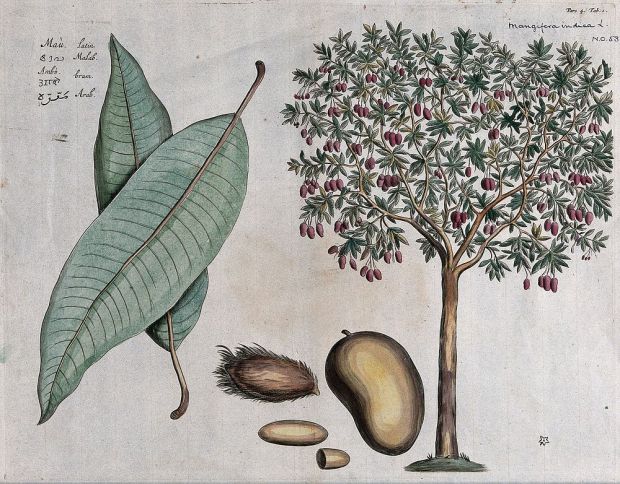
On the way back he went for a walk along the riverbank, and spotted a beautiful mango grove, and thought it would be a great place to do a little meditation retreat. Returning to the Buddha he said “I’ve found a perfect place for meditation, somewhere to exert myself 1 to transform my mental states! I want to go and do a little intensive solitary retreat there right now!” But the Buddha replied: “sure, but could you wait a while, until someone else turns up to take over as my PA?”2 But Meghiya was very insistent, asking twice more, and saying “Bhante, you’re okay, you’re enlightened, you’ve done all the work you need to in transforming your mind, but I’ve got a lot further to go, so please let me go, and I’ll strive to practise right effort in meditation.” So the Buddha relented: “what can I say, when you talk of striving! Go and do what you see fit.”
Meghiya bowed to the Buddha, plunged into the mango grove, and spent the whole day sitting in meditation at the foot of a mango tree. But to his astonishment he was constantly assailed by unskilful thoughts: sexual fantasies, annoyance and irritation, and even violent fantasies.3 “How amazing that though I’ve gone forth into the life of the homeless wanderer out of sincere faith4, I’m still harassed by this obsessive and destructive thinking!”
That evening, he went back to the Buddha and told him what had happened. And the Buddha gave him a teaching.
“Meghiya, when the heart’s liberation5 is incomplete, there are five things that you need.”
1. A practitioner needs spiritual friends6 , good companions, fellows in the spiritual life.
2. A practitioner needs ethical integrity, restrained by the precepts7 and resolutions they’ve taken on, living well with healthy habits, sensitive to the slightest fault, undertaking the precepts8, and training in them.
3. A practitioner needs easy access to Dharma discussions9, discussions emphasising renunciation so that the heart opens; such talk conduces to disenchantment, detachment, the cessation of suffering, peace, direct Insight, and Nirvana. Talk on leading a simple life, contentment, self-reliance and integrity. Talk on enthusiasm and cultivating one’s mind; on ethics meditation, wisdom, and liberation.
4. Then a practitioner lives with their energy10 aroused for letting go of unskilful states and cultivating skilful ones. They generate strong endeavour, resolved and committed to skilfulness.11
5. So a practitioner becomes wise12, seeing clearly how everything arises and passes away, a noble and penetrating Insight conducing to the ending of dukkha13.
“Now Meghiya”, continued the Buddha, “if you do have good spiritual friends, then you can expect to develop all the other four qualities: ethical integrity; access to Dharma discussions; aroused energy; and deep wisdom.
“Then you can decide on a [meditation topic]: contemplating the unattractive to deal with craving; the Metta Bhavana to transform ill will; the mindfulness of breathing to disrupt compulsive thinking; and finally contemplating impermanence to uproot egoistic conceit14. (Truly seeing impermanence illuminates non-self, and the uprooting of egoistic conceit is enlightenment in the here and now.)”
Then the Buddha, aware of its meaning, at that time uttered this inspired saying15:
Little thoughts and refined thoughts,
when followed stir up the heart.
Not knowing these thoughts of the heart,
one runs here and there with a mind out of control.
But knowing these thoughts of the heart,
one restrains them, ardent and mindful.
When followed, they stir up the heart –
the awakened let them go without trace.
From the Pali Canon, Udana, 4.1, the Meghiya Sutta
Based on translations and commentaries, especially by Dhivan (privately published); Piya Tan; Thanissaro; John Ireland; and Sangharakshita.
- padhāna ↩︎
- The Buddha normally had a PA/attendant to look after people coming to see him, respond to requests for talks and visits and so on. Perhaps he also needed someone to talk to as he developed the Dharma, and to remember what he’d said – this was fairly early on, long before Ananda became his ideal assistant. ↩︎
- The commentary says there were lots of mosquitoes, and then woodsmen turned up not far away and started sawing down a tree. ↩︎
- saddhā ↩︎
- cetovimutti ↩︎
- kalyāṇa mitta ↩︎
- patimokkha ↩︎
- Literally, ‘training principles’, sikkhapada ↩︎
- dhammakatha ↩︎
- viriya ↩︎
- This is samatha meditation; what Meghiya was unable to do in the mango grove ↩︎
- pañña ↩︎
- Frustration or suffering ↩︎
- Literally the conceit ‘I am’ ↩︎
- From translations by Dhivan and Thanissaro ↩︎

