Mind

Science and Buddhism VIII: Conclusion

Science and Buddhism are distinct.  They have their own projects, they have their own attitudes.  I’d love to see them influencing each other in the future.  They agree in many ways — they are both trying to see clearly the way things connect together, what patterns there are in life and the world.  Scientists notice, like Buddhists, that nothing is fixed or isolated — everything is involved in a dance of mutual interaction. They agree with Buddhists that the so-called Self is a convenient fiction — there are just mental processes.  Scientists are very aware that perception is vulnerable to illusion and delusion, and that we need other ways to find out what’s going on, because our senses are not reliable.  And as for God, 200 years ago, the French astronomer Pierre Laplace said: ‘I have no need of that hypothesis’.  

Both Buddhism and science are aware of an enormous, vast universe, probably with many inhabited places at inconceivable distances from each other, but with the same laws applying everywhere.  Science also agrees with Buddhism that animals are basically like us, and that we can find animal drives pushing us along from deep within.  There are even some very mysterious parallels between Buddhist understandings and the way that science understands the whole of the cosmos, and quantum mechanics.

At its best, science is very cautious, taking nothing on trust, wanting everything to be checked in experience, and double checked by others as well.  I feel that Buddhism adopts the same approach.

I would love to see Buddhism having more influence here in the West, and to do so, I think it needs to take the West’s greatest achievement — science — very seriously.  It can ask Science for help: science can help the Buddhist project in its specialities — the first two niyaamas, the inorganic and the organic.  In the third order, the citta niyaama, the techniques of science can greatly contribute to the understanding of the mind. Buddhism has the project of alleviating suffering — science can help greatly with this, through medical and technological advances.

But I think that Buddhism can return the favour — it can help science in many ways.  Its global vision of reality can help provide a more effective philosophical standpoint for science; it has an experimental technique, as it were, for intuitively grasping the way that phenomena fit together. Thus through Buddhist wisdom the meaning and the significance of our experience can become more apparent.  We need that technique — contemplation of one’s experience within a quite space of meditation — to simplify the tangle of conditions, and to make them less misted over by our own hopes and fears and needs.  So I sense that Buddhism, neuroscience and psychology can work cooperatively together to gain a deeper sense of the way that the mind works.  Finally, Buddhism can help science through its realisation that the way that one lives — ethics — affects one’s ability to be realistic about one’s experience.  Science does not at present have a trustworthy source of ethics, and if scientists do not know how to be ethical, we cannot trust them to be basically benevolent.  I think that Buddhism can help with this.

Imagine how the Buddha might have responded if he had encountered modern science.  He might have said: “these scientists are suffering — they need the Dharma.  Their work is often undirected and clumsy, and gives rise to unforeseen sufferings, sometimes even deliberate sufferings.  Help them encounter the Dharma, help them see its relevance first to them, and then to their work”.

I think that the universes of science and Buddhism can merge — perhaps they will merge — in a more comprehensive worldview for the centuries to come — a worldview that draws on the creative geniuses of millions of men and women who have contributed to the cultures of the East and the West — but also a worldview that tackles conflict and poverty far more effectively than we seem to be doing at the moment. 

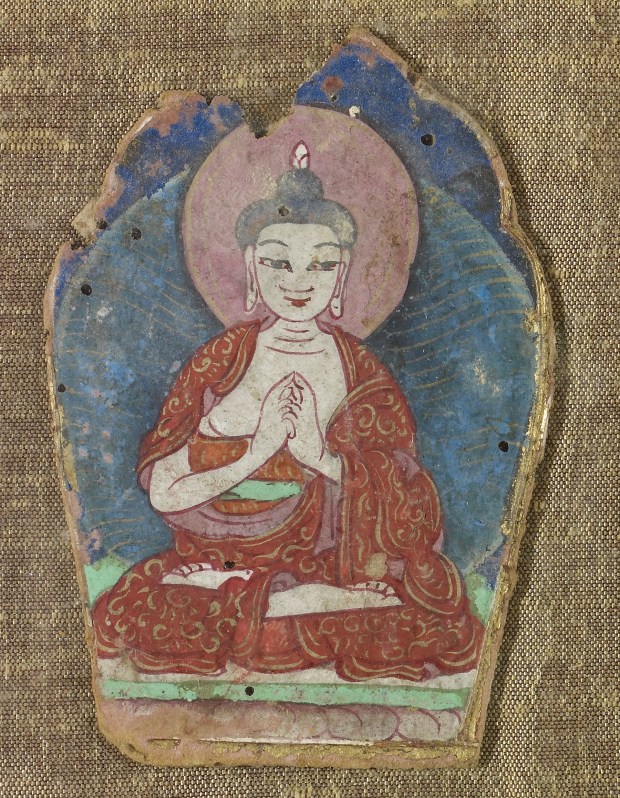
Image is Vairocana, from the Walters Art Museum

    Science and Buddhism VII: Science and Rebirth

    Dalai Lama at 2 (Sirensongs)

    Buddhism at present diverges from science, in incorporating in its worldview various apparently out-of-body experiences, including the possibility of mental processes unlinking from a dying body, and relinking with a growing embryo — i.e. rebirth. See the formidable investigations of Ian Stevenson.[1]  Most schools discuss a period between death and rebirth known in Tibetan as the Bardo. Are these notions accessible to objective study? There is no need to debar science from the phenomena of the psyche, and even the suggestion of karmic links between one’s willed actions and later events should be, to some extent, testable scientifically.

    Rebirth is coherent if the mind is not just physical events.  The mind is certainly very conditioned by the brain and the body.  Consciousness always finds itself in a body, but traditional Buddhism says it might not be a physical body. What would your mind without the vehicle of a physical body be like? It may be unencumbered by the burden of flesh, but it would also be, I guess, lacking in many abilities.  For example, the influence of the senses is quite mysterious.  In the Bardo, one probably can’t do anything to physical things — the body is the interface with a physical world.  One probably can’t think in a linear fashion — no plans, no thinking things out, no deliberate recall etc.  If you are unused to it, you are just swept along in a dreamlike condition — ‘why is all this happening to me?’  Or you are blissed out and thoughtless like the devas.

    There isn’t even a persistent entity, a Self, during life, so there is definitely no soul that persists from one life to another.  But yet the Buddhist view is that the karmic processes that you have set in motion during your life don’t simply vanish at the moment when the body becomes a corpse.  Somehow they are still viable; they can germinate and have an influence over another person, newly conceived.  More than an influence — the view is that a foetus growing in its mother’s womb can’t survive without some non-physical contributions from a previous life.  So it’s not you that survives death, yet processes that have built up during your life do go on to have their own consequences in another future life.

    This is the Dalai Lama on rebirth.  “The various instances of consciousness… come into being because of the presence of preceding instances of consciousness, and since matter and consciousness have totally different natures, the first moment of consciousness of the new being must be preceded by its substantial cause, which must be a moment of consciousness.  In this way, the existence of the previous life is affirmed.”[2]  Traditionally, rebirth is not seen as an issue of faith, but is something that can be verified through rational inference, according to the Dalai Lama, and I would add the testimony of others, and perhaps personal memory.

    In any case, there is no doubt that mental processes influence the physical through karma — and eventually the whole universe will probably be radically affected by the presence in it of self-aware beings.[3]


    [1] E.g. Ian Stevenson, Twenty Cases Suggestive of Reincarnation (University press of Virginia, 1974).

    [2] The Universe in a Single Atom, 141.

    [3] See David Deutsch, The Fabric of Reality (Penguin, 1997).

    Science and Buddhism III: Investigating Reality

    How do you find out what is the case?  Consider the criteria of the Kalama Sutta in which the Buddha provides a list of what he regards as unreliable sources of knowledge or advice:

    • something asserted repeatedly
    • tradition
    • hearsay
    • scriptural texts
    • sophistical reasoning
    • logical inference
    • prolonged consideration
    • getting carried away by a view that you identify with
    • indulgence in the pleasure of speculation
    • a person who makes a plausible impression
    • your respect for a spiritual teacher

    None of these are reliable sources of knowledge.  Instead, he says, ‘when you know of yourselves that these teachings are skilful, blameless, recommended by sensible people [viññugarahitā], and that followed through and practised they lead to welfare and happiness, then practise them and stick to them.’[1]

    We can investigate:

    1. Our surroundings — the material world.  Here, science is paramount, and manipulating things using what is learnt leads to technology.
    2. Ourselves — our ‘inner’ experience, character, drives, aspirations, abilities, pathologies; how this state of mind has come about.  What to do about it.  There are some Western insights, but Buddhism is way ahead.
    3. Other ‘selves’. But also,
    4. we can investigate how all these three fit together. 

    Science supremely respects objective investigation, so that only ‘objects’ can be investigated — separable, isolatable things, or at best processes.  So its natural tendency is to reduce 3 and 2 to 1.

    Buddhism makes 2 paramount, but doesn’t reduce 3 and 1 to 2.  Instead, it offers two ways of apprehending the totality of 1-3 — how they fit together in a single nondual universe.

    Direct apprehension

    The first way is said to be direct apprehension, with no mediation of descriptions, or models or framework etc.  You can’t prove this is possible, though you can intuit whether a holistic grasp of the situation (being completely present, with no need for divisions or discriminations — jñana, not vijñana) is in a sense already available, but overlain by rather nervous and insecure habitual colourings, enhancings, ignorings, and mental concepts.

    It seems unlikely that this kind of insight could directly answer questions relevant to the physical sciences.  But when it comes to the mind and human life, Buddhists would tend to privilege their personal insights over the findings of science.  However, as soon as an insight (assuming such a thing to be possible) is reduced to a conceptual explanation, which it presumably has to be to be conveyed to another person, it has switched to the same objective level that science operates on.  This is the reason that the Dalai Lama is prepared to expose the teachings of Buddhism to scientific scrutiny, and to alter them if they are falsified.[2]

    An intimation of the outcome of insight in is valuable to science.  Buddhism tries to gradually accustom one to the fact that there are no things, no essences, nothing ultimately exists, but neither are things nonexistent, and one has no core-self, and so on.  At first, this attitude is rather disturbing — it feeds in to one’s sense of insecurity.  But if a scientist can become accustomed to it, I think that it will help them to ponder the significance of their results more effectively, not distracted by essentialist or dualist assumptions.  Our intellect gives a certain form to the phenomena that we are trying to make sense of; but this is not the form of the things in themselves.

    Conditioned arising

    The second way of apprehending the totality of inner and outer experience is to find what might be the most simple and austere framework for accounting for reality, when conceptual structures first come in — very aesthetic, calm, vivid, elegant.

    This is the way or ways that someone with considerable insight will use to try to give an account of their perspective — attempting to be as helpful as possible for others to achieve insight.  The account is known as pratitya samutpada.

    It starts from the insistence that:

    • Nothing is fixed.
    • There are no independent entities (including oneself).

    So all phenomena are an interconnected flow.  The Buddha put it like this:

    ‘This being, that becomes.  From the arising of this, that arises.  This not being, that does not become.  From the ceasing of this, that ceases.’ 

    Whatever we think of as a thing or event wells up from the past on a wave of supporting conditions, and only remains so long as the conditions remain.  And that thing itself is a factor in other things or events arising.

    The Buddha’s image is of a fast-moving river, with froth and eddies: structures in the water which form and vanish, merge, stay or move swiftly on….  But their formation and evolution and movement and interaction are all completely law-governed.

    The number of factors is too great for exact predictions, in most cases.  And you can’t reduce the number of influences on one entity to a manageable number — other small influences might become appreciable (as in the butterfly effect).  But according to this view, nothing is completely fortuitous.  And there is no need to invoke a supernatural personality who runs the universe, or who decides to bring it into existence.

    The natural laws of conditioned arising apply to the objective world, to one’s own mind, and to other people.

    Is the world made up of things?

    Buddhism has very fully investigated the laws of conditioned arising in human mind and life.  Science has done so in the material world.  Science does take this process approach, but often forgets it, in ‘discovering’ some fixed entity.

    There is a strange contradiction in science.  It is supposed to be about the hard and objective material world.  But nearly everything it talks about is actually invisible — atoms, subatomic particles, pressure and electric current, distant galaxies, black holes and the Big Bang,  continental drift, evolution over millions of years, genes and instincts in animals.  These all have to be inferred using very sophisticated theories working on the data from very sophisticated equipment.

    We tend to believe it all a bit too easily!  We are very respectful and credulous when we hear about genes or atoms, even though we’ve never seen one. The theories are wonderful, and are very fertile ways of understanding the universe, but we should not think that they are true.  We shouldn’t take them too seriously.  They are just very effective models, ways of coming to an understanding of the world for minds that work like ours do.  A different being would have a very different science, and we will have, I suspect, a very different science in 100-200 years.  It’s all a wonderful story, with vividly imagined and extremely weird characters in it.  But don’t be too solemn about it all as if it is some sort of absolute reality. 

    To put this in Buddhist terms, there is a radical consequence of everything being interrelated, mutually conditioned.  Complete mutual conditioning means that there are actually no things being conditioned.  We can provisionally label parts of the tangled flow with names, thinking of them as real entities, but soon they have vanished and turned into something else.  So none of the names we use refer to anything which has the properties that one assumes that things must have.  There is no entity that exists in isolation, and no entity can give rise to or sustain itself, no entity can remain the same.  Conditioned coproduction shows that everything is shunyata, and therefore that every situation is open — it can evolve into something quite different.  You can’t say that all these categories that science talks about are somehow protected from shunyata.  Atoms and genes have no existence of their own; neither does gravity or natural selection.  They are just helpful descriptions that pick out parts of that flowing tangle, so that we can make some kind of sense of it while we wait until we can have insight into the whole thing.


    [1] Ratnaprabha’s translation.

    [2] In Buddhism and Science: Breaking New Ground, B. Alan Wallace (editor), Columbia University Press, New York, 2003, 77.

    Science and Buddhism II: Understanding One’s Mind

    Scientists themselves have increasingly seen the importance of ‘the observer’.  Science is for human beings, so it needs to understand what it is to be human, what self-awareness is, and what the range of human needs are (scientists tend to stop at the survival (medicine), and material (technology) needs.)  But above all because immediate experience is all we have!  All else is inferred, models, theories, assumptions, attempts at communication etc.

    So take mental processes seriously.  And take seriously the mental processes of others — there is a real possibility of empathy.  (Note how primitive Western philosophy and psychology can be here, without ‘contemplative’ disciplines.)

    Can consciousness be studied scientifically (i.e. objectively)?  Of course it can.  But one can miss what it actually is — and think that consciousness is a thing, rather than it being ‘actual awareness’ – a ‘light’ you and I are immersed in now, in a rolling present.  The structures that I use to make sense of the ‘contents’ of this illumination (which ‘I’ think of as partly inner, partly outer) can be studied.

    Real empathetic communication implies different people’s described worlds can be compared.  One can even construct highly simplified circumstances amenable to careful measurement (experimentation) as in brain imaging, and correlate measured variations with reported mental states, and with observable body responses or actions.

    Actual experience and the states of the brain act reciprocally upon one another, so that it is incoherent to say that brain states simply cause mental events.  Perception (says the Buddhist neuroscientist Francisco Varela) can be regarded as subsidiary to the mental function of imagination.  Perception refers to what is present, imagination to what is not present, and the two mix so that in every moment they are emerging into awareness from an unconscious background, as a living present. 

    It is still the case that the dominant view among neuroscientists is, in effect, that processes in the body cause the mind.  But neuroscientists such as Varela have shown that one’s state of mind can access local neural processes, so that neither can be reduced to the other.  The mental state corresponds to a particular neural state, and actively incorporates or discards any contemporary neural activity in the relevant brain region, evaluating many potential neural states, “until a single one is transiently stabilised and expressed behaviourally”[1].  Mental states (says Varela) require both a phenomenological and a biological account.  The neural elements and the global cognitive subject are co-determined; the subject is emergent, not just from the brain, but also from preceding mental states.  Buddhism extends this account by offering its pragmatic consequences, showing how the living present, with imagination active, is a means for human transformation. 


    [1] Varela and Depraz, in Buddhism and Science: Breaking New Ground, B. Alan Wallace (editor), Columbia University Press, New York, 2003. 213.  See also Varela, Thomson, and Rosch, The Embodied Mind (MIT press, 1993), 22.

    Needing Nothing

    NEED

    These are the discussion notes accompanying my first ‘Budcast’ talk at the North London Buddhist Centre, October 2018.

    The podcast of the talk itself is here.

    According to Buddhism, our craving – being dominated by need – is the basic cause of suffering, our sense of frustration and lack.

    The opposite of craving is a freedom of the heart and mind, which is the goal of Buddhism. Happiness does not come from getting what you want, but from liberation from craving.

    What is craving?

    “Craving… Is painful.… Craving is the longing for pleasure that we are not yet enjoying. It is a state of privation or lack, and hence of uncomfortable tension. As long as we have some hope of satisfying the craving, we usually fail to notice its unpleasant side, because the anticipation of future pleasure conceals the present pain, as sugar might mask sharp taste.” (Subhuti , Mind In Harmony, 24.)

    For example, one can crave for material things, for other people, and for status or a secure identity. None of these things are reliable, they change, so if the craving leads on to grasping and clinging, it will inevitably result in a sense of insecurity, loss and frustration. If it becomes habitual, it is an addiction.

    Likes and dislikes.

    The succession of our experiences, some pleasant and some unpleasant, is pulling us and pushing us. They’re pulling us and pushing us because of our preferences, because of our likes and dislikes. The question is who is the boss? A lot of what we like and dislike is fairly arbitrary, yet we allow it to govern our lives. Can you ever arrange your life so that you will always get what you want, and never get what you don’t want?

    If we govern our lives by our likes and dislikes, by the search for gratification, when will we have time to find meaning and significance, to make a real difference to the world? Pleasant experiences are wonderful, they refresh your life, but they can easily be contaminated by craving.

    One of the big radical, and perhaps counterintuitive, Buddhist suggestions is no longer to let your preferences be the boss. You don’t use that scale of judging things anymore. Instead, you start to learn what is skilful and what is unskilful, to use the Buddhist terminology. You don’t try to go for experiences, instead you try to decide how to act. It’s a radically different way of living a human life.

    And a skilful action is one which leads you into more expansive and freer states of mind, and which causes benefit to both yourself and others. An unskilful action is one that yields experiences which are contracted, self protective, anxious and tense, and which causes harm to both yourself and others.

    The precepts – training in skilfulness.

    1. I take on the training not to harm anything that breathes. [Kindness]
    2. I take on the training not to take what is not given. [Generosity]
    3. I take on the training not to lose my way through sense desire. [Contentment & Simplicity]
    4. I take on the training not to speak falsely. [Truthfulness]
    5. I take on the training to avoid intoxicants which cause carelessness. [Mindfulness]

    Desire/intention is okay

    There’s not necessarily anything wrong with desire. It’s craving that’s the problem. But there are different kinds of desire – there’s the desire for stimulation and gratification, which tends to cause us problems. But there are also wholesome desires. Hunger, thirst, sex, well-being, love, acceptance – these come from our evolutionary past and our upbringing. As our species evolved, we needed to look out for food and shelter, companionship and belonging, protection, affection and sex.

    There’s also the desire for the unknown, for a creative life, for a life bringing happiness to oneself and others. Desire for truth and authenticity. These are positive.

    How to work with craving.

    • Noticing craving, staying with the experience/feeling. Imagine being interested in what’s happening, but without needing it to be just right, without needing it to be as if designed just for you.
    • Noticing discomfort, and staying with it. Renunciation is a great virtue in Buddhism – it means not acting on craving, not letting it turn to grasping.
    • Mindfulness of experiences, starting with the body.
    • Cultivating aesthetic appreciation, kindness, contentment
    • Learn and internalise how craving leads to suffering because of impermanence. Because everything changes, if you hang onto anything, you will be hurt and disappointed. Realising this deeply is insight.
    • Learn meditation: meditation is doing nothing. Imagine the calm delight of not needing anything, simply sitting still.

    “The craving of one who lives carelessly increases like a fast-growing creeper. One races from place to place, like a monkey in the jungle leaping from tree to tree in search of fruit.” (The Buddha, Dhammapada, 334.)

    Freedom.

    There are three chains or fetters (from The Essential Sangharakshita, 198-201). Breaking them yields what the Buddha calls ‘the taste of freedom’.

    1. Habit. We are the sum total of our habits “a habit that a certain stream of consciousness has got into”. This knot can be untied, getting rid of the old self, becoming continually aware, positive, responsible, sensitive and creative of oneself.
    2. Superficiality. Acting from the surface, without thoroughness, without care, in appearance rather
      than genuinely, because we are divided, especially the rational mind from the deep emotions. You may be very busy, but lacking singleness of purpose, not doing things with the whole force of your being. “A small part of us is prospecting ahead, but the greater part is lagging far behind.” Commitment to something you really care about is the solution to superficiality.
    3. Vagueness. Not wanting to decide, shrinking from the pains of growth, keeping options open with several interests and aims. Break it by thinking clearly, sorting out priorities between alternatives, not postponing the moment of decision.

    Our essential need as human beings, once food clothing shelter and leisure needs have been
    met, is freedom – which is needed in order to grow. We need space to grow into. Freedom from all that restricts us externally and internally, from our conditioning and our old self.

    Bhikkhu Bodhi (The Taste of Freedom, 1994): Freedom is spiritual autonomy, not simply licence to do what you feel like. Consider the sequence: complete bondage in prison, then unshackled in prison, then released into a life with many responsibilities, then a dictator who can do whatever he wants. However, even for the dictator, pleasant and unpleasant experiences still lead on to craving, hostility and delusion, compulsively, so one is not really free, there is no mastery, which shows that licence is not the same thing as freedom. You need to be free from craving, hostility and delusion.

     “Prisoner, tell me who was it that wrought this unbreakable chain?  It was I, said the prisoner, who forged this chain very carefully.  I thought my invincible power would hold the world captive, leaving me in a freedom undisturbed.  Thus night and day I worked at the chain with huge fires and cruel, hard strokes.  When as last the work was done and the links were complete and unbreakable, I found that it held me in its grip.”

    (Rabindranath Tagore, Gitanjali, 31.)

                                        Notes by Ratnaprabha, http://www.northlondonbuddhistcentre.com

    Tolerance — ksanti

    Kusunoki_masashige

    Kusunoki Masashige, photo by Jim Epler https://www.flickr.com/photos/epler/

    The Zen master and the general

    In the warring period of medieval Japan, one of the most ferocious of the clan generals swept into a peaceful valley with his army. The general was used to the terror his arrival would always cause. The Buddhist monks in the local Zen monastery fled into the mountains – all except one. The general stomped through the monastery buildings, and was very surprised to find one remaining monk, the Abbot, a well known Zen Master, who was calmly sitting in his room. He strode up to him. his sword drawn: ‘Don’t you know who I am? You dare to remain seated in my presence? I have killed scores of men. Do you realise that, without blinking an eyelid, I could run you through with this sword?’ The Zen master did not move. ‘General,’ he said ‘do you realise that, without blinking an eyelid, I could be run through with that sword.’ After a pause, the general put away his sword and bowed, and ordered his army to leave the valley.

    I remembered this story as a striking example of a special kind of tolerance which is found in Buddhism, a personal tolerance which includes  the ability not to join in with any games of power. (I will question the Zen Master’s behaviour later.)

    Tolerance in Buddhism

    It’s tempting to bestow some reassuring but bland declarations of how nice it would be if everyone else were more tolerant. But what of our own personal level of tolerance? I’d like to look at that from a specifically Buddhist angle.

    I learnt Buddhist meditation as I was about to start my finals at university (and I certainly needed the effects of meditation then!) So I had some contact with a Buddhist, the meditation teacher, in fact he was the one who told me that story. He impressed me very much, and I decided to investigate Buddhism as a whole, not just the practice of meditation.

    Two things, among others, really struck me about Buddhism. One was its emphasis on the individual, and one’s actual experience, here and now. The other was that it does more than tell you that you ought to be kind to people, and tolerant and so on. It recognises that you may not feel kind or tolerant, and so it offers practical methods for developing such qualities, and methods for leaving behind habits that lead to harm and suffering. These two points apply to Buddhist tolerance.Firstly, it is said to be individual tolerance that matters most. So it is not Buddhism that is tolerant, but Buddhists. And it is not other isms that Buddhists tolerate, but real individual people. I think this is quite an important distinction.

    However, if you strongly identify with your religion or your ideology, and label other people with their religion or ideology, then it is very tempting to make the label so huge that you can’t see the person behind it. And then it is a label which you tolerate, or don’t tolerate, as the case may be. She is a Moslem, so she must be bloodthirsty and fanatical, say.

    The second point was to do with seeing tolerance as a quality to be developed in the individual, using practical methods, not as a pious hope, or something received from outside you by grace. So what is the quality of tolerance like, and how can you develop it?

    Well, I’ve been using the word tolerance, which of course is an English word, to translate a traditional Buddhist term which actually has a rather broader meaning. The word in Sanskrit is ksanti, a rather beautiful word, I think. As well as tolerance, it means forbearance, patience, kindness, and maybe the best translation is non-reactivity. Non-reactivity is something the Zen Abbot exemplified, I think. It is the ability to respond with kindness whatever another person does to you. Quite a tall order, but it is something you can gradually strengthen, as we’ll see. It is not something you just have or don’t have, and you just have to put up with it. This is a great mistake, I think, which it is very easy to make. I can believe, ‘well, so I am a bit crabby. But I was born like that, and that’s the way I am.’ .So ksanti is a quality you can develop, the ability to remain cheerful and positive even if people are not treating you as you’d like to be treated.

    An old poem ascribed to the Buddha includes the line: ‘Ksanti is the highest form of austerity.’ I think this means that when people get difficult, learning not to react with more of the same is a better form of training than the most impressive feats of self-denial or fasting and so on.

    Developing ksanti

    So how do you learn ksanti, how do you develop tolerance as a personal quality?

    In Buddhism, the first steps for cultivating any inner quality are ethical ones. You apply awareness to your actions, and to your feelings as well. You restrain any impulses that are intolerant, because if those emotional urges turn into words and actions, they get a firmer hold on you, as well as damaging whoever has to bear the brunt. Instead of acting from intolerance, you emulate anyone you know, or know of, who seems to be truly tolerant, and so your habitual behaviours slowly adjust.

    But ethics is only a first step, and it is not enough. You need to tackle the intolerant impulses at their roots in the heart, and cause tolerant impulses to sprout there instead. Any method which achieves a direct emotional change is called meditation. Meditations for developing ksanti use the medium of empathy. In a meditation to cultivate kshanti,you would get into a quiet state of mind which is flavoured with confidence. This is because the meditation will not work if you do not have a strong sense of self-worth. You could say that you can’t really tolerate others unless you can be tolerant to yourself: everyone has flaws and makes mistakes, but it is counter-productive to give yourself a hard time about them. In Buddhism, they are called ‘adventitious defilements’ because deep down you are ok, there is a core of inner purity, the potential for Enlightenment.

    So with that feeling of being happy about yourself, you than call to mind the people you are intolerant of (whether or not you think the intolerance is justified), and you start to feel what it must be like to be them, as best as you can. You regard them with the same kind of understanding that you have for yourself, and notice that they are the way they are because of all sorts of circumstances, and some of those circumstances can change. Thus you start to empathise with them.

    As you empathise more, you may realise that your intolerance of them is based on very superficial characteristics – it’s their tone of voice or their facial expression which really gets up your nose. Alternatively, you may decide that their behaviour is just not on. In Buddhist terms, their behaviour is unskilful, ie it is damaging to themselves or others. This is where your tolerance is really tested – when it seems that you have good reasons for it. William Blake says:

    Learn … to distinguish the Eternal Human … from those States or Worlds in which the Spirit travels. This is the only means to FORGIVENESS OF ENEMIES.[i]

    In other words, we can recognise that our common humanity is where our regard for each other comes from. On the surface of that humanity, everyone passes through many mental states, some skilful, some unskilful. If our reason for not being tolerant is others’ mistakes and unskilfulness, then we will tolerate no-one.

    You can’t ignore unskilfulness. But I think you need a thoroughly tolerant frame of mind in order to be of any real use in helping someone overcome it. And maybe you can’t — maybe you can’t cope with this person, but you have no choice but to cope with your own reactions to them.

    There are much more advanced developments of ksanti or tolerance in Buddhism, connected with the very significance of birth and death, but I just wanted to give you some practical ideas about how to make it stronger. There is one more thing I’d like to add about tolerance as a quality. Kshanti has been defined as not expecting anything.[ii] This may seem a bit extreme, because we always, surely, have some expectations. But then we are often being disappointed. And what makes it so difficult to be tolerant is other people not fulfilling our needs and our expectations of them. Expect nothing, and life is full of very pleasant surprises!

    So in this talk, I have deliberately focussed on ksanti, tolerance, as a quality for each individual to strengthen in themselves. We may think we are already very tolerant. That may be true when it comes to events in distant countries, or the religious rites of exotic communities. Tolerance is really tested, though, between you and your relatives, the people you work with, or whoever is with you now. Can we really put up with such weird and unreasonable human beings in such close proximity?

    One reason for the difficulty of being tolerant is that other people are different from us, and their differences can seem unreasonable, even threatening. Can I accept that someone else is fully human, and deserving of a good and full life, even though they are not like me? One way out of this problem is to regard differences as unreal, but I think that is a cop out.

    Religious tolerance

    I wanted to concentrate on personal tolerance, so I have not discussed religious tolerance, or the toleration of variant views and beliefs. As you know, this is not really an issue for Buddhism as a tradition, despite very poor behaviour by some Buddhist communities. But ksanti or tolerance as a personal quality is just as much an issue for Buddhists as for anyone else. For a Buddhist, any other person is to be treated as an independent human being, responsible for their own destiny, who is potentially a Buddha, whatever their opinions may be.

    But what if their opinions are pernicious? For example, what if they hold tenaciously to an ideology in which a huge section of the community is regarded as untouchable, their very shadows being seen as polluting, as is still the case in large parts of India? If so, then I think the harmful views should be exposed, but in a spirit of personal friendliness. So I am pointing out that you do not have to tolerate everything. Tolerance does not mean blurring the truth and pretending that we all believe the same thing or are really all on the same path. I am convinced that there are  real differences between people, and also real differences between the Buddhist approach and other approaches, and between different people’s priorities and aims. I feel it’s rather intolerant for someone to insist otherwise.

    Why is it that (with exceptions such as Northern Myanmar in our own time) Buddhists have as a whole has been quite happy to coexist with other religions and ideologies, while for most of their history, the other world religions have not been tolerant of each other?

    I haven’t time to treat the whole issue thoroughly, and I could well be quite wrong about it. But I consider that it is connected with belief in God. Buddhists do not believe in God. Buddhism is a religion of discovery, of discovering the truth by taking full responsibility for the growth of your own wisdom and compassion. The other main world religions are, for most of their followers, religions of revelation. If you believe your truth is revealed from an infallible divine source, then it is difficult to admit the quite different revelations of other religions, or even the different interpretations of the revelation of your own religion.

    It is obvious that individual theists can be genuinely tolerant people, but I think that such people have left behind some of the traditional associations with God. Each theistic religion as a whole, as a tradition or an institution, seems to militate against many forms of tolerance, and will carry on doing so unless there are some big changes. For example, I very cheekily asked a priest why the church did not simply repudiate the Old Testament, but he wasn’t having it!

    So, if you are a believer in God, however you conceive of him, a non-theist might really test your tolerance by saying: ‘I am convinced that God does not exist, and that belief in God can in itself explain why there is more active intolerance in the theistic religions than outside them.’

    Conclusion

    I was thinking some more about the story of the Zen Abbot and the general. It is an impressive story, and he must have been a very impressive man. But I am not sure he was setting a very good example. In fact, I am sure he had no intention of setting an example, he was just being himself. If I had been there, I am certain I would have scampered off into the mountains with the other monks.

    When I have told such stories before, some people usually respond by saying: ‘If everyone acted like that, society would fall apart!’ or ‘Someone has got to resist the tyranny and oppression of the strong over the weak’, or they think he was just lucky.

    I sympathise with these responses, but I think they miss the point. The Abbot was not writing a list of recommended behaviours to suit all situations. He was just being himself, and each of us is different. For a start, we have probably not developed anything like his imperturbable kshanti, and that is not something you can pretend about.

    Another Japanese master was lucky enough to die in his bed. As he lay dying, his devoted disciples gathered round, and asked him for his last words of wisdom. He just croaked: ‘I don’t want to die!’ ‘But master’, they said, ‘we want some final advice that posterity will remember you for’. ‘No really,’ he said ‘I don’t want to die.’ So I am sort of heartened by that. Maybe we can develop tolerance, tolerance for each of our fellow human beings, not imposing our expectations on them. But maybe we can keep one or two aspects of this world untolerated, as that last Zen master did with the expectations of his own pupils; maybe we can even refuse to tolerate the finality of death, and discover for ourselves what  it is all really about.


    Based on lecture to a United Nations Association interfaith meeting in 1995

    [i] William Blake, Jerusalem, 49: 72-5. His capitals.

    [ii] Chogyam Trungpa, Cutting Through Spiritual Materialism, 174.
    Welcoming impermanence – or not?

    Do you think we can make Buddhism sound too positive, pandering to a need for reassurance that everything is rather lovely, really?

    Bhikkhu Bodhi’s 2016 article ‘The Transformations of Mindfulness’ (1) is on the gradual leaching of central Buddhist priorities from Western Buddhist and mindfulness teaching. He acknowledges that coming to terms with one’s life, even delighting in it and dealing with various destructive habits through present-moment mindfulness is a very positive thing. But it leaves out the centrality in Buddhism of seeing through the defects of Samsara (unenlightened experience) and renouncing them, on the traditional basis of unfashionable/non-scientific viewpoints including karma and rebirth. He makes a number of points, but one of them in particular struck me. He says that some modern Western Buddhists and mindfulness teachers:

    ‘see impermanence as imbued with positive significance. They admit that clinging to what is impermanent brings suffering, but take this connection to mean, not that one should renounce the impermanent in favor of the imperishable nibbana, but that one should learn to live in the world with an open mind and loving heart, capable of experiencing everything with awe and wonder. The practice of mindfulness thus leads through the door of impermanence and selflessness to a new affirmation and appreciation of the world, so that one can joyfully savor each fleeting event, each relationship, each undertaking in its wistful evanescence, unperturbed when it passes. This attitude, though it has some resonances with Zen Buddhism particularly as expressed by Thich Nhat Hanh, is quite at odds with the Buddhism of the Pali Canon, the tradition from which mindfulness meditation originates. In classical Buddhism the fact of impermanence is viewed as a sign of deficiency, a warning signal that the things we turn to for happiness are unworthy of our ultimate concern. As the Buddha says: ‘Conditioned things, monks, are impermanent, unstable, unreliable. It is enough to be disenchanted with all conditioned things, enough to be dispassionate toward them, enough to be liberated from them.’

    How do you feel when you read this? On the one hand I rejoice in that Zen-style open heart, and perhaps want to hunt the Pali Canon for contrary references. Or perhaps the early Buddhist approach is now out of date? On the other hand, my tendency to want to present Buddhism in these reassuring terms perhaps does it a disservice, partly because I am complacently content to keep my Buddhism on that level of successfully adjusting to the vicissitudes of life, finding joy and satisfaction in the ordinary, and pretending to myself that the full outcome of Dharma practice is no more than that.

    I’ve also reflected on this in relation to a very different tradition: Tsongkhapa’s inspiring threefold summary of the path from the very beginnings of the Tibetan Gelugpa school (2). It is simply

    • Renunciation
    • Bodhicitta (a compassionate mind set on awakening)
    • Wisdom

    To be frank, I’m rarely willing to renounce, I resist the embrace of the compassionate Bodhicitta, and I sidestep perfect vision of what is really going on. It’s easy to say this, but am I prepared to face the consequences of my habits of avoiding, and change my ways?! A chink of light is that I feel even more excited when I encounter Dharma teachings that oppose my customary approach than when I find teachings that encourage it. Is it not exhilarating to have your opinions exposed and convincingly overturned?

    (1) Handbook of Mindfulness: Culture, Context, and Social Engagement, edited by Ronald E. Purser, David Forbes, Adam Burke (Springer, 2016), p3.

    (2) The Three Principal Aspects of the Path, by Je Tsongkhapa. (Sangharakshita’s edition, translated by John Driver, is in The Middle Way, XXXV, No 3, November 1960, pp 99-102.)

    Am I humanist? Am I liberal?

    Homo Deus coverHumanist? Liberal?

    I’m in the middle of reading Homo Deus, Yuval Harari’s follow-up to his excellent Sapiens. It is so fluently and clearly explained, that it easy to forget that it’s possible that he’s not right in some of the things he says, but I suspect he generally is! His theme is understanding humanity and it’s trajectory, especially the drives for human bliss, human power, and an unlimited human lifespan.

    I was particularly interested in what he says about humanism, the doctrine that glorifies those three aims. What follows may not do justice to his arguments…

    He points out that humanist ideas have replaced the old European reliance on forms of religious authority to such an extent that humanist assumptions tend to be invisible to us. Particularly liberal ones. And as he went through them, I had to acknowledge that I felt a shudder of horror at the sense that they are assumptions. So in Buddhist terminology they are they are ditthis, views, and ditthis at best need to be taken as provisional conceptualisations, and at worst may be wrong views. He describes three basic forms of humanism – evolutionary, socialist, and liberal.

    The evolutionary form says that some people are superior to others, and the species will progress if the superior ones are allowed to dominate. This may be comparatively benign, in the sense of recognising genuine artistic or scientific genius, or in the sense of recognising the possibility of genuine spiritual progress. But we particularly observe it in the horrors of eugenics and Nazism. Like all forms of humanism, socialist humanism values humanity above everything else, but it does so in the mass rather than in the form of individuals, initially overthrowing the privileged few through class conflict, and dreaming of an egalitarian utopian society in the future.

    Liberal humanism is probably the one most taken for granted, it started earlier than the other two, as the value of each individual was recognised. It led to a sense that one’s own wishes and preferences are paramount, the more choice the better, and perhaps “do what thou wilt shall be the whole of the law”, leading to consumerism, valuing immediate personal desires and so on. You need to think for yourself, and come up with your own set of values. The interior world of personal experience is far richer and more important than the exterior or shared worlds. All meaning is to be drawn from personal inner experiences. Human life is sacred, people must be kept alive at all costs. Free will and free choice are the highest authority. Be true to yourself: once you’ve clarified your feelings, they will tell you how to behave, and what is right. Something is bad only if it makes you feel bad, and as well as amplifying our own feelings, we should respect the feelings and sensitivities of others.

    So our personal experience is prioritised – a combination of sensations, emotions, and thoughts – and we need to become increasingly sensitive to the flowing variety of our experiences. Thus we specialise like gourmets in our favourite range of sensations, sharpening our aesthetic sense, and also developing our ethical sense about what is right.

    Now it seems to me that the basics of humanism have a lot going for them, and that basic Buddhism does include a humanist message, particularly the message of cultivating the psyche and its sensitivity. But it is salutary to me to notice how much I take the liberal humanist message for granted, and reinterpret the grand sweep of Buddhism almost entirely within that framework, though sometimes I use the evolutionary or socialist humanist frameworks. But is Buddhism really a framework that puts the individual human being, especially me, at the centre of all things?

    I’ve long felt oppressed by the tyranny of my own preferences. And my impression is that most practising Buddhists I know are not very different from the mass of Western consumers in how strongly their decisions are based on what they happen to want at the time, whether it’s snacks, the temperature of the room, the comfort of the seat, the retreat or holiday destination, or even their moral judgements and political opinions… If you arrive at a retreat, are you eager to choose your own room and bed, hoping most are still free? If your bed is allocated before you arrive, do you find yourself complaining, at least tacitly, that it does not fully suit your needs?

    Being governed by immediate preferences is giving priority to vedana. Vedana means the sensation, usually pleasant or unpleasant, that is an aspect of every moment of experience, and impels us to welcome and repeat the experience — or not. But my understanding of the Dharma is that vedana is, in a sense, given. I don’t need to pay very much attention to it, what’s important is karma, that is basing my decisions to act on whether it is skilful or unskilful, rather than on whether I feel like doing it or not. (Fortunately, the skilful is often quite pleasant!) In any case, is there really a unitary me with a deciding will?

    Like a good liberal I aspire to improve my sensitivity; sometimes I am pleased to say it is my karmic sensitivity that I value. But how often do I prioritise broader issues of welfare and integrity over the ‘me’ and its petulant demands?

    TURNING THE WHEEL OF DHARMA

    The Buddha’s first teaching

    Image: John Hill

    Today, 8 June 2017,  is the full moon of Dharma Day, the anniversary of the Buddha’s first teaching, known as Turning the Wheel of Dharma.

    Here is my Re-rendering of the Dhammacakkappavattana Sutta (Ratnaprabha, June 2017)

    This is what I heard. (After his awakening), the Buddha arrived at the game reserve near Varanasi, (and was reunited with his five former comrades).

    He taught the group of five. He said to them: “Going forth (to seek awakening), you must avoid two extremes.

    “Looking for gratification in sense pleasures is demeaning, crude and ignoble. It’s what people always go for, but it’s pointless, and it takes you nowhere near the goal.

    “Yet self-torment is also ignoble and pointless, and (it commits you to needless) suffering.

    “Instead of veering towards one of these extremes, (if you’re) attuned to reality, you will wake up to the middle path. It yields vision so that you truly know. It leads to peace, to complete awareness, to quenching (the flames) and waking yourself up fully.

    “Speaking simply, the middle path has eight aspects. These are complete vision, complete emotion, complete communication, complete action, complete livelihood, complete effort, complete mindfulness, and complete unification (of the mind). When I attuned myself to reality, I woke up to this path.

    “Furthermore, (I woke up to four noble truths). Firstly, this is the noble truth, the grand reality, of pain. Birth, ageing and illness are painful. Death is horrible. (Then you’ll encounter) depression, grief and physical agony; unhappiness and despair as well, and losing what you love, and not getting what you want. In fact all the aspects of life that we cling to are painful.

    “This is the noble truth, the grand reality (that explains) where pain comes from. It comes from thirst, from craving. It is craving that impels us to remake ourselves so that we are still conjoined with gratification and clinging, indulging in one thing after another. (More specifically), it is craving for sense-gratification, craving for continuing (as we are), or craving for oblivion.

    “This is the noble truth, the grand reality, of the finish of pain. It is the fading and finishing of that same craving, giving it up, letting it go, not depending on it any more, so that we are completely free from craving.

    “This is the noble truth, the grand reality of the way that finishes pain. It is the same middle path (that avoids the extremes) – complete vision and so on.

    “When I fully woke up, I saw this for the first time. A fresh insight, wisdom and awareness, indeed a complete illumination, dawned on me. I truly saw pain as a grand reality, I saw I had to understand it, and (eventually) I did.

    “Similarly, I truly saw, as a grand reality, how pain comes from craving. I saw I had to let go of that craving, and I managed to do that.

    “And I truly saw the grand reality of (the possibility of) pain finishing (for good). I knew I had to realise that finish directly, and I did realise it.

    And I truly saw the grand reality of the middle way that frees one from pain, I saw that I had to journey on that way, and I travelled it to the end.

    “It was these crucial insights that enabled me to perfect my full and complete awakening. This is an awakening that completes the journey, (a journey open to) all forms of life in the universe. I saw, and I realised: unshakeable is the liberation of my mind, I’m no longer compelled to re-make myself, this is it.”

    The group of five listened enraptured to the Buddha. And as he listened, one of them, Kondañña, saw the truth clearly and lucidly, and realised that all that comes into being must also finish. “Kondañña knows!” Exclaimed the Buddha, “Kondañña knows!”

    This, in the game reserve near Varanasi, was the (first) rolling of the Wheel of Dharma by the Buddha. The earth spirits yelled with all their might: “THE SUPREME WHEEL OF THE BUDDHA’S DHARMA IS NOW TURNING, AND NO ONE CAN STOP IT!” And the cheer went up through the ranks of invisible beings up to the (formless) world of pure spirit, so that the whole world trembled, and an incandescent light spread from horizon to horizon.

    Brackets signify words added for clarification. Some repetitions have been removed. This re-rendering is interpretive, and other interpretations are possible; it is well worth looking through several translations.