suffering

Science and Buddhism VIII: Conclusion

Science and Buddhism are distinct.  They have their own projects, they have their own attitudes.  I’d love to see them influencing each other in the future.  They agree in many ways — they are both trying to see clearly the way things connect together, what patterns there are in life and the world.  Scientists notice, like Buddhists, that nothing is fixed or isolated — everything is involved in a dance of mutual interaction. They agree with Buddhists that the so-called Self is a convenient fiction — there are just mental processes.  Scientists are very aware that perception is vulnerable to illusion and delusion, and that we need other ways to find out what’s going on, because our senses are not reliable.  And as for God, 200 years ago, the French astronomer Pierre Laplace said: ‘I have no need of that hypothesis’.  

Both Buddhism and science are aware of an enormous, vast universe, probably with many inhabited places at inconceivable distances from each other, but with the same laws applying everywhere.  Science also agrees with Buddhism that animals are basically like us, and that we can find animal drives pushing us along from deep within.  There are even some very mysterious parallels between Buddhist understandings and the way that science understands the whole of the cosmos, and quantum mechanics.

At its best, science is very cautious, taking nothing on trust, wanting everything to be checked in experience, and double checked by others as well.  I feel that Buddhism adopts the same approach.

I would love to see Buddhism having more influence here in the West, and to do so, I think it needs to take the West’s greatest achievement — science — very seriously.  It can ask Science for help: science can help the Buddhist project in its specialities — the first two niyaamas, the inorganic and the organic.  In the third order, the citta niyaama, the techniques of science can greatly contribute to the understanding of the mind. Buddhism has the project of alleviating suffering — science can help greatly with this, through medical and technological advances.

But I think that Buddhism can return the favour — it can help science in many ways.  Its global vision of reality can help provide a more effective philosophical standpoint for science; it has an experimental technique, as it were, for intuitively grasping the way that phenomena fit together. Thus through Buddhist wisdom the meaning and the significance of our experience can become more apparent.  We need that technique — contemplation of one’s experience within a quite space of meditation — to simplify the tangle of conditions, and to make them less misted over by our own hopes and fears and needs.  So I sense that Buddhism, neuroscience and psychology can work cooperatively together to gain a deeper sense of the way that the mind works.  Finally, Buddhism can help science through its realisation that the way that one lives — ethics — affects one’s ability to be realistic about one’s experience.  Science does not at present have a trustworthy source of ethics, and if scientists do not know how to be ethical, we cannot trust them to be basically benevolent.  I think that Buddhism can help with this.

Imagine how the Buddha might have responded if he had encountered modern science.  He might have said: “these scientists are suffering — they need the Dharma.  Their work is often undirected and clumsy, and gives rise to unforeseen sufferings, sometimes even deliberate sufferings.  Help them encounter the Dharma, help them see its relevance first to them, and then to their work”.

I think that the universes of science and Buddhism can merge — perhaps they will merge — in a more comprehensive worldview for the centuries to come — a worldview that draws on the creative geniuses of millions of men and women who have contributed to the cultures of the East and the West — but also a worldview that tackles conflict and poverty far more effectively than we seem to be doing at the moment. 

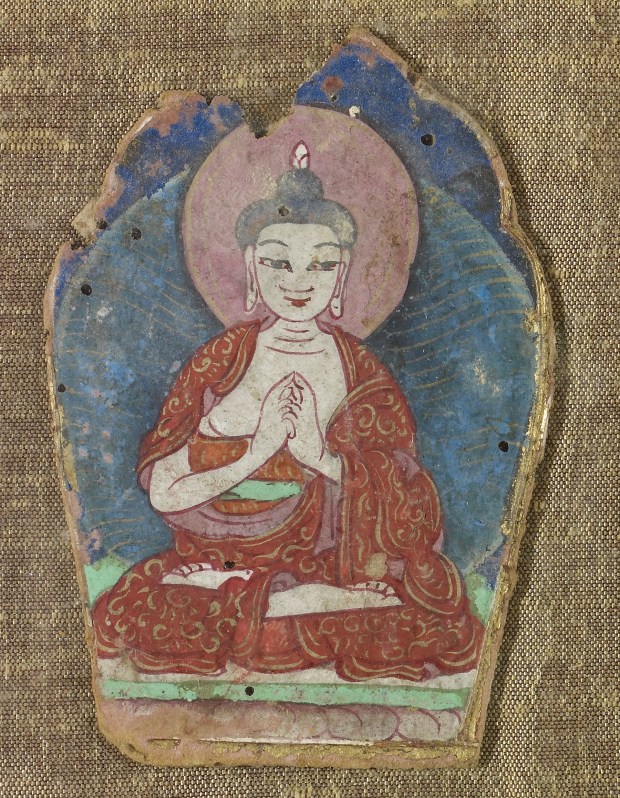
Image is Vairocana, from the Walters Art Museum

    TURNING THE WHEEL OF DHARMA

    The Buddha’s first teaching

    Image: John Hill

    Today, 8 June 2017,  is the full moon of Dharma Day, the anniversary of the Buddha’s first teaching, known as Turning the Wheel of Dharma.

    Here is my Re-rendering of the Dhammacakkappavattana Sutta (Ratnaprabha, June 2017)

    This is what I heard. (After his awakening), the Buddha arrived at the game reserve near Varanasi, (and was reunited with his five former comrades).

    He taught the group of five. He said to them: “Going forth (to seek awakening), you must avoid two extremes.

    “Looking for gratification in sense pleasures is demeaning, crude and ignoble. It’s what people always go for, but it’s pointless, and it takes you nowhere near the goal.

    “Yet self-torment is also ignoble and pointless, and (it commits you to needless) suffering.

    “Instead of veering towards one of these extremes, (if you’re) attuned to reality, you will wake up to the middle path. It yields vision so that you truly know. It leads to peace, to complete awareness, to quenching (the flames) and waking yourself up fully.

    “Speaking simply, the middle path has eight aspects. These are complete vision, complete emotion, complete communication, complete action, complete livelihood, complete effort, complete mindfulness, and complete unification (of the mind). When I attuned myself to reality, I woke up to this path.

    “Furthermore, (I woke up to four noble truths). Firstly, this is the noble truth, the grand reality, of pain. Birth, ageing and illness are painful. Death is horrible. (Then you’ll encounter) depression, grief and physical agony; unhappiness and despair as well, and losing what you love, and not getting what you want. In fact all the aspects of life that we cling to are painful.

    “This is the noble truth, the grand reality (that explains) where pain comes from. It comes from thirst, from craving. It is craving that impels us to remake ourselves so that we are still conjoined with gratification and clinging, indulging in one thing after another. (More specifically), it is craving for sense-gratification, craving for continuing (as we are), or craving for oblivion.

    “This is the noble truth, the grand reality, of the finish of pain. It is the fading and finishing of that same craving, giving it up, letting it go, not depending on it any more, so that we are completely free from craving.

    “This is the noble truth, the grand reality of the way that finishes pain. It is the same middle path (that avoids the extremes) – complete vision and so on.

    “When I fully woke up, I saw this for the first time. A fresh insight, wisdom and awareness, indeed a complete illumination, dawned on me. I truly saw pain as a grand reality, I saw I had to understand it, and (eventually) I did.

    “Similarly, I truly saw, as a grand reality, how pain comes from craving. I saw I had to let go of that craving, and I managed to do that.

    “And I truly saw the grand reality of (the possibility of) pain finishing (for good). I knew I had to realise that finish directly, and I did realise it.

    And I truly saw the grand reality of the middle way that frees one from pain, I saw that I had to journey on that way, and I travelled it to the end.

    “It was these crucial insights that enabled me to perfect my full and complete awakening. This is an awakening that completes the journey, (a journey open to) all forms of life in the universe. I saw, and I realised: unshakeable is the liberation of my mind, I’m no longer compelled to re-make myself, this is it.”

    The group of five listened enraptured to the Buddha. And as he listened, one of them, Kondañña, saw the truth clearly and lucidly, and realised that all that comes into being must also finish. “Kondañña knows!” Exclaimed the Buddha, “Kondañña knows!”

    This, in the game reserve near Varanasi, was the (first) rolling of the Wheel of Dharma by the Buddha. The earth spirits yelled with all their might: “THE SUPREME WHEEL OF THE BUDDHA’S DHARMA IS NOW TURNING, AND NO ONE CAN STOP IT!” And the cheer went up through the ranks of invisible beings up to the (formless) world of pure spirit, so that the whole world trembled, and an incandescent light spread from horizon to horizon.

    Brackets signify words added for clarification. Some repetitions have been removed. This re-rendering is interpretive, and other interpretations are possible; it is well worth looking through several translations.