Buddha

The Ancient City:  the Buddha and William Blake

The Buddha once tried to describe to his disciples what it had been like to discover the path of total spiritual transformation.

He said that he had felt like a traveller walking through the wild forests on a mountain height.  The traveller came upon an ancient trackway, overgrown, untravelled for many years,.  He scrambled through the undergrowth and followed the track to a great and ancient city, uninhabited, in ruins, almost obscured by the jungle.  The traveller decided he would not stay in the place, though he loved its beauty, but would return down the ancient trackway and go to see the ruler of the country.  He said, “Sire, I have found an ancient trackway, and at its end  an ancient city, and I know that city was once the capital of our country.  Sire, let us restore that city!”  And this is what they did — they went back, with many men and women, and lovingly restored the city to its former glory, and cleared the ancient trackway so that all could follow it.
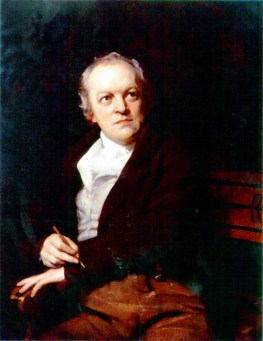
William_Blake_by_Thomas_Phillips wikimediaWilliam Blake was a Londoner, he lived in the biggest city in the world at that time, around the turn of the Nineteenth Century.  It was a dirty and stinking place, with a sinister repressive government at its hub, and it was teeming with little tyrants and their little victims.  Blake saw all this very clearly.  He felt pity and anger.  Yet he was a visionary, and he also saw a different city, made of light.  His was not a utopian vision, a wonderful gleaming marble London of some ideal future.  For him, the harmonious city of light was the human mind, his own and everybody’s mind, completely liberated from the oppression of self obsession, completely cleansed of the smoke and grime of error.  He called the perfect city Jerusalem.

If Blake had been more ordinary, he might have dreamt again and again of his Jerusalem, and sighed when he woke up.  He might have taken to the streets to demand that someone build it for him.  Or more probably, the everyday oppressions of life might have smudged the image, until all that he was seeking was a bit of recognition, a reasonable income as an engraver and painter, and a few cronies to reminisce and grumble with.

However, Blake was not ordinary.  I won’t call him great, or a genius, because that would be to betray his own insistence that everyone has access to that vision of Jerusalem, though the trackway to it is still overgrown, a tough climb.

His vision changed and became more dynamic.  He took his eyes off Jerusalem’s glistening spires of golden light, shimmering on the horizon.  His new vision was a plan, a life’s-work.  It was of a different city, to be built with work and action, with conversations and personal connections, and particularly with the works of the artist.  This city, which is always being built, he called Golgonooza.

Blake was an artist, he was a painter, an engraver, and a poet.  The Buddha was also a visionary, but he was not, as we suppose, an artist.  He was the discoverer of a trackway leading to the ancient city which he called Enlightenment, and the work of his life was to point out this trackway to as many people as he could, to assure them that it was not impassable, and to entreat them never to let it become overgrown again and to keep it clearly marked on all the maps.  I am a Buddhist, and I am also an enthusiast for the visions of William Blake.  I have a very strong sense that in a way Blake’s city of art is the same as the city being restored in the Buddha’s vision.  However, even if the cities are the same, the trackway of artistic creation would seem to be a very different route to it than the track way of leading a Buddhist life.  Was Blake’s track the same as that of the Buddha?

Please don’t take these explanations  too seriously. Blake’s vision is not really of a city.  The Buddha did not really follow a track, in fact was known as the ‘Trackless One’. These ideas may indicate something which you can live, but they are no more than ideas until they are lived, and when they are lived, they have a life of their own, and these words become superfluous.

In any case, here we are now.  There is nowhere else we can start from.  And sometimes, we realise, we are wandering through a thick forest.  Usually, we are not even on the mountain height, and the little animal tracks that we follow do not really lead anywhere.  There is something wrong, something lacking.  The world falls short of our desires.  We have a sense that we are staring at an engraved print, and we can’t find the window that looks out onto the real thing.  As we look at this two-dimensional illustration of life, we feel a longing.  It may occasionally be a longing for the complete unbounded green landscape itself, but often it is one of many little longings stimulated by some little shape in the illustration.  The imagination is vast, but the world that flickers through our senses is small, and so frustration and pain are endemic.

In the vast world glimpsed in imagination, that is, complete Imagination, there is no need for any limit of any kind, not even the separation of the inside, my mind, from what I think of as an indifferent world outside.  That completely open dimension is not something to be manufactured, and it is not in any way limited by our inability to dwell in it, and so, for Blake, it is an eternal realm from which conscious beings have wandered.  His task is to restore us to that open realm.  He sees himself and others as human beings to be perfected through great struggle.  As he advances, his surroundings will light up more and more, their imperfections will drop away, until he finds himself as the ideal man, within Jerusalem.

Yet here we are now, in the thick forest.  There is something wrong, there is a lack, and we are, all the time, scrabbling about, driven by the sense of lack.  It is like an intense thirst, but most of what we drink to try to quench that thirst only satisfies very briefly, if at all.  The Buddha and Blake share an intense optimism, which one feels must have come from their genuine discoveries.  They both thought that lack, thirst and aimlessness are not inevitable.  But we have to have the courage to see what it is that we do that is not working.

What Buddhism characterises as a desperate thirst, Blake describes in dramatic terms.  Here is a stupendous human being, like a god, who has become estranged from the eternal city of Jerusalem.  The human being is Blake himself, and is Everyman.  As a Christian, he might give him the name Jesus.  But usually, he calls him Albion. He is the Sleeping Lord whose bones are the hills of Britain, or who is made up of all the potentially united people of Blake’s own nation.  Albion is asleep, or perhaps he’s dead.  In his dreams, the city Jerusalem has become his estranged wife, and his divided mental life has cascaded into two, and then four, and then many many beings, who clasp each other or fight each other, as they grapple with their dim memory that something has been lost.  His poems describe the dreadful and cruel selfishness of the female emanations and the male spectres in the fallen state.

It is possible that the Tibetan Book of the Dead is talking about a similar estrangement.  Like Albion, we topple at last into the uncontrolled dreams of death.  The light of reality is so dazzling as to be both agonising and terrifying.  And, the Tibetan Book of the Dead says, we swoon away from the light, and eventually struggle out of complete unconsciousness into a sequence of dream visions.  At first, there is an intensely beautiful, symmetrical, colourful mandala of five male Buddhas each embracing a female Buddha.  Spangled discs of pure colour offer a trackway into that mandala, which is sometimes described as a palace or even a city.  Coloured smokes wreath about it, seeming safer and more familiar, and the dreamer (or dead person) finds the smoky colours alluring, and loses the vision of the beautiful mandala.  The mandala is replaced by visions of enlightenment which become increasingly wild and ferocious, but each of which offer a pathway into the completely open realm.  We tumble along ‘the bardo’s dangerous pathway’, buffeted and dragged by all the habits and tendencies we have been consolidating over the years, until eventually we are left only with our future father and mother making love, and in a tantrum of jealousy, we hurl ourselves between them.

For Blake, the dream drama of Albion’s fragmented selves is not an utter nightmare, because he can begin to identify the different characters, and discover the games they are playing.  Far worse would be an undifferentiated confusion in which there is no awareness at all.  Nevertheless, confusion and tragic misunderstandings underlie most of our attempts to express our longings in the fallen world.  Confusion, rationalised, becomes error.  If only error can be given a clear outline, can be compelled to fully reveal itself, then it can be overcome.  If, as Blake claims, “Truth can never be told so as to be understood and not be believed”, then if error is uttered clearly enough, it must immediately be seen through.

For a similar reason, the Buddha devoted a lot of effort to exposing what he called false views.  He and Blake both felt that evil ultimately comes from a basic confusion.  What is really immoral is not to disobey a set of ordained laws, but to act from the fear, thirst, and cruelty that we use to defend a selfhood trapped in confusion.  Confusion perceives a divided world (the Buddhist word for ordinary consciousness means “divided knowing “), corresponding to the fragmentation of the giant Albion.

We can change our perception and escape from confusion by trusting what Blake at first calls the Poetic Genius; in trusting it, it strengthens.  Later, he calls it Imagination or Vision: it corresponds to the Buddhist term shraddha.  Shraddha is usually translated as faith,  but actually, it is a combination of a vision of what is truly significant in life with a longing to create a truly significant life.   It comes from an expansion of awareness, initially, an improvement in sensory awareness.  Here, Buddhism stresses mindfulness practice, and Blake’s practice of mindfulness was the exercise of his acute powers of observation through drawing and writing.  “A Poet, a Painter, a Musician, an Architect: the Man or Woman who is not one of these is not a Christian”, by which he meant someone willing to expand his or her visionary awareness.  Although there are other means, it seems to me that some kind of artistic practice is probably the best way for us in this secular age to cultivate shraddha.

Shraddha, vision, is an enlargement of perspective, which opens the space for an energetic engagement with life.  “Energy is Eternal Delight” says Blake, and the free expression of energy is perhaps his prime human virtue.  Both life and consciousness provide unlimited reserves of energy to every human being, but its expression is inhibited, often because what one feels like doing with it is thought to be unacceptable or wicked.  Here we come to an apparent difference between traditional Buddhism and William Blake.  For Blake, at least according to his rhetoric, any form of restraint is anathema.  “Those who restrain desire, do so because theirs is weak enough to be restrained; … being restrained, it by degrees becomes passive.”   Buddhism however insist that genuine spiritual energy must always be put into what are called ‘skilled’ states of mind.  ‘Unskilled’ states of mind should be subject to restraint, because of the dreadful consequences of acting from them.

Consequently, I puzzled for a long time over Blake’s proverb “Sooner murder an infant in its cradle than nurse unacted desires.”  It seems to say that you should do whatever you feel like doing, even if it causes harm.  At first I thought that as a “Proverb of Hell” it was intended just to shock.  Later I concluded that Blake did sincerely mean what he wrote, and at the same time definitely wished no one to harm another. Desire is an uprush of energy, and that energy is potentially enormously creative, but festers if it is allowed to stagnate.  So it is crucial to use desire, or energy, as a basis for action, even if it is only mental action.  Desire is a signal to create, and the fuel of creativity.

Joyful engagement is the way of grappling creatively with one’s surroundings.  The most significant element of one’s surroundings is other people.  Blake said “Mutual Forgiveness of each vice/These are the Gates of Paradise”.  It is easy to be overwhelmed by the flaming energies into which Albion has fragmented in Blake’s writings, and thus miss both the motive and message of his work.  He seeks the cleansing of our vision because we are in such a terrible plight: he wants everybody to be able to live in what he calls Eternity, in mutual love, and he wants this because of the swelling of love in his own breast.  Blake marvellously displays the greatest Buddhist virtue — compassion.

Blake ran along the ancient trackway, and came back with excited news of the ancient city, wanting to restore it, and wanting to call it Jerusalem.  His vision of that city, and of why it is in ruins, is immensely stimulating, and it is worth scrutinising his words and images just for that.  He has also opened up sections of the ancient trackway.  Add one extra stretch of track to his map, and perhaps it is complete.  What is lacking is samadhi: intense, calm, one-pointed contemplation of experience in states of deep meditation.  As a visionary artist, it may be that he possessed the equivalent of samadhi, but I don’t think he realised that without it, anxiety and vacillation will entangle most of us before we reach the city.

First Published in Urthona magazine, 2000.

Sources

The Buddha’s Ancient City: Samyutta Nikaya, 12-65; and see F. L. Woodward, Some Sayings of the Buddha (Oxford, 1973), page 25.

For the myth of Albion, Jerusalem and Golgonooza, see Blake’s prophetic books Milton and Jerusalem, especially in the beautiful facsimile editions published by the Tate Gallery.

Most of the quotations on desire and energy are from The Marriage of Heaven and Hell.

I think that the best commentary on Blake’s writings is still Northrop Frye’s Fearful Symmetry (Princeton University Press, 1947).  Also see Sangharakshita, Buddhism and William Blake (Ola Leaves, 1981).

The Great Monkey and the discovery of mangoes (a Jataka story)

Animals

Illustration by Andy Gammon

Long ago, before men had tasted mangoes, the bodhisattva was reborn as a monkey, near the banks of the Ganges. Growing up strong and vigorous, he became leader of his troop. The monkeys found a huge mango tree on the river bank: ‘Its sweet fruits of divine flavour were as large as water jars, and from one branch the fruit fell on dry ground, from another they fell into the Ganges.’ The troop feasted eagerly on the fruit, but the bodhisattva pondered, and decided that he must not let the ripe fruit fall into the river, or there would come a time when disaster would befall his followers.

So after the next blossoming, he made the monkeys eat or discard all the fruitlets on the branch that overhung the river. However, one single fruit ripened because an ants’ nest hid it from view, and it fell into the water.

Meanwhile, many miles downstream in the great royal capital Benares, King Brahmadatta was idling away his life. His many wives did their best to keep him amused, his courtiers flattered him and devised elaborate feasts, and the king himself grew more fat and more bored. In the afternoon he would go with his court to his bathing place on the Ganges. Nets were strung across the river, upstream and downstream, to keep out the crocodiles, and the king would wallow in the shallows to his heart’s content, and then emerge for a picnic.

One night, after the king had returned to his palace, the fisherman who put away the crocodile nets found a strange object caught in the mesh. Was it the egg of some huge water bird? Red and green it was, weighty, soft to the touch; swollen, blushing, and fragrant. Did the fisherman know what it was? no! — So he gave it to the chief queen. Did the queen know what it was? no! — So she gave it to the king. Did the king know what it was? no! — So he asked the queen, who asked the fisherman, who did not know. The fisherman fetched the woodman: he would know. He said to the king ‘Eat it, sire’. Suspiciously, the king made the woodman taste some first, and an enchanting perfume filled the palace as the fruit was cut.

Yes, it was the very mango that had fallen from the monkey’s tree, and the king was soon guzzling its flesh, leaving some small pieces to tantalize his wives and courtiers. He was delighted, and the fragrant essence pervaded his body. They were ecstatic, and the fragrant essence pervaded their bodies. But when the mango was finished, the sensuous king craved more; the whole gourmand court were obsessed with mangoes. So Brahmadatta ordered an expedition for the next morning. They would all go up river to look for the tree. The bodhisattva monkey’s worst fears were about to be realized.

The king’s boats stopped under the mango tree, its branches bending with ripe fruit, and Brahmadatta and his wives and courtiers feasted to repletion, all falling asleep under the great tree. The moon rose. At midnight, our monkey troop arrived for their mangoes, not noticing their new and deadly rivals snoring contentedly on the ground. The noise of the monkeys woke the king, who saw them and smiled. `The mango is an ideal fruit, but it lacks a savoury. Tomorrow we will eat mangoes and roast monkey!’ Brahmadatta awakened his men and had the tree surrounded by archers, ready to shoot at first light.

Trembling, the monkeys came to their leader — ‘What shall we do?’ ‘Do not fear,’ he whispered, and climbed to the very end of the bough which overhung the river. With a prodigious leap, he made the far river bank, landing in a bush. There, he carefully calculated the length of his leap, broke off a long bamboo pole to reach the branch, tied one end to the top of the bush, and tied the other end to his waist. The great monkey gathered every sinew for a mighty leap, and ‘with the speed of a wind‑torn cloud’ he sprang for the branch. But oh! the pole was just too short. With a despairing convulsion, the bodhisattva clutched the branch as he fell. ‘O monkeys, my back must be the bridge. Run swiftly to the pole and safety.’

So the troop escaped the dreadful fate of adorning Brahmadatta’s breakfast table. But look — the last monkey to cross is the bodhisattva’s great rival, and he stamps on his chief’s back as he passes, causing his heart to crack in a wave of pain. The cruel rival fled, laughing. The bodhisattva was alone, lashed to a bamboo pole, hanging on to the tree.

Brahmadatta had seen all in the growing light. ‘This is but a beast, yet he risks all to save his kin!’ and at daybreak he sent his boats into midstream and had a platform built on them. Gently, the dying monkey was taken down and tended. The king sat next to him on the ground and spoke, his heart full. ‘You could have saved yourself, great being. What are you to those chatterers, what are they to you?’ ‘Those monkeys are my charge, king. In terror of your brutal arrows, they looked to me, and so I saved them. Neither death nor bondage will disturb my breast, since those I ruled are now safe. I tell this to you, O king, that you may learn that a wise ruler seeks the welfare of all in his domain.’

And so the bodhisattva died, and Brahmadatta gave him a monarch’s funeral, enshrined his bones, and abandoned his own luxurious ways to rule righteously, following the instructions of a monkey.

Catherine RhysDavids, Stories of the Buddha, Dover, New York 1989 (1st edn 1929), 149–53. Tradition says that the Buddha told this story when discussing the value of seeking the welfare of one’s kin. Feats of courage and self sacrifice in defence of the troop are well known among the macaque group of monkeys (an early illustration of this birth story from the Bharat Stupa shows monkeys of this type), and are ascribed to kin selection. The idea is that it is genetically worth while to risk your life if you save the lives of close relatives, since they carry similar genes to yours. However, despite the naturalistic observation of much of this two thousand year old story, it is important as a moral fable, and not for its portrayal of animal behaviour.

Vangisa the poet

39a Aloka_LBC_painting-747601

Aloka working on his triptych of the Buddha and his disciples

A THOUSAND AND MORE

A story of the poet-monk Vangisa, from the Kindred Sayings, i, 192.

Once, the Abundant Man was staying near Savatthi, in Anathapindika’s park, the Jeta Wood, with over a thousand Bhikkhus. He gave a talk about Enlightenment, which was instructive, eye-opening, exciting and inspiring. They all listened to the Dharma enraptured, attending closely with their whole minds.

Afterwards, Vangisa the poet came up and saluted the Buddha, saying ‘It’s come to me, Abundant One, it’s come to me, Happy One.’ The Buddha said ‘Let it come to you, then, Vangisa!’, and Vangisa praised him in a fitting poem.

A thousand comrades and more
Are gathered round the Buddha here
And here he teaches Dharma pure,
A want-less state, Nirvana sure,
Suffused with utter confidence.

To words of spotless Dharma
Taught by the peerless Buddha
They listen without distraction.

So beautiful, the Awakened shines
As noblest in this noble band.
O dragon of abundant treasure,
Seventh sage in the line of seers,
Summer thunder-cloud of timely rain,
Pouring Dharma on your listeners!

And I, a listener, left my dreams,
Sleeping in the teatime sun,
So eager to see my teacher here.
Mighty hero, I Vangisa will ever follow,
And let my words flow in devotion.

The Buddha said ‘Tell me, Vangisa, had you already composed these verses?’ ‘No, my teacher, they came to me as I spoke them.’ ‘Then please, Vangisa, let us hear some more.’ ‘Then I shall contnue,’ said Vangisa.

The devious ways of death you master,
And take your plough to crumble
The fallow fields of our hearts.
Look at him! Sowing freedom,
Reaping harvest of the Path-grains.

He shows the bridges over the flood,
He shows the deathless shore,
And we that have seen that Dharma
Are moored immoveable.

A bearer of the light, he burst
Beyond all viewpoints dark and fixed.
First knowing, then surmounting
The highest peak, he guides us to that vantage.

Now! With the truth so well explained,
What place is there for sleeping,
For we who’ve heard the Dharma?
Thus within the Buddha’s system,
Train well, practise intensely without pausing,
And always keep your reverence alive.

Adapted freely by Ratnaprabha from Catherine Rhys Davids’ translation (Pali Text Society), with help from the Theragata version (verses 1238-1245) translated by Prof. Norman.

The Heart of Leaping Wisdom — The Heart Sutra

THE HEART OF LEAPING WISDOMjewel

A free re-rendering of the Heart Sutra by Ratnaprabha

  1. I salute the Abundant Lady, Noble Leaping Wisdom!
  2.  The Bodhi-hero noble Master Kind-gazer was practising the ocean-deep life of leaping wisdom,
  3. And he gazed down,
  4. Seeing only the five segments of oneself and total experience,
  5. And knowing they were essentially completely open.
  6. Kind-gazer said:
  7. ‘Right here and now, Sharp-eye, the world you experience and your body are completely open.
  8. And open reality is just what you call the world and body.
  9. The world and body precisely are complete openness.
  10. And open reality precisely is what you call the world and body.
  11. Anything in the world or body is completely open.
  12. And anything in open reality appears as the world and body.
  13. ‘All responses of like and dislike are completely open.
  14. And open reality is … [as for the world you experience…]
  15. And anything in open reality appears as all responses of like and dislike.
  16. ‘Every time you notice and recognise anything is completely open.
  17. And open reality is … [as for the world you experience…]
  18. And anything in open reality appears as every time you notice and recognise anything.
  19. ‘Every little urge or proclivity you feel is completely open.
  20. And open reality is … [as for the world you experience…]
  21. And anything in open reality appears as every little urge or proclivity.
  22. ‘Your split awareness itself is completely open.
  23. And open reality is … [as for the world you experience…]
  24. And anything in open reality appears as your split awareness.
  25. ‘Right here and now, Sharp-eye,
  26. Everything you can name or think about is completely open.
  27. Everything is without identifiable characteristics.
  28. Everything neither comes into being, nor finishes.
  29. Everything is neither morally bad, nor pure.
  30. Everything is neither lacking in perfection, nor perfect.
  31. ‘Next, Sharp-eye, get into a completely open meditation.
  32. There, there’s no world or body.
  33. There’s no response of like or dislike.
  34. There’s nothing to notice or recognise.
  35. There are no little urges or proclivities.
  36. There is even no divided awareness.
  37. ‘Get into a completely open meditation.
  38. There, there are no senses or mind-sense.
  39. There’s nothing to sense, nor ideas or images.
  40. There is no sense awareness, nor even mental consciousness.
  41. ‘Get into a completely open meditation.
  42. There, there’s no unknowing, or karma-formations, nor all the links they lead to, up to decay and death,
  43. But there is no stopping of these twelve links, either.
  44. ‘Get into a completely open meditation.
  45. There, there’s no frustration.
  46. There is no craving to make you frustrated.
  47. There is no peaceful cessation of all frustration,
  48. Nor is there a spiritual path to lead to it.
  49. ‘Get into a completely open meditation.
  50. There, there is no real knowing;
  51. There are no Buddha-achievements;
  52. There is no lack of Buddha-achievements.
  53. ‘Next, Sharp-eye,
  54. It is because of his complete indifference to achievements,
  55. And because he relies on Leaping Wisdom,
  56. That a Bodhi-hero can live with no barriers trapping his mind or heart.
  57. Having burst through all barriers, he does not panic;
  58. He is no longer upside-down;
  59. Finally, he achieves Enlightenment.
  60. ‘Every Buddha throughout time,
  61. With just this Leaping Wisdom,
  62. Fully wakes up to perfect and complete Enlightenment.
  63. ‘Next, learn the great secret name of Leaping Wisdom.
  64. It’s the Lady of Full Knowing’s secret name,
  65. The best name,
  66. The name as good as a Buddha,
  67. The name that calms all frustration.
  68. It’s true, and it works,
  69. It’s the secret name spoken by Leaping Wisdom herself.
  70. Here it is:
  71. ‘Leap; Leap; Leap over; All of you leap over; AWAKE! That’s it!’

Notes

Please refer to Sangharakshita’s commentary on the Sutra (lecture 73 on Free Buddhist Audio, & in Wisdom Beyond Words).

I produced this re-rendering during the ‘Towards Insight’ Order retreat at Guhyaloka in September 1994, where we were studying and reciting the Heart Sutra. My purpose was to produce a fresh and immediate interpretation of the Sutra, based on a number of translations and commentaries, primarily to help my own reflection on and study of the text. I don’t understand most of the Sutra and do not have Insight into shunyata, nor can I read Sanskrit, Tibetan or Chinese! So do not regard this as a reliable English version. Even on the level of the discursive intellect, several other interpretations are possible. I haven’t even tried to preserve the Sanskrit grammatical forms. And I have freely expanded the terse Dharmic concepts in order to convey a more accessible meaning.

The notes below refer to my line numbers. The full diacritics of the Sanskrit words can be found in Conze (A). Words in brackets are additions: I have added words or phrases for clarity or to expand sections for more efficient reflection.

Title       Also includes the word Sutra.  Heart (Hrdaya) is the ‘essence’, and also the mind/heart that operates with Prajnaparamita.  Leaping (paramita) is glossed as ‘going beyond (to the other shore)’, and can also mean excellence or perfection; ‘leap’ is Han Shan’s image. Prajna is the Imaginal faculty, leaping onto a safe refuge beyond the ocean of suffering. The Heart of Leaping Wisdom Sutra only sketches in a few, advanced stages of the path; it is more a ‘path of no steps’ teaching, a path of one leap (or a few leaps), you might say. The much more gradual accumulation of merit is described in other scriptures.

1             Abundant lady  – Bhagavatyai; as an epithet of the Buddha, usually ‘Blessed One’ or ‘Richly endowed one’ (Sangharakshita). Here referring to Leaping Wisdom, and so in feminine form, hence Lady (grammatically feminine, and referring to the female Buddha).  Noble: Arya.

Following this, the long version has an introduction setting the scene on Vulture’s peak, with the Buddha in the Samadhi ‘Perception of the Profound’.

2             Bodhi-hero – bodhisattva.  Master Kind-gazer – Avalokiteshvara. Ishvara is a ‘lord’ or highly capable being. Avalokita means ‘looks down’ – in compassion being understood.   Practising – caramano; or ‘meditating’.  (ocean) deep – gambhiram.  Life – caryam; or ‘practice’.

3             gazed down – vyavalokayati, echoing his name.

4             five segments … experience – the skandhas. The Chinese version then adds (in our puja translation – see refs.) ‘and transcended the bonds that caused him suffering’. The Chinese translator working with Kumarajiva may have added this, but Hsuang Tsang has it too, despite the fact that it is not in his Sanskrit source (see Hurvitz, in Lancaster).

5             essentially completely open – svabhavashunyan. My ‘completely open’ and ‘open reality’ for shunya/shunyata are from Herbert Guenther’s explanations of the word as the ‘open dimension’ (of being). (Kindly Bent to Ease Us, Pt I (Dharma, 1975), 169 & 264n. Also see his Tibetan Buddhism in Western Perspective (Dharma, 1977), 73-4).  After 5, the long version has Sharp-eye ask Kind-gazer how to train in Leaping Wisdom.

7             Right here and now – iha, literally ‘here’. I’m suggesting that ‘iha’ is drawing Sharp-eye’s attention to his present experience. (See also lines 25, 31, 53 and 62.)   Sharp-eye – Shariputra. A ‘shari’ (his mother’s name) is apparently a bright- and sharp-eyed bird; ‘Sharp-eye’ seems to fit his acute mind. (I’ve freely ‘translated’ his and Avalokiteshvara’s names to help in looking at the Sutra’s characters in a fresh light.)   the world … your body – rupa; as a skandha, rupa can be the whole objective content of experience (‘the world’), or just one’s body and senses.

8             is just (what you call) – 7 and 8 actually just say ‘rupa is shunyata, shunyata (or the very shunyata) is rupa’. Of course, I can’t grasp this paradoxical part of the Sutra, but 8-11 (as well as the following lines on the other skandhas) seem to be saying that both ‘objective’ appearances and ‘subjective’ processes are completely open, yet there is not a thing called shunyata which is distinct from appearances and experience, let alone a nihilistic void – Han Shan warns against getting ‘immersed in the void and stagnant in stillness’. The three (two in some versions) ways of putting it are presumably to guard against wriggling out of this conundrum. Perhaps it is sufficient just to contemplate the words as they are, and let them sink in. However, I’ve expanded them a little in translation, based on the Indian and Tibetan commentaries – hence ‘what you call’. Shunyata seems to have two strands of ‘meanings’: the utter lack of inherent existence in any phenomenon, and the ultimate invalidity of any labelling or conceptualisations of any phenomenon. As concepts, shunyata and rupa are distinct, of course. They are identical in that there is nothing other than ineffable reality for one’s divided awareness to misperceive as split into various labellable (‘what you call’) segments, like the skandhas. Therefore, all that non-dual Transcendental consciousness (Prajna) needs to vision is complete openness.

12           (Appears as) – again, I’ve added this. The commentaries explain that everything we experience is a manifestation of shunyata, which ‘does not prevent the causally originated semblances’ (Manjughosha Sadhana), and this mere appearance can be relatively real. Shunyata is to do with experience, not metaphysics. However, it presumably is not that shunyata manifests rupa and nothing but rupa: ‘it’ manifests the other skandhas too. And, for our spiritual purposes, we do need to make a distinction between the potentially misleading appearances that weave our life and world, and the completely open reality that we fail to see life and world as. But I’m out of my depth here! ‘All appearances are reflected in prajna’s mirror’, says Han Shan.

13           Responses of like and dislike – vedana; can be neutral too. The Sutra just lists the remaining skandhas, but I’ve repeated Kind-gazer’s statements in full for each one, to aid reflection.

16           Every time you notice and recognise (anything) – samjna.

19           Every little urge or proclivity (you feel) – samskaras. ‘Proclivities’ is Sanghrakshita’s suggestion, or was it ‘propensities’?

22           Your split awareness (itself) – vijnana.

26           Everything you can name or think about – all dharmas. 26-30 constitute the ‘eight-fold profundity’.

27           (Everything) – ‘all dharmas’ is not actually repeated in 27-30.  Without identifiable characteristics – (a)-lakshana. This could be part of the previous word, shunyata, in which case, 26-27 together mean all dharmas ‘have the characteristic of shunyata’, as Conze has it, and the profundity would only be sevenfold. All the Indian commentators have 27 as a separate statement.

28           neither comes into being, nor finishes – anutpanna (or ‘not produced’), aniruddha.

29           neither morally bad, nor pure – amala (literally ‘not stained’), avimala.
30           neither lacking in perfection, nor perfect – anuna; or ‘not deficient’ (in the spiritual qualities to be accumulated by practice); aparipurnah; or ‘not filled’ (Chinese versions have ‘not increasing or decreasing’).

31           Next – tasmac usually means ‘therefore’, but it can mean (says Wayman) ‘afterwards’. So perhaps the first two sections of Kind-gazer’s teaching, which start with ‘here’, are calling for an immediately open attitude to present experience, although they can be used as meditations (see Khenpo’s Progressive stages of Meditation on Emptiness). The last three sections all start with tasmac (or tasmaj), perhaps implying that once one has some Insight into open reality, then one should meditate on the following statements. Hence my (get) in(to) a completely open (meditation), for what is literally ‘in shunyata’. Han Shan confirms that this is a meditation, intended to wipe out all (remaining) errors, and several commentators align it with the ‘bhavanamarga’, the fourth of the five paths.

32           There, there’s no … – presumably (if I’m not being too logical) if you enter a samadhi which directly contemplates open reality itself (one of the Doors to Liberation), then you will no longer apprehend all the ‘appearances’ (rupa etc) listed in 32-52, despite the fact that when you are not in the samadhi, open reality is no other than all those appearances.

37           (Get into …) – The phrase ‘in shunyata’ only occurs at the beginning of the whole (31-52) section. I’ve repeated it for each separate list because each can be used as a separate set of topics for contemplation.

38-40     — The 18 dhatus (sense-spheres or -constituents) are the six sense organs, including mind (manamsi), their objects – sounds etc, including ‘dharmas’ (my ‘ideas and images’) for mind – and their (sense-) consciousnesses, including manovijnana. The Sutra literally just says ‘no eye-dhatu and so on up to no manovijnanadhatu’. It also lists the 12 ayatanas (sense-bases or -sources), but since these are identical to the first 12 of the 18 dhatus, I’ve not repeated them. This section refers to the subjective and objective world of the senses, the whole of reality for an ordinary person. Han Shan explains that to realise that the sense-world is non-existent in shunyata is a leap beyond this ‘Dharma of worldly men’.

42           unknowing … decay and death – the 12 ‘negative’ (as we call them in the TBC) nidanas. This and 43 (their cessation) and 44-48 (the Four Noble Truths) is basic Buddhism, all operational concepts, categories to be leapt beyond when they are no longer spiritually useful.

50           real knowing – jnanam; non-dual wisdom, not here distinguished by the commentators from Prajnaparamita.

51           (Buddha)-achievements – praptir; literally attainment. The old commentaries say that 50-52 refer to the Bodhisattva’s non-dual wisdom and ‘attainment’ of Buddhahood. In open reality, one does not need to take even these ideas literally.

54           (his) – actually there are no pronouns in the Sanskrit in this paragraph, I think, so no gender is implied.  Complete indifference to achievements – apraptitvad; this is Sangharakshita’s gloss: literally, ‘non-attainmentness’. Han Shan concludes: ‘gainlessness is the real and ultimate gain’.

56           no barriers trapping … mind or heart – acittavaranah; avarana (barrier or veil) as in the three veils of karma, kleshas and jneya (views). Refers to all the barriers that separate one from one’s experience. Can sometimes mean the five hindrances, which are more usually the nivaranas. Han Shan says that if you rely on ‘discriminative feeling and thinking, the heart (citta) and objects will bind each other and can never be disentangled from the resultant avid graspings (avarana)’. But, he continues, if you meditate using the faculty of Prajna, then when the shunya heart contacts shunya appearances, only liberation results.

57           burst through (all) – nastitvad; literally, just ‘in the absence of’.  does not panic – atrasto; or tremble, or fear. If you’ve got barriers, then open reality will seem frightening, if (as Sangharakshita points out) you are open enough to see how threatening it is to your limited self.

58           no longer – atikranto; literally he’s ‘stepped above’, or ‘passed beyond’.  upside-down – viparyasa, as in the four ‘topsy-turvies’ or mental perversities: seeing the permanent as impermanent, etc.

59           Finally, … Enlightenment – nishtha-nirvana; or ‘the fulfilment or summit’ (the name of the fifth and final path) of nirvana. achieves – praptah; the start and end of the paragraph thus says: ‘through non-achievement … he achieves (same term) Enlightenment’. Only direct knowledge of reality (Leaping Wisdom), says Sangharakshita, confers Enlightenment.

60           throughout time – tryadhva; the three times, of present, past and future.

61           With just – ashritya; literally ‘through relying on’.

62           Fully wakes up – abhisambuddhah.

63           learn – jnatavyam; ‘one should know’ (the secret name). secret name – mantra, but often regarded as a dharani too, especially in China and Japan.

64           Lady of Full Knowing’s – mahavidya; or just ‘great knowing’s’. Wayman suggests this refers to Leaping Wisdom herself, since vidya is feminine.

65           best – ‘nuttara.

66           as good as (a Buddha) – samasama; literally ‘equal to the unequalled’.

67           frustration – duhkha.

68           It’s true – satyam. it works – amithyatvat; ‘for what could go wrong?’ (Conze), or ‘without fail’ (Han Shan), or ‘since it is not false’ (Other translations).

69           spoken by … (herself) – ukto; delivered by.

70           Here it is – tadyatha. An ‘Om’ is sometimes added after this word, both tadyatha and Om being included in the secret name by Tibetans (see bijas on lotus petals illustration in Kelsang, p130).

71           Leap; Leap;  – it is said that the secret name is best left unexplained and untranslated, but nearly all the commentators explicate it in some detail! I thought an imperative sounds better, though it is actually a past participle, ‘gone’. It could also be rendered ‘proceed; proceed’, or ‘leave it behind; leave it behind’. Leap over; – paragate; or across (to the other shore), echoing the para in prajnaparamita. All of you – –sam-; literally ‘completely’: two of my sources (Thich Nhat Hanh and a Japanese version) say that ‘sam’ refers to everybody, not just yourself, going to the other shore. ‘All of you’ leaves a satisfying ambiguity. AWAKE! – Bodhi; Enlightenment. That’s it!  – svaha; which is the traditional last word of mantras of female deities (replacing Hum), meaning, roughly, ‘all is well’.

The longer version has an epilogue, in which the Buddha approves Kind-gazer’s teaching.

References

Modern commentaries and translations

Sangharakshita, Wisdom Beyond Words (Windhorse, 1993), 25-35. (Incl. Conze’s trs. slightly modified.)

Conze, Edward (A), Buddhist Wisdom Books (Allen & Unwin, 1958). (Incl. Sanskrit text of the shorter form, and English trs.)

Conze, Edward, (B) ‘The Prajnaparamita Hrdaya Sutra’, in Thirty Years of Buddhist Studies (Cassirer, 1967), 148-167. (Incl. Sanskrit text of the longer form.)

Rabten, Geshe, Echoes of Voidness (Wisdom, 1983), 18-45. (Translated by Stephen Batchelor. Incl. trs.)

Kelsang Gyatso, Geshe, Heart of Wisdom (Tharpa, 1989, 2nd edn). (Incl. trs, and Tibetan trs in Roman and Tibetan script.)

Suzuki, D T, ‘The Significance of the Prajnaparamita Hridaya Sutra in Zen Buddhism’, in Essays in Zen Buddhism, Third Series (Rider, 1953), 222-238. (Incl. trs.)

Tejananda, ‘A Rendering of the Heart Sutra’, in The Order Journal No. 1 (Nov. 1988), 23-6. This is a revision, designed for chanting, of Conze’s translation, plus some criticisms of the ‘Kapleau’ version (which we use in the Triratna Buddhist Order Puja). Most of the criticisms are misplaced, because they assume that discrepancies between the Puja version and Conze’s are mistakes, when in fact they generally reflect the fact that the two are from different original texts: there are a number. The Puja version in probably from a classical Chinese version (as used in Japan) translated in the workshop of Kumarajiva before 519 CE, and thus our earliest known version. Conze (B) suggests that several phrases in the Sanskrit texts that Conze used are later alterations.

Kapleau, Philip, Zen Dawn in the West (Rider, 1980), 180-1, has the translation of the Heart Sutra used by Kapleau’s disciples, almost identical to the one in the TBC Puja Book.

Red Pine, The Heart Sutra, the Womb of Buddhas (Counterpoint, Berkeley, 2004)

Thich Nhat Hanh, The Heart of Understanding (Parallax, 1988). (Incl. trs.)

Wayman, Alex, ‘Secret of the Heart Sutra’, in Lancaster (ed.) (see below), 135-152.

Older Traditional Versions and Commentaries

Various, in Lancaster, Lewis (ed.), Prajnaparamita and Related Systems (Berkeley Buddhist Studies Series 1, 1977). Includes a translated transcription from the Chinese (by Hurvitz) and a translation from the Khotanese (by Bailey, with comments by Lancaster).

Donald S Lopez Jr, The Heart Sutra Explained (State Univ. of New York Press, 1988). Includes trs., a connected commentary based on the seven known Pala dynasty Indian Commentaries, and two Tibetan Commentaries. Very thorough, authoritative and interesting.

Han Shan, ‘A Straight Talk on the Heart Sutra’, in Charles Luk, Chan and Zen Teaching, First Series (Century/Rider, 1960) 209-223. Inspiring.