Buddha

The Story of Angulimala

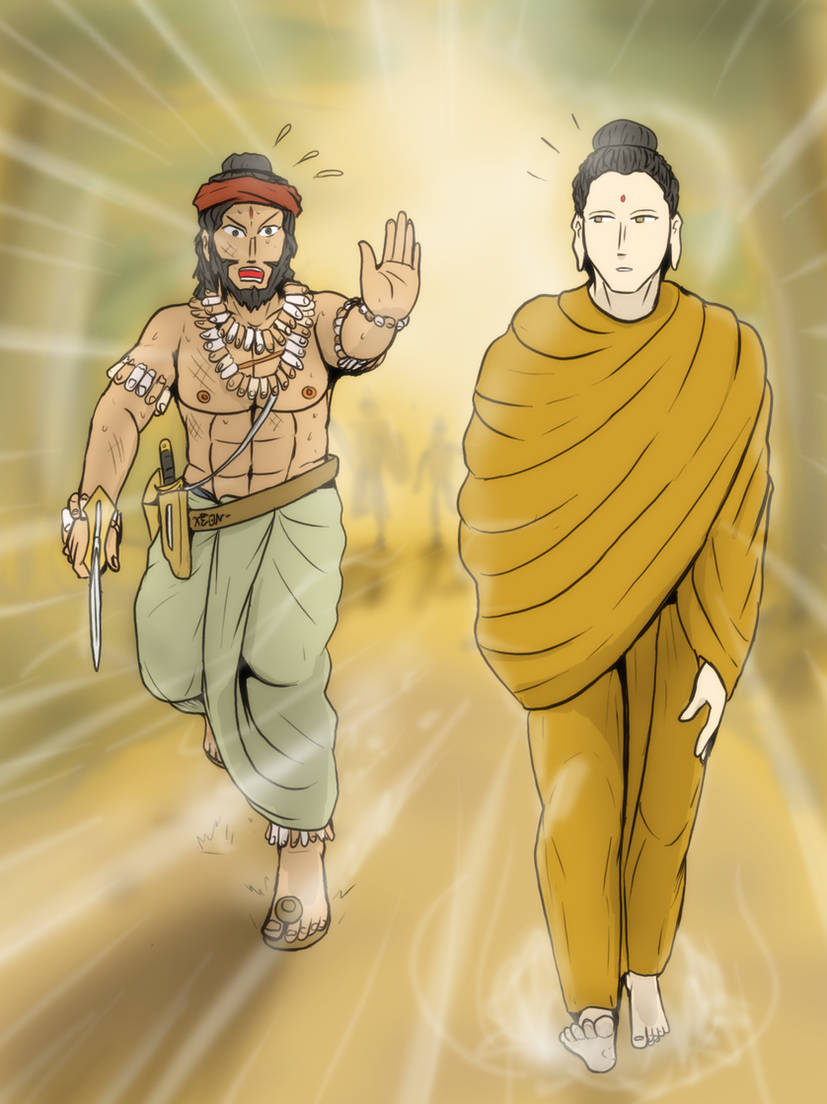
Image by VachalenXEON

The Buddha gained enlightenment under the Bodhi Tree in north-east India, and established a community of followers, many of them monks and nuns who lived a homeless life, meditating, and wandering to teach the basics of Buddhism to whoever they met.

One day the Buddha himself, walking alone, was travelling through the kingdom of Kosala, through the villages on the fringe of a huge dense jungle. One track led through the centre of the jungle, into the neighbouring kingdom of Magadha. As the Buddha started down that road, people came out of their houses. Stop, stop, don’t go down there, O holy man. Nobody who goes down that path into the jungle ever returns. But the Buddha ignored them and continued. In the next village the locals were even more decisive: stop, stop O holy man, don’t go down that track, anyone who goes down into the jungle is sure to be murdered! But the Buddha ignored them and continued. As he came to the edge of the jungle, there were no people, the towns and villages were completely depopulated. But there was one old man in a hut under the trees. He said to the Buddha: stop, stop O holy man, don’t go into the jungle, there lives the murderous bandit Angulimala, he will not let you live.

So the Buddha asked the old man who is this Angulimala, how come he is so dangerous? And the old man told him the story of the most feared bandit in the whole of India.

Angulimala was of the Brahmin caste. He longed for wealth, he longed for pleasure, but most of all he longed for power. He was bullied and looked down on by his fellows, he wished he could get his revenge. His mother said – if you want to be an influential and powerful man, you must go and study with the old priest who lives on that hill. He knows all the Mystic secrets. So Angulimala enrolled in his classes. He learnt the power of speech and how to manipulate others with your words. He learnt the magic spells – the rite of fascination, the rite of destruction. He learnt martial arts and swordsmanship, he became stronger and stronger, so none of the others in the class could withstand him.

The old priest’s young wife gazed on Angulimala, Angulimala gazed on the young woman. But the priest saw. The priest decided that Angulimala was far too dangerous to have in his household. So he devised a plan. He said to Angulimala: do you want power? Do you want influence? Do you want control over others? Yes, said Angulimala I desire these things more than anything in the world. The priest said: who then is the most powerful person? Angulimala replied: I guess O master it is you. No, said the priest, there is one far more powerful than I. Angulimala said: then you must mean the great King Pasenadi with his vast army, never conquered. The priest said, no, there is one far more powerful even than King Pasenadi. Who is that? Said Angulimala. the priest replied: it is God himself. The great Brahma, ruler of the world, feared by gods as well as men is the most powerful being. Yet you can become that being! Would you like that? Yes, said Angulimala but surely that is not possible. The priest said this is the auspicious time, it is the only time when a human being can become Brahma. But it is a very hard path to follow. In order to become Brahma, by the next new moon, with your own hand, you must kill 100 people, no more no less and no later than the new moon. Then you will become the great God Brahma.

The priest’s plan worked, Angulimala set off to find his victims, and the priest knew that he could not possibly survive such a murderous campaign, he would be rid of him forever!

Angulimala plunged into the depths of the great jungle, and haunted the only road that led through it, the track from the kingdom of Kosala to the kingdom of Magadha. A traveller came down the road, Angulimala drew his sword and sprung on the traveller, killing him swiftly. He dragged his body into the ditch, and lay in wait. Then a couple came down the track together, both were soon dispatched, Angulimala dragged them into the ditch. That’s three, he thought. But how do I ensure I kill exactly 100 people? So he cut off the right thumbs of his first three victims, and hung them up in a tree by his lair where he slept each night. The next morning, he found that crows had nibbled the flesh from the thumbs that he hung in the tree, so he threaded them together on a leather thong, and wore them round his neck. That was how he got his name – Angulimala means a necklace of thumbs.

The next day a merchant’s party came through the jungle, 16 people became his victims, but two got away, and spread the news to the surrounding villages of the dangerous bandit. Parties came now with armed guards, but Angulimala’s skill was too good for them, he would spring unexpectedly from the branch of a tree, dispatch the guards, and then kill the members of the party. So all the local people near the jungle, left their houses, their villages, even their towns, and fled the area in fear of the great bandit. Still he found victims, and at last around his neck on the thong there were 99 thumbs. He just needed one more victim, and then, he knew, he would become the most powerful being in the universe, the great God Brahma. But he only had a few hours until the new moon’s little silver Crescent, would appear in the sky. And nobody was coming into the jungle!

Meanwhile, King Pasenadi, he with the vast army, had at last heard about the serial killer plaguing the jungle in his land. He knew that a small party of soldiers would not be enough, he decided to send his army into the jungle to root out Angulimala and bring him to justice. Angulimala’s mother heard the news of the great armed expedition against her son, she thought: I must warn him, he has no chance against the army. She ran into the forest.

Angulimala sat in hiding above the track, hoping that someone would come, when he saw a little figure scurrying along the track towards him. At last, my hundredth victim, all my dreams will come true, he thought. He leapt down and grabbed the frail woman passing along the track. It was his mother! What was he to do? She said Angulimala my son, you must flee! The king’s army is on its way he looked into the sky and he saw that soon the new moon would rise. There is only one thing for it I must kill my own mother for the 100th thumb. She saw what he was planning, and fell sobbing to the ground. But at that moment, another figure appeared coming down the track. Who was that? It was a wandering holy man. It was The Buddha! Walking peacefully, unhurriedly, steadily with no trace of fear straight towards Angulimala. He was so surprised that he let the Buddha pass, but he thought thank goodness I will not have to face the terrible sin of killing my own mother. I will take this holy man, he will give me my hundredth thumb.

So Angulimala left his mother, drew his sword and raced down the track after the Buddha. But something extraordinary happened. Despite his speed and athleticism, he drew no closer to the Buddha. He ran faster, he ran as fast as he could, but the Buddha stayed exactly the same distance in front, though the Buddha was simply walking at a steady pace. Angulimala was exhausted he couldn’t work out what was happening, and at last he stood stock still, and shouted at the top of his voice O holy man, stop stop stop. The Buddha continued walking, but looked over his shoulder and said this:

O Angulimala I have stopped it is you who have not stopped.

Angulimala was puzzled – these holy men were known never to lie, yet this man was moving down the track saying he had stopped, Angulimala was frozen to the spot in bewilderment, yet he was told he had not stopped. What do you mean what you mean, he shouted to the Buddha, and the Buddha turned round and approached him, and said quietly I have stopped. I have given up chasing after selfish desires. I’ve stopped blaming others for my own misfortunes. I’ve stopped resenting the success of other people. I’ve stopped fooling myself with false views. But you, Angulimala, are swirling around and around on the endless wheel of life, like one caught in a whirlpool. Your mind is whirling, your desperation is sweeping you as if over a waterfall. Angulimala was totally shocked. The Buddha was looking at him with compassion in his eyes, and not the slightest trace of fear. Angulimala was silent for some minutes. Neither man said anything. Then Angulimala fell to his knees, and said teach me how to stop, please teach me how to stop.

So the Buddha took Angulimala back to the local Monastery, and asked the monks there to shave his head, give him the ochre cloak to wear, and make him a Buddhist monk.

Angulimala took the precepts of nonviolence, ahimsakha. Angulimala did the meditations on lovingkindness.

Angulimala lived on gifts of leftover food provided by the local people. And he went into the town on his alms round, with his begging bowl walking mindfully from door to door, but soon somebody recognised him – that is Angulimala the bandit, and everybody fled in terror. And Angulimala returned to the monastery with an empty bowl. The next morning he went out again, this time the locals had discussed the case, and realised that he had no weapon, he was now dressed as a monk, he could not harm them. So they plucked up courage, they threw clods of earth at him, they yelled obscenities and imprecations at him, they threw stones; and he limped back to the Monastery with no food in his broken bowl, his cloak in rags, and blood streaming down from a nasty cut on his head.

The Buddha saw him: bear it monk, bear it monk. You are now reaping the fruits of your karma. Your violent action leaves you in a violent world.

At last Angulimala was able to travel safely into the town to beg his alms. One day as he was passing a house he heard a woman screaming in anguish inside. He asked what was the matter – she was pregnant, and in danger of a breach birth. She was in agony, and her baby was unlikely to survive. The doctors could not help her. Angulimala rushed back to the Monastery and asked the Buddha: what can I do, is there any way I can help her? The Buddha said only one thing will save this woman’s life. That is a declaration of utter truth. It has to be the deepest truth that she hears, then her baby will be born safely. You must say to her “I utter this truth, that since the day I was born, I have never harmed any living being.” Angulimala said: but I have killed 99 people, how can I possibly say I have harmed no one? The Buddha said: that, Angulimala, was a different person. Since then you’ve had a new birth, a birth as Ahimsakha, the man without violence. You can make that statement truthfully. Angulimala went straight back to the woman’s house, “I utter this sacred truth, that since the day I was born, I have never harmed any living being.” The baby was delivered safely, and the mother’s pain was gone. A man with a necklace of thumbs had changed his name. He had changed his nature, he had become Ahimsakha, the man without violence. And before long he became one of the awakened ones.

Science and Buddhism VIII: Conclusion

Science and Buddhism are distinct.  They have their own projects, they have their own attitudes.  I’d love to see them influencing each other in the future.  They agree in many ways — they are both trying to see clearly the way things connect together, what patterns there are in life and the world.  Scientists notice, like Buddhists, that nothing is fixed or isolated — everything is involved in a dance of mutual interaction. They agree with Buddhists that the so-called Self is a convenient fiction — there are just mental processes.  Scientists are very aware that perception is vulnerable to illusion and delusion, and that we need other ways to find out what’s going on, because our senses are not reliable.  And as for God, 200 years ago, the French astronomer Pierre Laplace said: ‘I have no need of that hypothesis’.  

Both Buddhism and science are aware of an enormous, vast universe, probably with many inhabited places at inconceivable distances from each other, but with the same laws applying everywhere.  Science also agrees with Buddhism that animals are basically like us, and that we can find animal drives pushing us along from deep within.  There are even some very mysterious parallels between Buddhist understandings and the way that science understands the whole of the cosmos, and quantum mechanics.

At its best, science is very cautious, taking nothing on trust, wanting everything to be checked in experience, and double checked by others as well.  I feel that Buddhism adopts the same approach.

I would love to see Buddhism having more influence here in the West, and to do so, I think it needs to take the West’s greatest achievement — science — very seriously.  It can ask Science for help: science can help the Buddhist project in its specialities — the first two niyaamas, the inorganic and the organic.  In the third order, the citta niyaama, the techniques of science can greatly contribute to the understanding of the mind. Buddhism has the project of alleviating suffering — science can help greatly with this, through medical and technological advances.

But I think that Buddhism can return the favour — it can help science in many ways.  Its global vision of reality can help provide a more effective philosophical standpoint for science; it has an experimental technique, as it were, for intuitively grasping the way that phenomena fit together. Thus through Buddhist wisdom the meaning and the significance of our experience can become more apparent.  We need that technique — contemplation of one’s experience within a quite space of meditation — to simplify the tangle of conditions, and to make them less misted over by our own hopes and fears and needs.  So I sense that Buddhism, neuroscience and psychology can work cooperatively together to gain a deeper sense of the way that the mind works.  Finally, Buddhism can help science through its realisation that the way that one lives — ethics — affects one’s ability to be realistic about one’s experience.  Science does not at present have a trustworthy source of ethics, and if scientists do not know how to be ethical, we cannot trust them to be basically benevolent.  I think that Buddhism can help with this.

Imagine how the Buddha might have responded if he had encountered modern science.  He might have said: “these scientists are suffering — they need the Dharma.  Their work is often undirected and clumsy, and gives rise to unforeseen sufferings, sometimes even deliberate sufferings.  Help them encounter the Dharma, help them see its relevance first to them, and then to their work”.

I think that the universes of science and Buddhism can merge — perhaps they will merge — in a more comprehensive worldview for the centuries to come — a worldview that draws on the creative geniuses of millions of men and women who have contributed to the cultures of the East and the West — but also a worldview that tackles conflict and poverty far more effectively than we seem to be doing at the moment. 

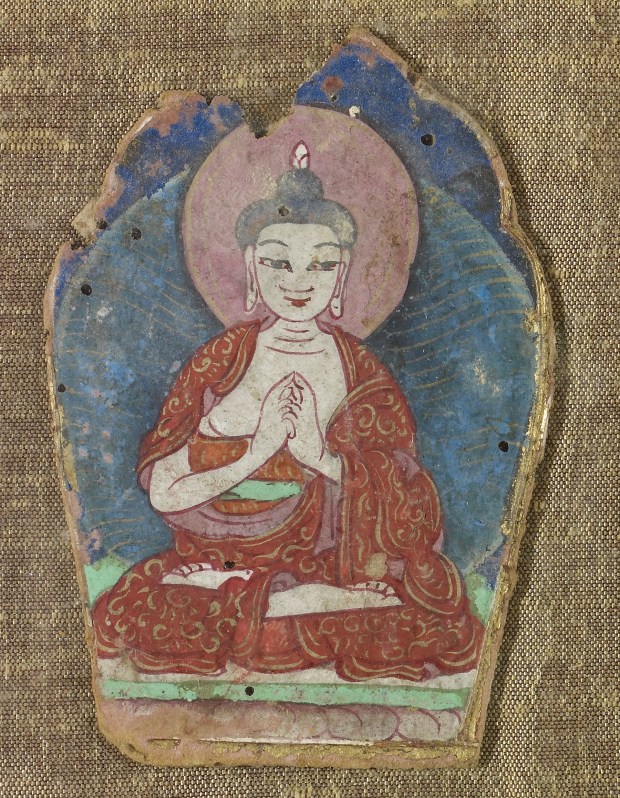
Image is Vairocana, from the Walters Art Museum

    The story of Dharma Day: The Buddha starts to teach

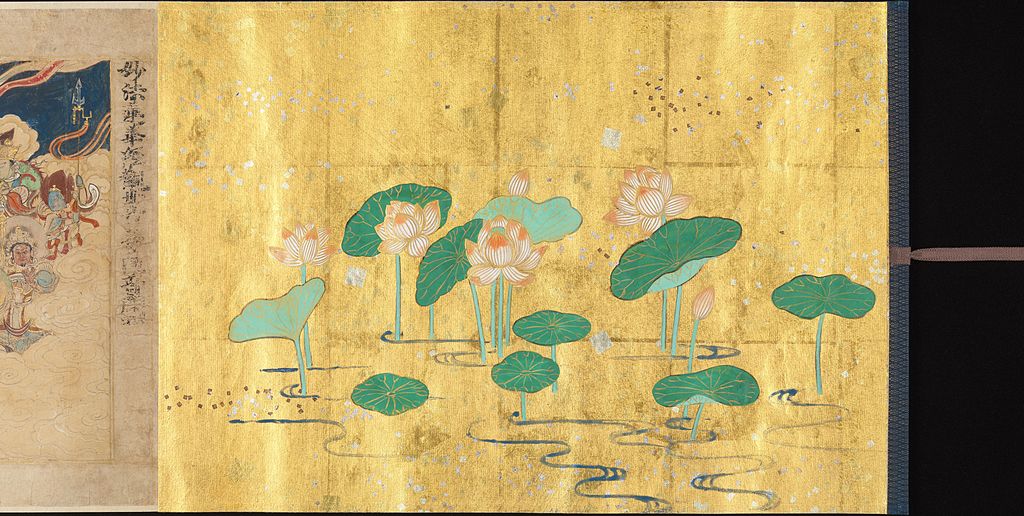
    Lotus pond

    Sugawara Mitsushige (1257) (Metropolitan Museum of Art), via Wikimedia Commons

    The Buddha’s decision to teach

    THE BUDDHA:

    [After my enlightenment,] I thought, ‘This Dharma that I have attained is deep, hard to see or realize, it is the highest, most peaceful goal of all. It’s beyond the scope of conjecture, subtle, to be experienced by the wise. But this generation delights in attachment, is excited by attachment and indulges in attachment. It’s hard for the people of this generation to see the truth of dependent arising. It’s hard for people to see the truth of stopping the karma formations, letting go, finishing craving, the fading of addictions, nirvana itself. If I taught, they would not understand me.

    Just then these verses … occurred to me:

    Enough now with teaching
    what, only with difficulty,
    I reached.

    This Dharma is not easily realised
    by those overcome
    with aversion & craving.

    What is abstruse, subtle,
    deep,
    hard to see,
    going against the flow —
    those delighting in craving,
    cloaked in darkness —
    they won’t [be able to] see it.’

    As I reflected like this, my mind inclined to dwelling in comfort, and not to teaching the Dharma.

    Then Sahampati, [a dweller in the sublime Brahma heavens] … thought to himself:

    SAHAMPATI

    ‘The world is lost! The world is utterly lost! The mind of the fully awakened one inclines to [his own comfort], not to teaching the Dharma!’

    THE BUDDHA

    Then, just as a strong man might extend his arm …, Sahampati disappeared from his Brahma-world and reappeared in front of me. He … saluted me with his hands before his heart:

    SAHAMPATI

    ‘Sir, let the abundant one teach the Dharma! Let the One-well-gone teach the Dharma! There are beings with little dust in their eyes who are wasting away because they cannot hear the Dharma. There will be those who will understand the Dharma!’ …

    ‘Throw open the door to the Deathless!
    Let them hear the Dharma
    realized by the Stainless One!

    Just as one standing on a rocky crag
    might see people
    all around below,

    So, O wise one, with panoramic vision,
    ascend the tower
    fashioned of truth.

    Free from sorrow, look at the people
    submerged in sorrow,
    oppressed by birth & aging.

    Rise up, hero, victor in battle!
    O Teacher, travel without debt in the world.

    Teach the Dharma, O Abundant one:
    There will be those who will understand!’

    THE BUDDHA

    Then, having listened to Sahampati’s invitation, out of compassion for beings, I surveyed the world with an enlightened eye. As I did so, I saw beings with little dust in their eyes and those with much, those with keen faculties and those with dull, those with good qualities and those with bad, those easy to teach and those hard…. Just as in a pond of blue or red or white lotuses, some lotuses — born and growing in the water — might flourish while immersed in the water, without rising up from the water; some might stand at the surface of the water; while some might rise up from the water and stand without being wetted by the water — so too, surveying the world with an enlightened eye, I saw [the range of beings].

    Having seen this, I answered Sahampati:

    ‘Open are the doors of the Deathless
    To those who can hear.

    Let them show their confidence.

    O Sahampati,
    If I [had thought I would not tell people]
    the refined,
    sublime Dharma,
    It was because it seemed too troublesome to me.’

    Then Sahampati realised,

    SAHAMPATI

    ‘The Abundant one has decided to teach the Dharma.’

    THE BUDDHA

    He bowed to me, and disappeared.

    The Buddha’s attempts to teach

    THE BUDDHA

    Then I thought, ‘To whom should I teach the Dharma first? Who will quickly understand this Dharma?’

    I thought of [my former teachers], but they had passed away…

    Then I thought: ‘The group of five [friends] who attended to me when I was practising fasting and self-denial, they were very helpful to me. [Now they are] staying near Benares, in the Game Park at Isipatana. What if I were to teach them the Dharma first?’

    Then, having stayed at Bodhgaya as long as I wished, I set out to walk [the long road] to Benares.

    Upaka the sectarian met me on the road between the (place of) awakening and Gaya village, and he said to me,

    UPAKA

    ‘Clear, my friend, are your faculties. Pure your complexion, and bright.

    What made you go forth? Who’s your teacher? In whose Dharma do you delight?’

    THE BUDDHA

    ‘All-vanquishing,
    all-knowing am I,
    with regard to all things,
    unattached.

    All-abandoning,
    freed by ending craving:
    having fully known this on my own,
    whom should I regard as my teacher?

    I have no teacher,
    and one like me can’t be found.
    I have no counterpart in the world with its gods.

    For I am a worthy one in the world;
    an unexcelled teacher.

    I, alone, am fully awakened.
    Cooled am I,             unbound.

    I’m going to Benares
    To set rolling the wheel of the Dharma.

    In a blindfolded world,
    I’ll beat the drum of the Deathless.’

    UPAKA

    ‘From your claims, my friend, you must be a Jina, a universal conqueror.’

    THE BUDDHA

    ‘Conquerors are those like me
    who have reached fermentations’ end.
    I’ve conquered evil qualities,
    and so, [yes], Upaka, I’m a conqueror.’

    UPAKA

    ‘May it be so, my friend,’

    THE BUDDHA

    And — shaking his head and taking a side-road — he left.

    Then, walking in stages, I arrived at Benares, at the Game Park in Isipatana, where the group of five friends were staying. They saw me coming from some way off, and made a pact with one another.

    THE FIVE

    ‘Friends, here comes Gotama the contemplative. [He has given up] our struggle [of self-denial], living luxuriously, straying from his exertion, backsliding into abundance. He doesn’t deserve our bows, or even for us to stand up to greet him. Still, if he wants to, he can sit down with us.’

    THE BUDDHA

    But as I approached, they were unable to keep to their pact. One stood up to greet me, another got me a seat. Another got some water for washing my feet. However, they [still] addressed me as ‘Gotama’ and as ‘friend.’

    So I said to them, ‘Please don’t address the Tathagata, the Thus-gone one, by name and as ‘friend.’ The Tathagata, friends, is a worthy one, fully awakened. Lend ear, friends: the Deathless has been attained. I will instruct you. I will teach you the Dharma. Practising as instructed, you will in no long time reach & remain in the supreme goal of the spiritual life, … knowing & realizing it for yourselves in the here & now.’

    THE FIVE

    ‘You did not attain any superior human states by practising hardship and deprivation, nor any special knowledge & vision worthy of a noble one. So how can you have done so now — living luxuriously, straying from your exertion, backsliding into abundance?’

    THE BUDDHA

    ‘The Tathagata is not living luxuriously, has not strayed from his exertion, has not slid back into abundance. The Tathagata, friends, is a worthy one, fully awakened. [And twice more I repeated my offer to teach them.]’

    [They still doubted, so] I said to the group of five, ‘Do you recall my ever having spoken in this way before?’

    THE FIVE

    ‘No, sir.’

    THE BUDDHA

    ‘The Tathagata, monks, is not living luxuriously, has not strayed from his exertion, has not slid back into abundance. The Tathagata, friends, is a worthy one, fully awakened. Listen, friends: the Deathless has been attained. I will instruct you. I will teach you the Dharma. If you practice as instructed, before long you will reach the supreme goal of the spiritual life and remain there…, knowing & realizing it for yourselves in the here & now.’

    And so I was able to convince them. I would teach two while three went to get food, and we six lived off what the three brought back from their alms round. Then I would teach three of them while two went for food, and we six lived off what the two brought back from their alms round. Then the group of five — thus exhorted and instructed by me — being themselves subject to birth, seeing the drawbacks of birth, seeking the unborn, unexcelled security from oppression, nirvana, reached nirvana. Being subject themselves to aging, illness, death, sorrow and defilement, seeing the drawbacks of aging, illness, death, sorrow and defilement, seeking the aging-less, illness-less, deathless, sorrow-less, undefiled, unexcelled security from oppression, nirvana, they reached nirvana. Complete knowledge & vision arose in them, their liberation was unshakeable, and from the rounds of rebirth they were completely free.

    From the Noble Quest Sutta, Majjhima Nikaya number 26.

    (Edited and adapted for reading aloud by Ratnaprabha from the translation by Thanissaro (1), referring to translations by Bhikkhu Bodhi (2) and Nanamoli (3).)

    Sources

    1. http://www.accesstoinsight.org/tipitaka/mn/mn.026.than.html .
    2. http://www.wisdompubs.org/book/middle-length-discourses-buddha/selections/middle-length-discourses-26-ariyapariyesana-sutta
    3. Ñāṇamoli Bhikkhu, The Life of the Buddha (Buddhist Publication Society, 1972)

    Lotus Sutra: the Image of the Plants

    The Image of the Plants

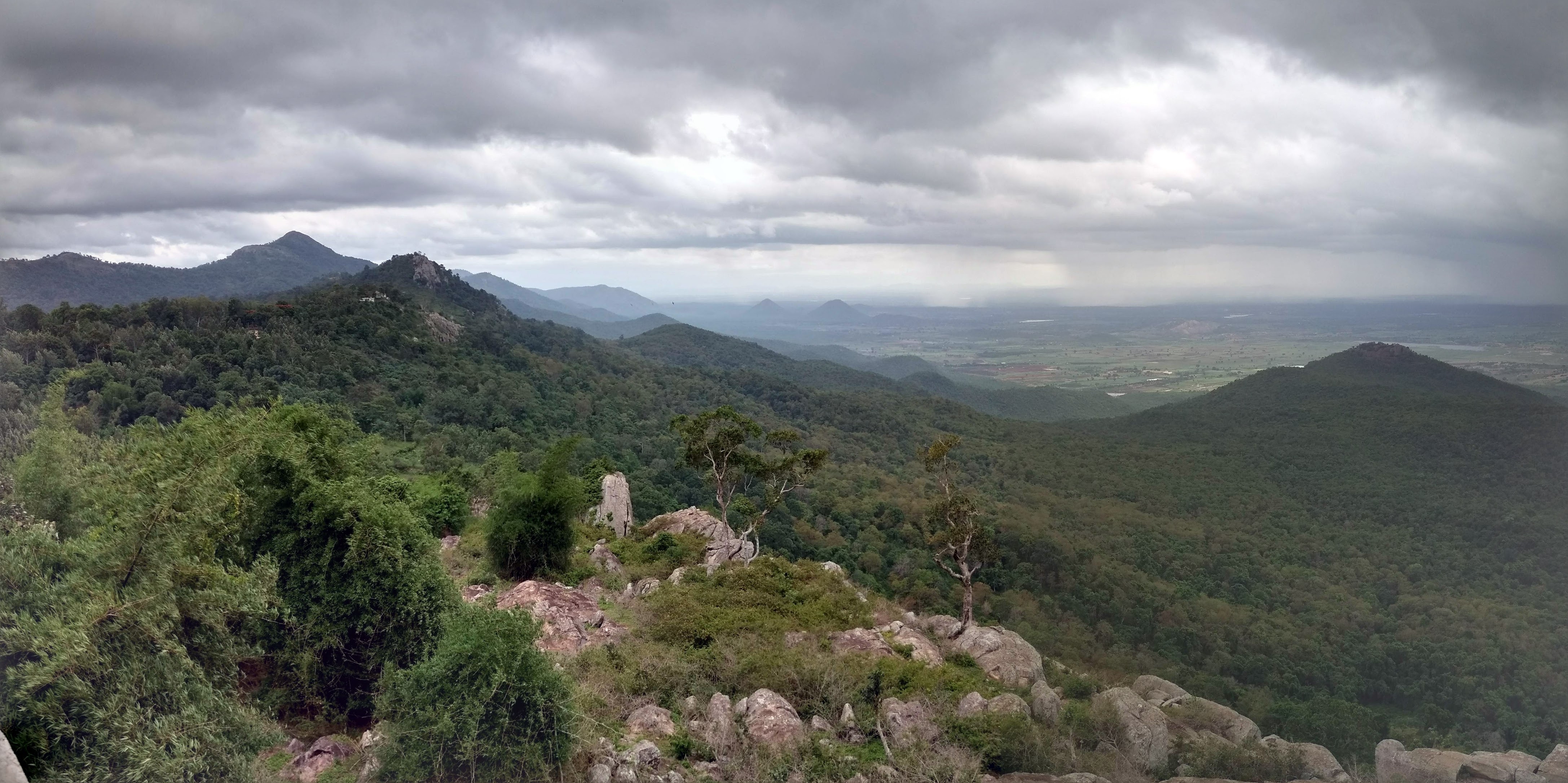
    Monsoon over Biligirirangans, India. (Shyamal – Own work, CC BY-SA 3.0)

    From the White Lotus of the Wonderful Dharma Sutra, Chapter 5.
    Abridged and adapted by Ratnaprabha for reading aloud.
    Based on the translations by Kato et al and Reeves, sub-headings not in the original.

    The Buddha adapts the Dharma according to his listeners

    The Buddha, the Dharma-king,
    Smashing ideas of being,
    Appears in this world.

    According to the needs of all beings,
    He teaches the Dharma in varied ways.

    The Buddha teaches people
    According to their strengths,
    With various explanations
    To bring them to helpful views.

    The Buddha is like a thunder cloud

    The Buddha is like a great cloud
    Rising above the [parched] world,
    Covering everything everywhere.

    A beneficent cloud full of moisture,
    Bringing gladness and ease to all,
    Where flashes of lightning shine and glint,
    And the voice of thunder vibrates afar.

    The [hot] sun’s rays are veiled,
    And the earth is cooled;
    The cloud lowers and spreads
    As if it might be caught and gathered.

    [Then] its rain everywhere equally
    Descends on all sides,
    Streaming and pouring without stint,
    Enriching all the land.

    His hearers are like plants in need of the rain

    On mountains, by rivers, in steep valleys,
    In hidden places, there grow
    The plants, trees, and herbs.

    Trees, big or small,
    The shoots of all the ripening grain,
    Sugar cane and grapevine,

    All these are fertilised by the rain,
    And abundantly enriched.
    The dry ground is all soaked,
    And herbs and trees flourish together.

    From the same water which issued from that cloud,
    Plants, trees, thickets and forests,
    According to their need, receive moisture.

    All the [plants],
    Each according to its scale,
    Can grow and develop.

    Roots, stalks, branches, and leaves,
    Blossoms and fruits in their brilliant colours,
    By the pouring of the one rain,
    All become fresh and glossy.

    Just as their forms and capacities
    Are some great and some small,
    So the enriching [rain], though one and the same,
    Enables each to flourish.

    The Buddha proclaims his impartial intent

    The Buddha is like this.
    He appears in the world,
    Like a great [monsoon]-cloud
    Universally covering all things;

    And having appeared in the world,
    He, for the sake of all living beings,
    Teaches in varying ways
    The reality of all things.

    The great World-honoured One
    To human and heavenly beings,
    And to all the other beings,
    Declares this:

    “I am the Tathagata,
    Honoured by people;
    I appear in the world
    Just like a great rain cloud,
    To pour enrichment on all parched living beings,

    “To free them all from suffering
    And so attain the joy of peace,
    Joy in this world,
    And the joy of nirvana.

    “Humans and heavenly beings and all!
    Give me your full attention,
    Gather around
    And behold the Buddha.

    “For the hosts of the living
    I teach the Dharma, pure as sweet dew:
    The Dharma with one taste
    Of freedom and nirvana.

    “With one wonderful voice
    I explain this meaning,
    Constantly taking the great way
    As my subject.

    “I look upon all [living beings]
    Everywhere [with] equal [eyes],
    Without favouring anyone,
    With no mind of love or hate.

    “I have no preferences
    Nor limitations [or partiality];
    At all times to all [beings]
    I teach the Dharma equally;

    “As I would to one person,
    So [I teach] to all.
    Constantly I proclaim the Dharma,
    Never occupied with anything else.

    “Going or coming, sitting or standing,
    I never weary or get downhearted,
    Pouring it abundantly upon the world,
    Like the rain, enriching everywhere.

    “Eminent and humble, high and low,
    Those who keep the precepts and those who break them,
    Those of admirable character
    And those of imperfect character,

    “With right views or wrong views,
    Quick-witted and dull-witted,
    [With] equal [mind] I rain the rain of the Dharma,
    Neglecting no one.”

    Summing up

    So the Buddha’s unbiased teaching
    Is like the one rain.

    [But] beings, according to their capacities,
    Receive it differently,
    Just as the plants and trees
    Each take a varying supply.

    The Buddha by this [image]
    Skilfully reveals [his methods],
    And with various expressions
    He proclaims the one single Dharma,

    The one essential Dharma,
    To be practised according to ability,
    Just as those thickets, forests, herbs, and trees,
    True to their type, grow lush and beautiful.

    Just so,
    Practising it step-by-step,
    All can gain the fruit of the way.

    The Dharma taught by the Buddha is like this.
    It is just like a great cloud
    Which with the same kind of rain
    Enriches humans like blossoms,
    So that each will bear fruit.

    The way in which you all walk
    Is the Bodhisattva-way;
    By gradually practising and learning,
    You will all become Buddhas.

    TURNING THE WHEEL OF DHARMA

    The Buddha’s first teaching

    Image: John Hill

    Today, 8 June 2017,  is the full moon of Dharma Day, the anniversary of the Buddha’s first teaching, known as Turning the Wheel of Dharma.

    Here is my Re-rendering of the Dhammacakkappavattana Sutta (Ratnaprabha, June 2017)

    This is what I heard. (After his awakening), the Buddha arrived at the game reserve near Varanasi, (and was reunited with his five former comrades).

    He taught the group of five. He said to them: “Going forth (to seek awakening), you must avoid two extremes.

    “Looking for gratification in sense pleasures is demeaning, crude and ignoble. It’s what people always go for, but it’s pointless, and it takes you nowhere near the goal.

    “Yet self-torment is also ignoble and pointless, and (it commits you to needless) suffering.

    “Instead of veering towards one of these extremes, (if you’re) attuned to reality, you will wake up to the middle path. It yields vision so that you truly know. It leads to peace, to complete awareness, to quenching (the flames) and waking yourself up fully.

    “Speaking simply, the middle path has eight aspects. These are complete vision, complete emotion, complete communication, complete action, complete livelihood, complete effort, complete mindfulness, and complete unification (of the mind). When I attuned myself to reality, I woke up to this path.

    “Furthermore, (I woke up to four noble truths). Firstly, this is the noble truth, the grand reality, of pain. Birth, ageing and illness are painful. Death is horrible. (Then you’ll encounter) depression, grief and physical agony; unhappiness and despair as well, and losing what you love, and not getting what you want. In fact all the aspects of life that we cling to are painful.

    “This is the noble truth, the grand reality (that explains) where pain comes from. It comes from thirst, from craving. It is craving that impels us to remake ourselves so that we are still conjoined with gratification and clinging, indulging in one thing after another. (More specifically), it is craving for sense-gratification, craving for continuing (as we are), or craving for oblivion.

    “This is the noble truth, the grand reality, of the finish of pain. It is the fading and finishing of that same craving, giving it up, letting it go, not depending on it any more, so that we are completely free from craving.

    “This is the noble truth, the grand reality of the way that finishes pain. It is the same middle path (that avoids the extremes) – complete vision and so on.

    “When I fully woke up, I saw this for the first time. A fresh insight, wisdom and awareness, indeed a complete illumination, dawned on me. I truly saw pain as a grand reality, I saw I had to understand it, and (eventually) I did.

    “Similarly, I truly saw, as a grand reality, how pain comes from craving. I saw I had to let go of that craving, and I managed to do that.

    “And I truly saw the grand reality of (the possibility of) pain finishing (for good). I knew I had to realise that finish directly, and I did realise it.

    And I truly saw the grand reality of the middle way that frees one from pain, I saw that I had to journey on that way, and I travelled it to the end.

    “It was these crucial insights that enabled me to perfect my full and complete awakening. This is an awakening that completes the journey, (a journey open to) all forms of life in the universe. I saw, and I realised: unshakeable is the liberation of my mind, I’m no longer compelled to re-make myself, this is it.”

    The group of five listened enraptured to the Buddha. And as he listened, one of them, Kondañña, saw the truth clearly and lucidly, and realised that all that comes into being must also finish. “Kondañña knows!” Exclaimed the Buddha, “Kondañña knows!”

    This, in the game reserve near Varanasi, was the (first) rolling of the Wheel of Dharma by the Buddha. The earth spirits yelled with all their might: “THE SUPREME WHEEL OF THE BUDDHA’S DHARMA IS NOW TURNING, AND NO ONE CAN STOP IT!” And the cheer went up through the ranks of invisible beings up to the (formless) world of pure spirit, so that the whole world trembled, and an incandescent light spread from horizon to horizon.

    Brackets signify words added for clarification. Some repetitions have been removed. This re-rendering is interpretive, and other interpretations are possible; it is well worth looking through several translations.

    Are scientific laws permanent?

    ‘All things are impermanent’: what about scientific laws?

    IDL TIFF file

    Saturn

    Impermanence is fundamental to Buddhism. It is even “Buddhism in One Word” (Sangharakshita).  The locus classicus for this particular doctrine could be seen as being a verse of the Dhammapada (a collection of sayings ascribed to the Buddha, which are very likely to be very close to his original teachings), which runs:

    277  sabbe sankhaaraa anichchaa ti yadaa paññaaya passati
    atha nibbindati dukkhe esa maggo visuddhiyaa.

    All processes are impermanent. When one sees this with understanding, then one is disillusioned with the things of suffering. This is the Path of Purification. (John Richards translation)

    So what is being stated as being impermanent is all processes — the Pali word being sankhara (the transliteration doubles the a’s to show they are the long form), or Sanskrit samskara.  It pointedly does not say, “all dharmas are impermanent”, but two verses later, it does say, “all dharmas are insubstantial (anatta)”.  Dharmas here probably means anything that can be an object of cognition, whether it is what we see as a physical thing, or an idea, or an attribute etc. I think it would be best to see a physical law as a dharma, but not a samskara (though a philologist friend who read an earlier draft disputes this).

    Verse 5 of the Dhammapada says:

    Occasions of hatred are certainly never settled by hatred. They are settled by freedom from hatred. This is the eternal law

    So here a psychological law is being stated as not being impermanent.  (Eternal law translates dhammo sanantano – ‘an eternal or age-old dharma’.)  Why should the same not be the case with the physical laws of the universe? However, it is possible that they are contingent in some way: the cosmologist Lee Smolin speculates that new universes are constantly being spawned within black holes, each new universe having slightly different physical laws from its parent universe. (The Life of the Cosmos.)

    But Buddhists might differ from many scientists, in particular those who think that there will eventually be a final theory of everything, in that they would count physical laws as dharmas, and so would assert that they are insubstantial.  In other words, a law has no independent existence of its own.  It is simply an ordered description of the way phenomena behave — how they influence each other, how they arise and pass away etc. and another type of intelligence might use a different set of laws to describe the same phenomena, though it would in principle be possible to cross-reference the two sets, and show how they are consistent with each other.  It is an object of the conscious mind.

    I wonder whether the regularity of scientific experimentation allows one to suspect that some physical laws would always be conceptually patterned in the same way, if different observers at perhaps very different times in very different parts of the universe set up their observations in the same way? In that sense, the law could be unchanging.

    What is impermanent?  In the Buddhist tradition, very little is left out of the rather loose term ‘samskara’.  It is most importantly used for people’s mental states, habits, characters etc — in other words, it is encouraging you to feel that you are not stuck in any form of life, or any personal tendency.

    This doctrine would assert that there can be no entity in the universe that was free from influence and thus change, similarly, no form of existence or realm, no physical object etc.  ( I am taking it as read that such entities are mind objects, though in this context they are mind objects within scientific discourse, which is very careful to specify them in ways that ensures they can be investigated coherently by many people using a variety of well defined observation methods.) But how would this apply to certain subatomic particles which are regarded as being completely stable?  Could one say that a proton(1) is a permanent entity?

    It may be that it is illegitimate to apply Buddhist insights to the scientific sphere. I hope not, I suspect that the meeting of the two ways of looking at human life could be stimulating and fruitful. Scientific findings are very robust, and could clarify the worldview of Buddhists in many ways. Buddhists could also help scientists, for example by offering cogent alternatives to the view that it is primarily the human brain that gives rise to human awareness, and that there is an absolutely real, dead universe, lacking in awareness, which is ultimately separate from the processes of awareness. More importantly, it can suggest a non-religious ethical framework for scientists, some of whom have little in the way of ethics apart from the pressure of public opinion.

    _______________

    (1) I had originally written ‘neutron’, a bit of a howler as a free neutron has a half life of less than 15 minutes. Free protons have never been seen decaying so far, so may be very long lasting, perhaps ‘permanent’, though protons within nuclei can transform to neutrons by beta decay, and a proton would lose its identity if it fell into a black hole.

    Did the Buddha Ban Drinking? Alcohol, Addiction and Mindfulness

    The fifth precept

    A pretty literal rendering would be: I undertake the footstep of training to abstain from:  beer, wine and intoxicants which cause carelessness.

    In Pali: Surā-meraya-majja-pamāda-ṭṭhānā veramaṇī-sikkhāpadaṃ samādiyāmi.

    The positive form as used in Triratna is: With mindfulness clear and radiant, I purify my mind.[1]

    What does this precept imply?

    In the early days of Buddhism it could be undertaken strictly, as a one-day precept, and then it was recited like this;

    All enlightened ones, for as long as life lasts, have given up the taking of liquors and intoxicants, of that which intoxicates, causing carelessness. They are far from intoxicants.  All of you have given up the taking of liquors and intoxicants. You abstain from drink which causes carelessness. For all of this day and night, in this manner, you will be known as having followed the enlightened ones, and the [precepts] will have been observed by you. [2]

    Would it help to try not to use alcohol or other intoxicants at all?  The Buddha said: [3]

    A layman who has chosen to practice this Dhamma should not indulge in the drinking of intoxicants. [4] He should not drink them nor encourage others to do so; realizing that it leads to madness. [5]

    Through intoxication foolish people perform evil deeds and cause other heedless people to do likewise. He should avoid intoxication, this occasion for demerit, [6] which stupefies the mind, and is the pleasure of foolish people.

    The precepts are “footsteps of training” — to do with moving on in a natural way from where you are now. So it’s not really a question of either drinking or not drinking, but of shifting in a direction that means that you are doing fewer things that cause heedlessness, and doing more things that encourage mindfulness. If your practice is alive, you’re probably looking at all your addictions and intoxications, and working with them, changing them in helpful ways.

    Does it also help others?

    In [giving up intoxicants, the disciple of the noble ones] gives freedom from danger, from animosity, from oppression to limitless numbers of beings. [And so] he gains a share in limitless freedom from danger, freedom from animosity, and freedom from oppression. This is [a] great gift … And [it leads] to welfare & to happiness.[7]

    You are more likely to break all the other precepts if you are inebriated. So others are in less danger from you if you remain sober. But perhaps more important nowadays is the freedom not to drink that you can grant others, who may have a serious drink problem, by not yourself not joining in social drinking.

    Addiction

    Addiction comes from wanting to repeat pleasures or palliatives until they become excessive.  Happiness does not come from pursuing pleasure, it seems to come from being fully engaged with life, and gradually breaking down the limitations on your awareness.

    You can tell whether or not you are addicted by whether or not you get distressing and uncomfortable symptoms when you stop using the intoxicant.   So whatever you enjoy, sometimes just try doing without it for a while, to experience yourself without your habitual props.

    Addiction also comes from wanting stimulants, to distract one from discomfort and unhappiness, and distract one from feelings of self-dislike.  A way of tackling destructive addictions is to enhance one’s feelings of self-worth.  The best way is from the genuine esteem and love of friends.

    The lesson is to offer love and esteem to others!

    Intoxication with health, youth, and life

    The Buddha describes that after seeing the four sights (examples of decrepitude, sickness and death, and of a seeker for truth), he reflected like this:

    Drunk with the intoxication of Youth, … Health,… [or] Life, an uninstructed, run-of-the-mill person engages in bodily misconduct, verbal misconduct, & mental misconduct. …  ‘Subject to birth, subject to aging, subject to death, run-of-the-mill people are repelled by those who suffer from [being subject to birth, ageing and death.] [He continues his reflection:] And if I were to be repelled by beings subject to these things, it would not be fitting for me…’ As I maintained this attitude — knowing the Dhamma without acquisitions — I overcame all intoxication with health, youth, & life as one who sees renunciation as rest. For me, energy arose, [Nirvana] was clearly seen.[8]

    Mindfulness

    It seems that originally Buddhist ethics emphasised only four precepts. The Buddha felt it necessary to add a precept about intoxication because he placed such an enormously high value on being conscious and aware, on being mindful. “Awareness is really precious and it is hard to come by”.[9] So the positive version of the precept is about mindfulness.

    • the mindfulness is clear; radiant
    • it is about being present;
    • not being forgetful (recollection[10]);
    • having a clarity of purpose, where you know what you’re doing and why you’re doing it;[11]
    • vigilance: having an awareness of your mental state, and whether it’s a good idea to act from that mental state or not;[12]
    • an awareness of the way your state of mind changes – noticing what’s coming up.[13]

    The Buddha’s analogy is that mindfulness is the bouncer of the mind.[14] It stands at the door, and some visitors it lets in, some it excludes. It is aware of the effect of the experiences and the stimuli that are trying to get into the club. Jostling at the door, are the intoxicants.  They range from specific substances such as alcohol to very general infatuations such as youth and health.

    You might consider your favoured intoxicants: what makes you less conscious? But also what makes you more conscious, face-to-face with life, what wakes you up?

    Did the Buddha ban drinking?

    Maybe some of the remarks I have made, and the quotations from the Pali Canon, could help you to decide how best to practise the fifth precept.  The Buddha was certainly stricter in his interpretation of the precept for those of his disciples who had forsaken home and family for a full-on life of practice, those we sometimes call the ‘monastics’.  Today, some Buddhists drink to excess, some drink, some don’t.  I had some mulled wine at a private view of paintings last week. Did it do me any harm? It did affect me. Would it have been a problem not to have it?

    Some questions for personal reflection

    • Is it generally worth the trouble to strive for mindfulness?
    • What are your ‘favourite’ intoxicants?
    • What effect do they have on you? Do they cause heedlessness?
    • What pleasures or benefits do you get from them?
    • Would you like to reduce your dependence on them and enjoy more awareness?
    • How could you do so?

    [1] https://thebuddhistcentre.com/system/files/groups/files/sevenfoldpuja.pdf

    [2] The eight lay precepts. http://www.accesstoinsight.org/tipitaka/an/an08/an08.041.vaka.html  The wording reflects Ñaravara Thera’s translation of the fifth precept.

    [3] Sutta Nipata, 400-401. Alternative translation by Jayarava, in an excellent essay on the fifth precept: The householder who finds pleasure in this Dhamma,/ Should not practice drinking alcohol;/ Should not cause any other good person to drink, /Knowing it leads to madness.

    Intoxicated, they foolishly do evil,/ And cause other negligent people to do likewise./ This occasion for disgrace should be avoided,/ This crazy, idiotic pleasure of fools. Dhammika Sutta. http://jayarava.blogspot.co.uk/2010/07/fifth-precept.html

    [4] majja

    [5] ummāda

    [6] pāpa

    [7] Abhisanda Sutta. http://www.accesstoinsight.org/tipitaka/an/an08/an08.039.than.html

    [8] Sukhamala Sutta. http://www.accesstoinsight.org/tipitaka/an/an03/an03.038.than.html

    [9] Jack Kornfield.  http://www.skepticfiles.org/mys3/action.htm

    [10] sati

    [11] sampajañña

    [12] appamada

    [13] appamada again.

    [14] Samyutta Nikaya IV 194

    Notes on right livelihood from Buddhist sources

    Right livelihood is ethical livelihood (the Buddha)

    1200px-Mancunian_Bees“And how is right view the forerunner? One discerns wrong livelihood as wrong livelihood, and right livelihood as right livelihood. And what is wrong livelihood? Scheming, persuading, hinting, belittling, & pursuing gain with gain. This is wrong livelihood…

    “One tries to abandon wrong livelihood & to enter into right livelihood: This is one’s right effort. One is mindful to abandon wrong livelihood & to enter & remain in right livelihood: This is one’s right mindfulness. Thus these three qualities — right view, right effort, & right mindfulness — run & circle around right livelihood.” (MN 117, Thanissaro trs)

    Monks, these five trades ought not to be plied by a lay-disciple… Trade in weapons, trade in human beings, trade in flesh, trade in spirits [intoxicants] and trade in poison. (Gradual Sayings, AN 5.177)

    The Buddha’s advice on working

    To a Householder

    “We, Lord, are laymen who enjoy worldly pleasure. We lead a life encumbered by wife and children. …We deck ourselves with garlands, perfume and unguents. We use gold and silver. To those like us, … let the Exalted One preach the Dhamma, teach those things that lead to weal and happiness in this life and to weal and happiness in future life.”

    Four conditions, Vyagghapajja, conduce to a householder’s weal and happiness in this very life. Which four?

    The accomplishment of persistent effort (utthana-sampada), the accomplishment of watchfulness (arakkha-sampada), good friendship (kalyanamittata) and balanced livelihood (sama-jivikata).

    1. Herein, Vyagghapajja, by whatsoever activity a householder earns his living, whether by farming, by trading, by rearing cattle, by archery, by service under the king, or by any other kind of craft — at that he becomes skillful and is not lazy. He is endowed with the power of discernment as to the proper ways and means; he is able to carry out and allocate (duties). This is called the accomplishment of persistent effort.
    2. Herein, Vyagghapajja, whatsoever wealth a householder is in possession of, obtained by dint of effort, collected by strength of arm, by the sweat of his brow, justly acquired by right means — such he husbands well by guarding and watching so that kings would not seize it, thieves would not steal it, fire would not burn it, water would not carry it away, nor ill-disposed heirs remove it. This is the accomplishment of watchfulness.
    3. Herein, Vyagghapajja, in whatsoever village or market town a householder dwells, he associates, converses, engages in discussions with householders or householders’ sons, whether young and highly cultured or old and highly cultured, full of faith (saddha), full of virtue (sila), full of charity (caga), full of wisdom (pañña). He acts in accordance with the faith of the faithful, with the virtue of the virtuous, with the charity of the charitable, with the wisdom of the wise. This is called good friendship.

    Herein, Vyagghapajja, a householder knowing his income and expenses leads a balanced life, neither extravagant nor miserly, knowing that thus his income will stand in excess of his expenses, but not his expenses in excess of his income.

    Just as the goldsmith, or an apprentice of his, knows, on holding up a balance, that by so much it has dipped down, by so much it has tilted up; even so a householder, knowing his income and expenses leads a balanced life, neither extravagant nor miserly, knowing that thus his income will stand in excess of his expenses, but not his expenses in excess of his income.

    (From the Dighajanu Sutta, Anguttara Nikaya VIII.54, translated by Narada Thera.)

    To Sigalaka

    And how, young householder, does a noble disciple, cover the six quarters?

    The following should be looked upon as the six quarters. The parents should be looked upon as the East, teachers as the South, wife and children as the West, friends and associates as the North, servants and employees as the Nadir, ascetics and brahmans as the Zenith….

    In five ways should a master minister to his servants and employees as the Nadir:

    (i)     By assigning them work according to their ability, (ii)     By supplying them with food and with wages, (iii)    By tending them in sickness, (iv)    By sharing with them any delicacies, (v)    By granting them leave at times.

    The servants and employees thus ministered to as the Nadir by their master show their compassion to him in five ways:

    (i)     They rise before him, (ii)     They go to sleep after him, (iii)    They take only what is given, (iv)    They perform their duties well, (v)    They uphold his good name and fame.

    The servants and employees thus ministered to as the Nadir show their compassion towards him in these five ways. Thus is the Nadir covered by him and made safe and secure.

    [From another part of the Sutta:] … There are, young householder, these six evil consequences in being addicted to idleness: he does no work, saying:

    1. That it is extremely cold
    2. That it is extremely hot
    3. That it is too late in the evening
    4. That it is too early in the morning
    5. That he is extremely hungry
    6. That he is too full.(From the Sigalavada Sutta, DN 31, translated from the Pali by Narada Thera.)
    7. Living in this way, he leaves many duties undone, new wealth he does not get, and wealth he has acquired dwindles away….

    The Four Appropriate Happinesses

    “Herein, householder, these four kinds of happiness are appropriate for one who leads the household life and enjoys the pleasures of the senses. They are the happiness of ownership, the happiness of enjoyment, the happiness of freedom from debt, and the happiness of blamelessness.

    “What is the happiness of ownership (atthisukha)? A son of good family possesses wealth that has been obtained by his own diligent labour, acquired through the strength of his own arms and the sweat of his own brow, rightly acquired, rightly gained. He experiences pleasure, he experiences happiness, thinking, ‘I possess this wealth that has been obtained by my own diligent labour, acquired through the strength of my own arms and the sweat of my own brow, rightly acquired, rightly gained.’ This is the happiness of ownership.

    “And what is the happiness of enjoyment (bhogasukha)? Herein, a son of good family consumes, puts to use, and derives benefit from the wealth that has been obtained by his own diligent labour, acquired through the strength of his own arms and the sweat of his own brow, rightly acquired, rightly gained. He experiences pleasure, he experiences happiness, thinking, ‘Through this wealth that has been obtained by my own diligent labour, acquired through the strength of my own arms and the sweat of my own brow, rightly acquired, rightly gained, I have derived benefit and performed good works.’ This is called the happiness of enjoyment.

    “And what is the happiness of freedom from debt (ananasukha)? Herein, a son of good family owes no debt, be it great or small, to anyone at all. He experiences pleasure and happiness, reflecting. ‘I owe no debts, be they great or small, to anyone at all.’ This is called the happiness of freedom from debt.

    “And what is the happiness of blamelessness (anavajjasukha)? Herein, a noble disciple is possessed of blameless bodily actions, blameless speech, and blameless thoughts. He experiences pleasure and happiness, thinking, ‘I am possessed of blameless bodily actions, blameless speech, and blameless thoughts.’ This is called the happiness of blamelessness.

    “When he realizes the happiness of being free from debt, he is in a position to appreciate the happiness of owning possessions. As he uses his possessions, he experiences the happiness of enjoyment. Clearly seeing this, the wise man, comparing the first three kinds of happiness with the last, sees that they are not worth a sixteenth part of the happiness that arises from blameless behaviour.” (A.II.69, from a Ven. Payutto Web Page.)  These four can be applied to your work, and summarised as: Joy in what you’ve got (enjoying the career and work that you already have, and the benefits you get from them, including financial); Joy in what you do with it (this is enjoying the products of your work — creativity and as well as material productivity); Joy in non-dependency; and Joy in a free heart.  See the Jack Kornfield talk, reference below.

    Working in Buddhist teams

    Defining TBRL

    ‘Team-Based Right Livelihood Businesses’ (TBRL) “were team-based because they consisted of a number of Buddhists working together. They worked together along broadly co-operative lines. And they were right livelihood businesses, because they operated in accordance with Buddhist ethical principles.”

    (Sangharakshita, The integration of Buddhism into Western Society, 1992)

    ” Team based right livelihood businesses have four distinguishing characteristics.

    1. They provide those who work in them with a means of support. They do not pay wages or salaries, and they give each worker what he or she needs according to their individual circumstances.
    2. They engage only in such activities that are ethical, ie. in accordance with the precepts. Morover, the team based right livelihood businesses are run in an ethical manner, and the workers treat one another ethically.
    3. They provide opportunities for the development of spiritual friendship within the work situation. [enumerated as number 2 in The integration of Buddhism into Western Society (1992): “they enabled Buddhists to work with one another”.] This is particularly the case where the workers not only work together, but live together in a community.
    4. Profits of the business are distributed as dana, for the benefit of FWBO/TBMSG activities of various kinds.” [In The integration of Buddhism into Western Society: “they gave financial support to Buddhist and humanitarian activities”.]

    (Sangharakshita, Looking Ahead a Little Way, 1999 and The Six Emphases of the FWBO.)

    “If anything is to be added [to the above four] it should be something to the effect that a right livelihood business would be one in which all the skills necessary for the success of the business were present – managerial and other skills.” (1987 Men’s Order Convention Questions)

    Cooperative working

    “If you have a co-op you’ve got a group of people who have equal responsibility in principle.  That doesn’t mean… that they’re interchangeable in terms of skills, but… there are no employers and no employees regardless of the specific functions the individual members of the co-op are performing. So you’ve got a situation in which people all accept responsibility, and that isn’t easy, because one usually finds within a group of people working together, that some … take on less responsibility, which means that the others have to take on a bit more responsibility to take up the slack… Usually those who take on more responsibility are in the minority, those who take on less responsibility are in the [majority]. Then those who take on less responsibility for the same reason that they take on less responsibility are resentful that other people have taken on more responsibility … In this way resentment develops, all sorts of criticism develops and so on. So you need really, to have a co-op at all, a group of really mature and responsible people.” they need to be concerned for the co-op as a whole, not just their job (at least full-timers).  So probably only order members should work in our ‘co-ops’…

    “If you have to think in terms of a career, well think of it as a career within the Movement as a whole.”

    (Sangharakshita, 1987 Women’s Convention.)

    It’s not difficult to start an FWBO centre, it’s more difficult to start a single-sex community, but the most difficult and demanding of all is to start a TBRL.  “But it’s also perhaps the most worthwhile of all because, …in some cases you not only work with other people but you live with those same people and living with them and working with them, you can develop a very close spiritual friendship.”

    “You work best on your relationships within the Team by all of you, more and more devotedly co-operating for the fulfilment of the aims and objects of the business.”

    “I regard the [FWBO] housewife as, in a way, working, you might say, in a Team Based Right Livelihood project, perhaps on a rather small scale, depending on the number of children.” (Sangharakshita, Dhanakosa Opening Questions, 1993)

    Also, ” the work situation is very important for developing a more virile kind of spiritual friendship.”

    “Unless they are manned entirely by stream entrants, all organisations and Movements will have an in-built tendency to degenerate. So err on the side of adherence to the ideal, if you have to err at all.”

    (Sangharakshita, Windhorse Trading Right Livelihood Questions)

    Subhuti’s five categories of right livelihood

    1. Doing work that is not unethical.
    2. Having contact with Buddhists in the same line of work.
    3. Working with other Buddhists.
    4. Setting up a Buddhist business, paying normal wages.
    5. Team-based right livelihood with a semimonastic lifestyle.
    6. (Summarised in: Working Life, an Exploration of Right Livelihood, Talk by Jnanavaca, London Buddhist Centre. I would add number 1a, Vocational work, which might be altruistic or artistic.)

    Historical spiritual communities, especially in the 19th century in America

    “Some of these communities developed business enterprises, and these business enterprises were quite successful, but they ended up absorbing all the energies of the people involved, and the spiritual communities became, sometimes officially and legally, business corporations; one or two of which, I think, continue still. And the whole spiritual community side of [things was lost. Broadly, they failed because there was] no common way of life, no common spiritual practice, and no real emphasis on individual growth and development and on helping one another to grow and evolve; and no emphasis on the community as a situation with a structure which helps the individual to evolve.”

    (Sangharakshita, Tuscany 82 Q&A)

    Team-Based Right Livelihood as spiritual practice

    “If the work is ethical it’s a spiritual practice. If the business is generating funds for dharma projects, for dana, obviously that’s a spiritual practice. One might even say that if it’s providing its workers with support, that’s a spiritual practice. It’s again a form of dana. And if it provides kalyana mitrata well certainly it’s a spiritual practice.” And you get your energies going through working hard.  (Sangharakshita, 1987 Men’s Order Convention Questions)

    Mindfulness and insight through working

    Mindfulness is important, but would you necessarily develop more mindfulness, say, at Vajraloka that at work?  “In your work there is an objective check up. You’re made more quickly aware if you have been unmindful.”  “There is a constant means of checking, objectively, how well you are doing. Not only in business terms, but even to some extent in spiritual terms. You may not get that in a more relaxed and, as it were, spiritual situation, unless you have a very fiery Zen type master perhaps.”

    Insight at work?  By its nature, insight doesn’t depend on any particular set of conditions: it arises in dependence on non-Insight.  The Indian  tradition in particular says that Shamatha is most conducive, but Zen provides many examples of insight in different situations.  Nevertheless, an extreme situation, pushing you to the edge, is most likely to give rise to insight, whether you are meditating or not.  Are you sometimes pushed to the edge at Windhorse Trading? “Maybe there are financial problems, and you tell yourself well yes there are these problems, but what is the challenge? Not to be disturbed, and just face the possibility of total failure with equanimity. … That’s the edge towards which you are being pushed. That you are not deep down really, ultimately concerned about success or failure. At least not in a personal sense.”  You can cultivate all the spiritual faculties at work, but to keep them healthy there are probably more specialised situations such as Puja and meditation and retreat and study which are also necessary, and are allowed for at Windhorse.  Sangharakshita would take a daily meditation practice, the weekly chapter meeting, and one month of retreats each year as a minimum.  If Windhorse was really a complete situation, why not commit yourself to it for life, as the Benedictines did in their monastery?  Those not suited to it could found other kinds of right livelihood businesses, especially those involved with providing the essentials of life, especially food, clothing and housing. (Sangharakshita, Windhorse Trading Right Livelihood Questions)

    Jack Kornfield’s five aspects of right livelihood

    1. Non-harming

    Avoiding livelihoods that, for example, involve weapons, exploitation, drugs, or whatever hurts people; and helping others avoid them, too.

    1. Appropriate happiness

    (See above)

    1. Growth and Awareness

    ‘Waking up’ in your livelihood.  Practising mindfulness, and facing reality in your work.

    1. Simplicity

    Keeping your work uncomplicated and straightforward, using it to support a simple life, not consumerist.

    1. Service

    Seeing your livelihood in terms of offering benefit to others, acting in a loving and selfless way.

    [I would add:  6. Fellowship: communication, friendship, kalyana mitrata, co-operation, empathy, Sangha etc.]

    http://www.cheraglibrary.org/buddhist/kornfield/jkliveli.htm

    Dogen on the Tenzo

    The job of cook is an all-consuming pursuit of the way. If one lacks the way-seeking mind, it will be nothing but a vain struggle and hardship, without benefit in the end.

    When washing rice, preparing vegetables, and so on, do so with your own hands, with close attention, vigorous exertion, and a sincere mind. Do not indulge in a single moment of carelessness or laziness. Do not allow attentiveness to one thing to result in overlooking another….

    The ancients said that cooks regard [rolling] up their sleeves as the way-seeking mind.

    Treat utensils such as tongs and ladles, and all other implements and ingredients, with equal respect; handle all things with sincerity, picking them up and putting them down with courtesy….

    Do not argue with the store officers over the amount of ingredients you have received. Without worrying about their quality, simply make the best of what you have. …

    Even when, for example, one makes a soup of the crudest greens, one should not give rise to a mind that loathes it or takes its lightly; and even when one makes a soup of the finest cream, one should not give rise to a mind that feels glad and rejoices in it.

    …When we work attentively, therein lies the principle that makes it possible to surpass our predecessors.  That you still do not grasp the certainty of this principle is because your thinking scatters, like wild horses, and your emotions run wild, like monkeys in a forest. If you can make those monkeys and horses, just once, take the backward step that turns the light and shines it inward, then naturally you will be completely integrated. This is the means by which we, who are [ordinarily] set into motion by things, become able to set things into motion. …

    Harmonizing and purifying yourself in this manner, do not lose either the one eye [of transcendent wisdom] or the two eyes [of discriminating consciousness]. Lifting a single piece of vegetable, make [yourself into] a six-foot [Buddha] and ask that six-foot body to prepare a single piece of vegetable. Those are [the cook’s] spiritual penetrations and magical transformations, his Buddha-work and benefiting of living beings. …

    Harmonizing and purifying yourself in this manner, do not lose either the one eye [of transcendent wisdom] or the two eyes [of discriminating consciousness]. Lifting a single piece of vegetable, make [yourself into] a six-foot [Buddha] and ask that six-foot body to prepare a single piece of vegetable. Those are [the cook’s] spiritual penetrations and magical transformations, his Buddha-work and benefiting of living beings. … (Dogen, Advice to the Cook, http://www.stanford.edu/group/scbs/sztp3/translations/eihei_shingi/translations/tenzo_kyokun/translation.html )

    And an unsourced quote from Dogen: ” when the cook takes the vegetable stems, it must be with the same power with which the Buddha turned the wheel of the Dharma…”

    Right livelihood reading list

    Author Title Subtitle Publisher
    Date
    Notes
    Badiner, Allan Hunt (ed) Mindfulness in the Marketplace Compassionate responses to consumerism Parallax 2002 Essays on consumerism etc, mainly by various American Buddhists
    Buchan, James Frozen Desire An Inquiry into the Meaning of Money Picador 1997 Nature and history of money and its illusory nature.  Not Buddhist.
    Carroll, Michael Awake at Work 35 practical Buddhist principles for discovering clarity & balance in the midst of work’s chaos Shambhala 2006 Based on Tibetan mind training, using slogans
    Dalai Lama and Howard Cutler The Art of Happiness at Work Hodder and Stoughton 2003 Conversations with the Dalai Lama on job satisfaction etc
    Inoue, Shinichi Putting Buddhism to Work A New Approach to Management and Business Kodansha Internation’l 1997 Japanese businessman, mainly on Buddhist economics, a little on RL
    Kinder, George Seven Stages of Money Maturity Understanding the Spirit and Value of Money in Your Life Random House 1999 Vaguely Buddhist angle on understanding spiritual and psychological issues around money.
    Kulananda & Dominic Houlder Mindfulness and Money The Buddhist Path to Abundance Broadway Books 2002 By two Order Members
    Lamont, Georgeanne The Spirited Business Success stories of Soul-friendly companies Hodder and Stoughton 2002 Transforming your workplace to be more spiritual, with many case histories
    Lewin, Roger and Birute Regine The Soul at Work Unleashing the power of complexity science for business success Orion Business Books 1999 Business organisational dynamics, prioritising genuine relationships and mutual respect, connecting people to values.
    Low, Albert Zen and Creative Management Charles Tuttle 1976this ed 92 Solving management problems using Zen ideas
    Maitland, Arnaud Master Work Master of time Dharma Publishing 2000 Disciple of Tarthang.  Communication, cooperation, responsibility, awareness & concentration; caring; mastering the flow of time.


    Padmasuri Transforming Work An experiment in Right livelihood Windhorse Publicat’ns 2003 On Windhorse Trading
    Payutto, P A Buddhist Economics A Middle Way for the Marketplace Buddha Dharma foundation 1994 (2nd edn) Ethics of making money
    Pratley, Peter The Essence of Business Ethics Prentice Hall 1995 Study text for managers
    Richmond, Lewis Work As a Spiritual Practice How to bring depth and meaning to the work you do Piatkus 1999 Buddhist approach, including the energy wheel, dealing with stress, worry, anger, boredom, failure etc and developing positive qualities.
    Roach, Geshe Michael The Diamond Cutter The Buddha on managing your business and your life Doubleday 2000 Business strategies from the Diamond Sutra
    Simpson, Liz Working from the Heart A practical guide to loving what you do for a living Vermilion 1999 Making work more fulfilling, vaguely Buddhist
    Tarthang Tulku Mastering Successful Work Skilful means: wake-up Dharma Publishing 1994 Making work into a path of realisation and transformation
    Tarthang Tulku Ways of Work Dynamic action Dharma Publishing 1987 Accounts of working for Dharma Publishing etc
    Whitmyer, Claude (ed) Mindfulness and Meaningful Work Explorations in Right livelihood Parallax Press 1994 Essays based on the eightfold path applied to work, mainly by American Buddhist teachers.
    Witten, Dona and Akong Tulku Rinpoche Enlightened Management Transforming yourself — and then your team — for maximum success Rider 1998 Applying Buddhist principles to managing

    Compiled by Ratnaprabha

    Gender in Buddhism

    The songs of the sisters

    The Therigatha of the Pali Canon is said to be the first spiritual text in the history of the world composed by women. Inevitably, some of its stories and poems confront the issue of gender and spirituality. For example, Mara, embodiment of distraction, approaches Kisa Gotami while she is meditating in the Forest.  He comes up to her with a grin, and says “what are you doing here crying in the forest, are you looking for a boyfriend?” But she sees through him at once:

    Khmer Tara or Parjanaparamita

    Tara from Cambodia

    I know you, time waster, you are Mara.
    I have finished looking for men.

    I don’t grieve,
    I don’t weep —
    and I’m not afraid of you,
    my friend.

    The mass of darkness is shattered.

    Having defeated the army of death,
    free
    of [longing] I dwell.

    And Mara curses under his breath and flees.

    [Kisa Gotami Sutta, SN 5.3, Thanissaro’s trs modified.]

    The Therigatha tells of another Buddhist woman, Soma.  She was also meditating under a tree, and Mara comes up to her: “who do you think you are, a woman, thinking you can attain enlightenment.  No woman with her two fingered intelligence can possibly make spiritual progress!” Apparently “two fingered intelligence” refers to the ability to tell whether the rice is cooked or not by rubbing it between your fingers.  He is trying to insult her by saying that she is only good cooking in the kitchen, although personally I think that getting the rice right is a pretty impressive achievement.  She replies “what difference should a woman’s state make, when the mind is well concentrated, when knowledge is rolling on, when she rightly has insight into the Dharma?  To one for whom the question arises, “am I a woman or am I a man in these matters?”… to such a one is Mara fit to talk!”

    So with the first woman, Mara’s game was to try to interest her in sex.  She was concentrating on meditation, and he started talking about boyfriends.  But she would have none of it.  The second time, he tries to instil doubt in her about her ability to move towards Awakening, simply because she is a woman.  But she points out that Awakening has nothing to do with gender.

    Gender

    In this post I want to look a bit more deeply into gender in traditional Buddhism.  My main motivation for covering this topic was because I wanted to do a little bit of research myself, and understand it better.  Why was I interested?  Well, gender always seems interesting.  And we often have such strong opinions about it!  When I gave a talk on the topic, someone present said ‘yes, I’ve got extremely strong views about gender issues!’  The post has turned out to be predominantly about women in Buddhism.

    Sometimes it seems that men and women are just human beings with slightly different shapes, and the issues that we face in life are very much the same, and what we can achieve is also very similar.  At other times it seems that there is a great distance between men and women, we seem to see things so differently, and we treat each other badly.  On a large scale, it seems in particular that women have been denied their rightful place in many spiritual traditions.

    Women in early Buddhism

    In ancient traditional India, women were strongly pushed into their roles as wives and mothers.  In fact the religious tradition that was gaining ground at the time of the Buddha was Brahminism, which later developed into what we now call Hinduism.  And that denied any spiritual role to women — they weren’t even allowed to listen to Brahminical teachings.

    But some things were changing.  Many people were questioning the old ideas, and some of them left home to become wandering philosophers, looking for teachers and debating with each other, and practising all sorts of weird practices.  Some of the wanderers were women.  And amongst the wanderers, one new religion was starting called Jainism.  The founder of Jainism, Mahavira, formed an order of nuns, though many of the Jains denied that women could gain enlightenment.

    While Mahavira was still alive, the Buddha started his teaching career.  He launched his two great legacies, the Dharma — a system of training towards awakening — and the Sangha, a spiritual network of people co-operating with each other.  Against the old-fashioned ideas of the time, his Sangha included women from its very early days.  But when he formed an order of full-time homeless celibate wanderers, the bhikkhus, it seemed that he was reluctant to also form an order for women.  Having said that, it does seem that some of his early women disciples were full-time wanderers, but this was probably before he had set up a systematic order of Bhikkhus with their rules, and ordination procedure and so on.

    So there is a story about how the women’s order started.  It is very difficult to tell how much of this story is historical fact.  Some of it may well have been invented by misogynistic monks later.  I think these events are of interest and relevance to men as well as women.

    Formation of the bhikkhuni Sangha

    About five years after the enlightenment, the Buddha’s foster mother Prajapati, the woman who had brought him up after his mother died, came to see him.  She was very keen to become a celibate homeless wanderer, with a rulebook, like the monks, and a number of her friends and colleagues were also interested.  But the Buddha refused.

    So Prajapati gathered together all the women she could find who wanted to become what we would now call a nun, and they went on a sort of protest march, already dressed in the robes stained with earth that the monks used to wear, and asked the Buddha again.  He continued to be reluctant, but his attendant and friend Ananda asked him whether women were capable of gaining enlightenment.  He said yes indeed they are, their spiritual potential is no different from men’s.  And he was persuaded to change his mind.  So he allowed an order of nuns (bhikkhunis) to form.  However he subordinated the nuns to the monks.  Monks as well as nuns always had to be involved in nuns’ ordination, the nuns had to defer to the monks, and at first they had to confess any transgressions to monks as well as nuns.

    Prajapati happily accepted the special rules, and so many women were ordained as nuns, and left their homes to live the celibate life.  After a little while Prajapati got fed up with having to defer to the monks, and she asked the Buddha to change this rule, but he would not do so.  He said that in the same way that a household mainly consisting in women is in greater danger from robbers than one with plenty of men, he wanted to safeguard his order by having it dominated by men.  He doesn’t really explain what the problem is.  But I think it is fair to say that this male domination has been the case in most periods of Buddhist history.  This seems very strange to us today, I think.  It’s so difficult to consider it in an open way.  Would it be a problem if monastic Buddhism was dominated by women?  Would it even be an advantage?  Would it be a problem if women became dominant in our Triratna Buddhist Order?

    It is very interesting that when Sangharakshita founded the Triratna Order, he decided not to follow the Buddha’s example.  He gave an equal ordination to both men and women, and he did not institute a mechanism to ensure that men will remain dominant.  However, I should say that he was untraditional in another important way as well.  The order he founded is not monastic — you do not have to be celibate to be an order member, and maybe that is a factor as well.

    The traditional Buddhist monastic order actually has two separate orders, one for men and one for women, although they do interact, and when they do the men are allowed to dominate.  But in general they conduct their affairs separately.  I mentioned that at the beginning women had to confess any breaches of the rules to both men and women, but after a while this rule was changed, and confession just happened within the men’s or within the women’s order.  However, unlike monastic orders, the Triratna order is not divided into two, it is one single order, though quite often men and women order members will meet separately or have separate retreats.  And nearly always, the preceptors who ordain women are women, and the preceptors who ordain men are men.

    Sexism in traditional Buddhism & the Pali Canon on women

    The most important conclusion for me is that the Buddha agreed with what the nun Soma said when she defeated Mara — gender has no bearing at all on enlightenment.  It is not a spiritual issue.  This itself is perhaps controversial, in that some people feel that there is a special women’s spirituality and a special men’s spirituality.  Of course there may be some differences in what men and women most benefit from, differences in the best circumstances to go for, but the principles are the same. We are all self-aware human beings with the same kind of mind.

    Karma Lekshe Tsomo, a western Tibetan nun, produced an excellent book called Sakyadhita: Daughters of the Buddha, and she says that “spiritual development is essentially an individual affair.  Institutions may limit women’s participation in the outer sphere, but no one can limit their inner development.”

    Nevertheless, the Buddha did establish differences in the institution of the monastic Sangha, and these differences probably seem unfair to us now.  But in the Buddha’s time it was a wonderful innovation for women.  At last they could escape from the constrictions of their family lives, and be pretty much independent, pursuing their own spiritual practice and forming their own communities.  Indeed, several of the most prominent teachers during the Buddha’s lifetime were women, and their pupils and disciples included men. Women were involved in the spread of Buddhism and in the exploration and the teaching of the Dharma.  It is sometimes suggested that the bhikkhuni Dhammadinna played an important role in clarifying the whole area of conditionality, the most important philosophical principle of Buddhism.  Those women Buddhists who chose to continue living with their families also played an important and outspoken role in the development of Buddhism.

    Disadvantages of being a woman?

    So we’ve seen that spirituality is the same for women and men, and the differences in early Buddhism were differences in how the institutions were set up, not in how men and women were regarded.  However we do see two forms of sexism in early Buddhism, which persist to this day.  The first form of sexism seems to be the classic antagonistic feeling that some religious men have towards women, putting them down, even being rather afraid of them.  In some Buddhist countries this attitude became stronger after the time of the Buddha, and conservative views of male dominance were transferred from the societies where Buddhism travelled into Buddhism itself.

    The second form is, in my opinion not really sexism, though it easily melds with the first form.  There are a number of texts in which monks are told to regard women as unclean, unattractive, dangerous and manipulative.  This sounds terrible!  But you will also find texts in which women celibate disciples are encouraged to regard men in the same way!  So what is going on here?  It seems rather extreme, but it is actually simply an attempt to help young celibate men and women dedicate themselves to their practice, and deal with the temptation to break their vows of celibacy or to get involved romantically with members of the opposite sex.

    Now, is there any difference between how men and women might approach leading a Buddhist life?

    It is quite often said in traditional Buddhist texts that there are significant disadvantages in being a woman.  For example, in his good wishes towards people practising Buddhism in the Bodhicharyavatara, Shantideva says that he hopes that all women will be able to become men in future lives.  He doesn’t even explain why — he just takes it for granted that that would be better!  I suppose that if you are encountering prejudice, you could say that it is better to be a man than a woman.  But apart from prejudice, the Buddha listed five specific disadvantages:

    • A woman has to leave her relatives when she joins her husband’s family
    • she has to suffer menstruation
    • pregnancy
    • and childbirth
    • and “she waits upon a man” (Samyutta, IV, 239).

    Note that three of these are biological.  Two of them are socially conditioned, but until recently we had our own versions of them in Western society.  A woman might not have to move in with her husband’s family, as was the norm in the Buddha’s society, but she used to be expected to sacrifice her own aspirations for the sake of her husband’s career and ambitions; and also be subject to him in some respects.

    The traditional view that women are generally at a disadvantage in trying to commit to a Buddhist life is still held by some Western Buddhists, including Sangharakshita and some influential members of the Triratna Order, though most in Triratna would disagree with this, I think.  (Once committed, Sangharakshita’s opinion is that there is no disadvantage.)

    However, if you are an independent, celibate woman like one of the Buddhist nuns, only one of the five issues (menstruation) will apply to you, and that one only up to the menopause.  Nevertheless, for many women, as well as men, it must have been a very hard decision to renounce the possibility of having children and a family in order to lead a full-time spiritual life.  Many made the decision after their children had grown up, and that is still often the case amongst Western women practising Buddhism.  Is this is still a bigger issue for women than for men?

    Karma Lekshe Tsomo, who did decide on the celibate option, is very grateful to the Buddha for setting up a celibate order for women.  “Out of compassion, the Buddha created an alternative community for women which freed them from familial constraints and encourage their spiritual pursuits.”  [p23]  She says that childbearing reduces one’s options in life: “the major disadvantage of a female rebirth [is] a vulnerability to pregnancy and the responsibilities of parenting which falls largely on the mother”, and makes meditation quite limited for 15 to 20 years.  And she concludes that “ordination is even more advantageous for women than for men.  Asian Buddhist nuns are well aware of this and candidly say ‘we are so lucky to be nuns.  We don’t have to have babies.'” [pp20-21]

    So the Buddha lists these five disadvantages of being a woman, including pregnancy, childbirth, and the restrictions of married life; but what are the comparable disadvantages in being a man?  Suggestions have included sexual obsession, competitiveness, recklessness, poor communication skills, unawareness of emotions, and inconsistency.

    Is gender fixed and definite?

    We saw that when Kisa Gotami sent Mara packing, she told him that gender has no bearing on spiritual practice.  Nevertheless, we see some Buddhists believing that it is preferable to be a man.  This debate seems to have been a live issue in many Buddhist societies.

    Once a ruler came to see the Buddha with his new baby girl, lamenting that he hadn’t had the boy he had hoped for.  The Buddha told him that in many ways it is better to have a daughter than a son.

    Later, a number of Mahayana sutras feature impressive enlightened females.  I say females rather than women, because some of them are said to be goddesses!  Shariputra asks one of them in the Vimalakirti Nirdesa Sutra why on earth she had not been reborn as a man given that her spiritual attainment is so high.  She doesn’t answer him in words she simply waves a sort of magic wand, so that he finds himself in her body, and she occupies his body, much to his dismay.  The changing of sex is to demonstrate that gender has no fixed existence.  She says that she has sought femaleness for many years but has not found it, and emphasises that being male or female is only a matter of appearances and convention.  There is no need to transcend femaleness to reach spiritual excellence, nor is there any need to be attached to femaleness.

    IMG_1633

    Green Tara by Devaraja

    In another story, the Bodhisattva Tara is advised that she would be better taking the form of a man.  But she replies that there is no such thing as a man, a woman, a self or a person, and she took a vow to remain female in all her lives as a bodhisattva, because of the scarcity of female teachers and role models.

    Tara challenges the very labels ‘man’ and ‘woman’, and indeed when I gave a talk on this topic in Stockholm, one person in the audience said that scholars have identified fourteen different genders!  There are examples in early Buddhist texts of trans-gendering: people who changed gender, man to woman or woman to man, and this was no obstacle to spiritual progress.  There are also examples of people of intermediate or undefined gender.

    The Mahayana examples of the danger of identifying with one’s gender too strongly go right back to the Buddha’s own early teachings.  Once he said that he wanted to talk about bondage and lack of bondage:

    A man attends inwardly to his masculine faculties, masculine gestures, masculine manners, masculine poise, masculine desires, masculine voice, masculine charms. He is excited by that, delighted by that. Being excited & delighted by that, he attends outwardly to feminine faculties, feminine gestures, feminine manners, feminine poise, feminine desires, feminine voices, feminine charms. He is excited by that, delighted by that. Being excited & delighted by that, he wants to be bonded to what is outside him, wants whatever pleasure & happiness that arise based on that bond. Delighting, caught up in his masculinity, a man goes into bondage with reference to women. This is how a man does not transcend his masculinity.”  And the Buddha says exactly the same with regard to women, and says this is how they do not transcend their femininity.  But if you don’t want to get bonded to what is outside you and derive your satisfaction from that bond, then you need to try not to get caught up in your masculine or feminine side, and not to get excited by the features of the opposite gender in other people.  Thus a man does not go into bondage with reference to women, and a woman does not go into bondage with reference to men, and each can transcend their masculinity or femininity.  [Saññoga Sutta: Bondage, translated Thanissaro Bhikkhu, condensed.]

    Single sex activities: advantages and problems

    I personally think that this difficulty of identifying too much with one’s gender is the main advantage of single sex activities.  This may seem strange — it might seem that the best way to transcend one’s own gender would be to ignore it and freely mix men and women together.  I think that definitely should be a part of one’s experience — it would be dreadful to spend one’s whole life only with one’s own gender.  But have you ever spent time just with women or just with men?  Did that have a different flavour to it?  I find that I can be more myself, and forget about being a male.  Recently I led a retreat in Sweden which was just for men.  One guy said he thought it was not in any way different from a mixed retreat.  But several of the others said they really valued being just with men sometimes.

    If you practise the Dharma, it is worth considering how you personally have found trying to practise with different mixes of people, especially on retreat.  Have people’s views on gender got in the way?  Do you find yourself holding fixed views on gender issues?  And can you rejoice in your masculine or feminine characteristics, something I think we probably need to do before going on to transcend gender in the way that Tara suggested?

    However, men also need to learn to relate to women simply as human beings, and women need to learn to relate to men in the same way, I would suggest.  This sounds so straightforward, but it is more difficult than it seems.  One of the reasons is that when we are with the opposite gender we tend to shrink back into our own gender sometimes, as if we are playing a role.  Sexual attraction, if any, is only a part of this.  So why not try celebrating your gender, and spending some of your time in male or female only company?  If there turn out to be no benefits, then you can stick to mixed groupings when the experiment is over.

    Buddhism and Science: a book edited by Alan Wallace

    Wallace Buddhism and ScienceBuddhism and Science: Breaking New Ground

    Alan Wallace (editor) Columbia University Press, New York, 2003

    Review by Ratnaprabha (Robin Cooper)

    First Published in The Western Buddhist Review, Vol. 4 (2003).

    The great Marxist sinologist Joseph Needham blamed Buddhism for stifling science and technology in China while they flourished in Europe.  In claiming that everything is an illusion, Buddhism “played a part in strangling the development of Chinese science”.  Zen Buddhism, in “rejecting all philosophy” was also unfavourable to a scientific view.  Since the Buddha refused to speculate, Buddhism discouraged scientific research. Above all, its main object is to escape from this world, not to try to understand it.  A “despairing” and “perverse” philosophy, he concludes.[1]  Needham’s analysis stands in marked contrast to all the sixteen contributors to this book, and indeed to the prevailing view today that of all the religions Buddhism is the most compatible with science.

    It is certainly a fact of history that a great surge in systematic scientific research, followed by technologies with overwhelming effects, took place in Europe from the 18th Century on.  Despite its sophisticated civilisations, science in Asia had to await influence from Europe before it was able to make comparable advances.  A common view has been that there was a religious factor in this difference, that something in Protestant Christianity favoured science.  However, an excellent essay in this volume by Jose Ignacio Cabezon indicates that the conditioning factors were far more complex, and that when Western science did arrive in Asia, it was treated by Buddhists in an open and welcoming way, in contrast to the responses to science of many European churchmen.

    When science did arrive, some South Asian Buddhist monks were tempted either to detect prefigurings of scientific discoveries in Buddhist texts, or to laud Buddhism as the most scientific of religions, and the Buddha as the first scientist.  They were supported, from Victorian times onwards, by westerners’ responses to Buddhism.  Cabezon points out that human beings have at first a tendency to treat what is culturally very different in terms of the culturally familiar, so a host of compatibilities between Buddhism and science were discerned.  Buddhism was seen as undogmatic, giving authority to the individual, critical in spirit, with a universal impersonal causal law (like science), and with a scientific ethics.  Colonel Olcott, a Theosophist instrumental in the revival of Buddhism in Sri Lanka, pointed out around 1889 that Buddhism shared an evolutionary vision with science, both teaching: “that man is the result of the law of development, from an imperfect lower, to a higher and perfect condition” (p. 44).  (I have explored this connection elsewhere.[2])

    Cabezon argues that the unsophisticated view of compatibility, or even identity, between Buddhism and science is now being replaced by one of complementarity.  Each has something to offer the other.  The contributors to this volume point out a number of such cross-fertilisations, concentrating on two areas in which Buddhist thought may be able to advance scientific understanding: cognitive science and modern physics.

    There is one man in particular who should be credited both with stimulating Western scientists to investigate Buddhism, and with reassuring Buddhists that they have nothing to fear from science — the Dalai Lama.  As an inquisitive boy-Lama roaming around in the vast Potala Palace, he loved to investigate exotic Western mechanical devices, as well as quizzing his tutors on science.  Somewhere, he relates how, as he turned a globe in his hands, it gradually dawned on him that this was a representation of our spherical world, and the flat cosmology of the ancient Indian texts had now been superseded.  He has never lost his eager fascination for science, and he instigated a continuing series of biennial meetings with groups of Western scientists, in which a number of topics have been freely explored.  (The meetings are organised by the Mind-Life Institute, and an appendix in the book lists those which have been published so far.)

    Thus many of the contributors have been involved in the Mind-Life conferences, and have to varying extents practised or studied within the Dalai Lama’s Gelugpa School of Tibetan Buddhism. Alan Wallace, the editor, is one of his translators as well as being a writer on Buddhism and science; the Dalai Lama’s chief translator, Thupten Jinpa is probably the only Tibetan monk to have studied Western philosophy to a doctoral level, and offers an interesting essay on Tibetan responses to science.  Geshe Jinpa informs us that the Dalai Lama does more than encourage a dialogue between Buddhism and science.  He is prepared to let science change Buddhism, so that if a fact emerges that is incompatible with Buddhist theory, he says, “there is no doubt that we must accept the result of the scientific research” (p. 77).  He “believes that the dynamic encounter with scientific thought could help revitalise Buddhist analysis of the nature of objective reality and the mind” (p. 78).

    After all, as the Dalai Lama writes in a short piece for this book explaining the nature of mind in Tibetan Buddhism for the benefit of scientists: “The mind is transformed when one ascertains and thoroughly acquaints oneself with fresh insights into the nature of reality that invalidate one’s previous misconceptions or false assumptions” (p. 96).  A Buddhist is interested in the way things are, not in clinging to any specific description, even descriptions hallowed by centuries of transmission in a Buddhist tradition.

    The section on cognitive science includes a very stimulating paper by the neuropsychologist David Galin.  He engages thoroughly with Buddhist ideas on self, being cheerfully prepared to challenge them, without being dismissive.  It is well worth breasting the current of his sociological jargon for the sake of several gem-like insights on the human mind.  How do we deal with the complexity of experience?  Well, we “seek and find, or project, a simplifying pattern to approximate every complex field… by lumping (ignoring some distinctions as negligible) and by splitting (ignoring some relations as negligible).  Both… create discreet entities useful for manipulating, predicting and controlling… [but] may impose ad hoc boundaries on what are actually densely interconnected systems and then grant autonomous existence to the segments”  (p. 108).  Even the contents of our own consciousness have to be dealt with in this way, resulting in our array of fragmented self-concepts, and we just put up with the anomalies that arise.  Buddhism, he explains, agrees that discovering entities is conventionally indispensable, but attachment and aggression arise through reifying them, which violates the principle that all things are interdependent, and all entities are conditional approximations.

    Galin is unhappy with Buddhism’s moral disapproval for these self-errors, since since they are “an essential evolutionary adaptation” (p. 132).  He applauds: “the Buddhist solution to the modern suffering of alienation and anomie… to completely contextualise self, not to simply erase it.” (p. 137)   He doesn’t, I think, have confidence in the possibility of an unmediated immersion in experience, making all self-views obsolete.  However, he recognises the importance of meditation.  We evolve to act in cumulatively more sophisticated ways on the environment, and have become able to model the states resulting from alternative courses of action (ie karma).  Sitting meditation eliminates physical action, and progressively limits mental action by interrupting the loop that connects action-observation-action.  Thus peripheral awareness has the space to grow, and to notice more and more facets of interrelatedness, allowing a more integrated mental structure to coalesce.

    Historically, the schools of psychology in the West have sought to arrive at a final analysis of what the self actually is, and thus represent the operation of the first fetter that, according to the Buddha, prevents irreversible Insight: fixed self view (satkayadrsti).  However, the present contributors do not represent this trend, which may have run its course.  They recognise the fragmentary and contingent nature of the empirical self.  William Waldron connects the accounts of evolutionary psychology and Buddhism concerning the deeply rooted defensive predispositions erected around the sense of an independent ‘I’ .  Human evil and suffering are caused by attempts to secure constructed selves, often at the expense of others.

    Waldron connects Buddhism and evolutionary psychology, claiming that both show that negative behavioural patterns (‘evil’) have a big influence over long periods of time in evolution, being present in ourselves as inherited capacities, active all the time as predispositions.  We can break such vicious, self-centred patterns by firstly understanding the human condition, and then working to overcome their influence.

    Here, Waldron misses an opportunity to discuss the systematic teachings of Buddhist ethics, an astonishing lacuna in the whole book.  The simplest Buddhist formulation of the way to emancipating enlightenment outlines three trainings: the training in morality, in meditation, and in wisdom.  Buddhism and Science makes an excellent contribution to discussing the second and third in the light of modern scientific approaches, but hardly mentions the first — morality.  Yet the connection between morality and scientific enterprises is a live topic in current discussions of science, with very good reason.  New scientific developments almost always have implications for human well-being beyond the satisfaction of the curiosity of the researchers, and beyond the promise of technologies for entertainment or labour-saving.  For example, transport, agricultural (e.g. genetic modification) and power generation technologies can have major environmental impacts.  And medical technologies can involve potentially harming some beings (including experimental animals) to fulfil the wishes of others.  The book is rich in philosophical and psychological topics, but hardly mentions ethics.[3]

    Another highly technical paper, again worth the effort, is by Francisco Varela and Natalie Depraz.  A Chilean neuroscientist who tragically died in 2001, Varela has for some years been making very fruitful connections between Buddhist non-dual understandings of the mind (informed by his ground-breaking work on brain states), and the work of the French phenomenologists.  Having established that actual experience and the states of the brain act reciprocally upon one another, so that it is incoherent to say that brain states simply cause mental events, he and Depraz show how perception can be regarded as subsidiary to the mental function of imagination.  Perception refers to what is present, imagination to what is not present, and the two mix so that in every moment they are emerging into awareness from an unconscious background, as a living present.

    It is still the case that the dominant view among neuroscientists is, in effect, that processes in the body cause the mind.  But Varela and Depraz have shown that one’s state of mind can access local neural processes, so that neither can be reduced to the other.  The mental state corresponds to a particular neural state, and actively incorporates or discards any contemporary neural activity in the relevant brain region, evaluating many potential neural states, “until a single one is transiently stabilised and expressed behaviourally” (p. 213).  Mental states require both a phenomenological and a biological account.  The neural elements and the global cognitive subject are co-determined; the subject is emergent, not just from the neural base, but also from preceding mental states.  Buddhism extends this account by offering its pragmatic consequences, showing how the living present, with imagination active, is a means for human transformation.  The authors then describe empathy-enhancing Tibetan visualisation techniques that effect this process.

    We can be dazzled by the power and scope of science into accepting the philosophical assumptions that many scientists live by.  But the materialist assumption, which includes the belief that the mind is only an epiphenomenon of the brain, is shown by analyses such as that of Varela and Depraz to be a very odd one.  After all, we know that we make free decisions to use our bodies in various ways: the mental is operating upon the physical, as well as being constrained by the limitations of the physical.  To suppress our knowledge of freedom of choice seems needless.  The difficulty is that notions of reciprocal and interweaving causal processes are comparatively new in the West, so a scientist would be afraid that granting causal efficacy to the mind would be to grant that the whole material universe came into being merely by the force of ideas.  A crucial contribution that Buddhism can make to science is to clarify the notion of dependent co-arising (pratitya samutpada).  When we observe a phenomenon, inner or outer, we can be confident that it arises and ceases through the coming together of innumerable cooperative conditions.  And that it forms an element in the complex of conditions out of which new phenomena are arising.  Consequently, no phenomenon exists independently, nor can it persist, since its conditions are inevitably changing.  The name that we give it does not refer to any real entity, but is rather a sort of focused torch beam selecting for our attention a little patch on the shifting cloudscape of experience.

    Varela and Depraz are refusing to see brain and experience as isolated entities: “there is no gap to bridge, only traces to follow” (p. 226).  By allowing to experience a genuine causal agency, they are taking the subjective pole of reality seriously, something that is essential if we are to understand more fully the ways in which body and mind interact.  Continuing research need not exclude consideration of those mental states which are comparatively less closely jointed to a brain.  Buddhism at present diverges from science, in incorporating in its worldview various apparently out-of-body experiences, including the possibility of consciousness unlinking from a dying body, and relinking with a growing embryo — i.e. rebirth.  It is disappointing that this volume is almost completely silent on rebirth, despite the formidable investigations of Ian Stevenson[4].

    Matthieu Ricard is a French-born Tibetan Buddhist monk with a background in science, whose published conversations with his philosopher father became a bestseller[5].  His article is on ‘Contemplative Science’, a vogue designation for Buddhism that is perhaps trying to appropriate some of the prestige of science.  However, the term does highlight the fact that meditation and other mental disciplines should be seen as valid methods for investigating the mind, complementing the objective techniques of brain scans and psychiatrists’ questionnaires.

    Many centuries ago, the dialecticians of the Madhyamaka School of Buddhism (starting with Nagarjuna) tackled Indian philosophical positions that in some ways resemble the standpoints of modern scientists.  But it seems to me that Ricard shares with some of the other contributors to this book, notably Wallace, an unreflective overconfidence in the potency of these arguments against views that after all arise from a very different, and often very subtle, philosophical background.  Western thought already provides well-developed approaches to understanding reality, which have spotted the weaknesses of dualistic, mechanistic, essentialist and idealist views; in this volume, we have excellent presentations on Kant (Bitbol), and on phenomenology (Varela and Depraz).  One might add Spinoza, who so inspired Einstein, and is the subject of a recent book by neuro-scientist Antonio Damasio[6], as well as William James, Karl Popper and others.  Much hard work will be involved in integrating these thinkers with Buddhism (as the astrophysicist Piet Hut points out in the concluding paper in this volume), but it will be very productive, and surely they cannot be ignored.  Eventually, though, we will need a new Tsongkapa: a fine scholar with a brilliant mind, highly realised through meditation practice.

    Meanwhile, the more unreflective western Madhyamikans, as well as putting old arguments into new bottles, also tend to conflate Buddhism as a whole with Madhyamaka thought, presenting rival Buddhist doctrines as if they had been been conclusively refuted by Nagarjuna and his successors in the Tibetan Gelugpa School.  There are scholars writing on science under the influence of other branches of Buddhism, and it is a great shame that the editor did not bring in their perspectives.  For example, several writers on Buddhism and Ecology (a topic unfortunately absent from this book) have practised in Theravada and Zen, including Joanna Macy, Kenneth Kraft, Leslie Sponsel, Bhikkhu Bodhi, and others.  (There is also a bit of a national bias, more than half of the contributors being Americans.)

    The modern physics section of Buddhism and Science explores the surprising departures from down-to-earth realism that have been emerging mainly in quantum mechanics during the past century.  Fitjof Capra popularised some of the parallels with Buddhism, in a general and rather unconvincing way, in his very influential The Tao of Physics, published nearly 20 years ago.  Despite my protestations above, I must admit that a rigorous application of Madhyamaka epistemology to physics, as we see in several of the contributions here, promises to be far more genuinely illuminating than the vague (often verbal) parallels of Capra.  But the most impressive paper is by the French philosopher of science Michel Bitbol.  (He characterises Capra and others as offering: “mere analogy at an ill-defined level of the two discourses, with obvious apologetic purposes” (p. 327).)  His ‘Cure for Metaphysical Illusions’ is an extremely thorough, and difficult, elucidation of neo-Kantian philosophy of science, explaining how Madhyamaka approaches can build on it, and extend it radically.

    Like Nagarjuna, Kant was aware of the limitations of concepts.  They are only for the formal ordering of the empirical contents, a process that will never end, though reason provides an inaccessible goal of complete rational understanding to regulate the process.  Unaware of this as we generally are, it is easy to take the form that our intellect gives to phenomena as being the form of the things in themselves, “projecting the a priori structure of the knowing subject onto the world, thus mistaking it for a pregiven worldly structure” (p. 328). This is the all-pervasive ‘transcendental illusion’, which is very hard to recognise, let alone to compensate for.  Bitbol calls on the neo-Kantian philosophers of science to help us with recognising it, but needs to bring in Buddhism to show us how to overcome the illusion.  “Nagarjuna’s exclusive mission was to free everyone from the spell of reified conventional truth” (p. 332).  (Bitbol helpfully points out in a note that samvriti satya, usually translated ‘conventional truth’, is more literally a surface truth covering over ultimate truth.) Thus, “to be in nirvana means seeing the very same things that appear to the deluded consciousness of samsara, but seeing them ‘as they are — as merely empty, dependent, impermanent, and non-substantial'” (333).

    Efforts towards a compromise between science and religion in the 19th-century West failed, leading to a schizophrenic attitude in which a system of beliefs and values were seen as indispensable, but the available system (monotheism) was incoherent in the light of science. Bitbol wishes to initiate the construction of a single higher-order tool, combining science, philosophy, and the “nondogmatic soteriology” offered by Madhyamaka.  The new tool needs to rely on the “dynamic potentialities” of doctrines, not their canonical texts, seeing them as operational rather than dogmatic.

    Scientific theories are not representations of the world, but are for structuring our actions and anticipating their outcomes, with philosophy helping adjust us between all the possibilities of action within a value system; then Buddhism opens life out in self-transformation.  Science does not reveal a pre-existent underlying absolute reality (realism), yet it is more than a set of useful techniques (instrumentalism), being “the stabilised byproduct of the dynamic reciprocal relation between reality as a whole and a special fraction of it” — the subject (p. 337).  The structure of scientific theories is highly significant, they are not arbitrary, but it is possible nevertheless to remain metaphysically agnostic.  In fact, Bitbol convincingly argues that this kind of philosophy of science is far more compatible with modern physics, especially quantum mechanics, than the belief in a mechanistic world and a dualistic epistemology.  Scientists resist relationalist and nondual philosophies, through fear of having no ground to stand on.  They can take heart, says Bitbol. Madhyamaka dialectically deconstructs substantialist and dualistic views, but it also introduces “a form of life in which losing ground is not a tragedy (it can even promote enlightenment…) and in which an alternative (say, pragmatic, integrated, and altruistic) strong motivation can be given to science.”  (p. 339).

    There is not space here to detail Bitbol’s compelling philosophical framework for quantum mechanics.  But I will mention his response to the problem of indeterminism — the unpredictability of quantum events.  Is it that chance is ultimate, and any deterministic laws that we find come from the law of large numbers?  Or is it that determinism is ultimate, and apparent randomness comes from the complexity of huge numbers of interacting events, as studied in chaos theory?  If we take a dependent co-arising-type approach, we will see that the causes of any event are not defined in the absolute, but are “relative to the very circumstances of the production of the phenomena” (p. 349).  Since phenomena arise in dependence upon an enormously complex context, a context which includes the person or instrumentation detecting the phenomena, they are immune to any certain determination.  Relations between things should be seen as being prior to the things that are relating; however, “neither connection, nor connected nor connector exist”, says Nagarjuna.  Buddhism’s radical analysis is needed to cap philosophy of science, since it comes from “direct stabilised experience of a disabused outlook” — i.e., non-conceptual Insight into reality — while the insights of Western philosophy, impressive though they are, are the products of the free play of ideas.

    Buddhism and Science succeeds so well because all its contributors take both Buddhism and science seriously, seeing that both represent ways of understanding human experience, and both present opportunities for enhancing its quality.  Although Joseph Needham was able to write so dismissively of Buddhism only a few decades ago, we now know that he was mistaken.  We know because scientists are engaging personally with the practice of Buddhism.  They are finding in it a congenial spirituality, which does not nag at their work, so long as that work does no harm. They are also finding that it offers remarkable new vistas into the methods and models of science itself.  But will Buddhism ever actually influence scientific practice — where to look in one’s research, how to explain and interpret one’s findings?    This book will convince the reader that mind-science has already  been changed by Buddhism, but the jury is still out on physics.   Francisco Varela has no doubt. His assessment, thinking particularly of Buddhism impacting science, is that: “the rediscovery of Asian philosophy, particularly of the Buddhist tradition, is a second Renaissance in the cultural history of the West, with the potential to be equally important as the rediscovery of Greek thought in the European Renaissance.”[7]  The dialogue has only just begun: we live in exciting times.

    [1] Joseph Needham, The Shorter Science and Civilisation in China, Volume I (Cambridge University Press, 1978), pages 264, 265, 272.

    [2] Robin Cooper, The Evolving Mind: Buddhism, Biology and Consciousness (Windhorse, Birmingham, 1996).

    [3] For a good survey, see Damien Keown, Buddhism and Bioethics (Macmillan, London, 1995).

    [4] E.g. Ian Stevenson, Twenty Cases Suggestive of Reincarnation (University press of Virginia, 1974).

    [5] Jean-Francois Revel and Matthieu Ricard, The Monk and the Philosopher (Thorsons, London, 1998).

    [6] Antonio Damasio, Looking for Spinoza: Joy, Sorrow and the Feeling Brain (Heinemann, 2003).

    [7] Varela, Thomson, and Rosch, The Embodied Mind (MIT press, 1993), 22.