buddhism

Science and Buddhism VIII: Conclusion

Science and Buddhism are distinct.  They have their own projects, they have their own attitudes.  I’d love to see them influencing each other in the future.  They agree in many ways — they are both trying to see clearly the way things connect together, what patterns there are in life and the world.  Scientists notice, like Buddhists, that nothing is fixed or isolated — everything is involved in a dance of mutual interaction. They agree with Buddhists that the so-called Self is a convenient fiction — there are just mental processes.  Scientists are very aware that perception is vulnerable to illusion and delusion, and that we need other ways to find out what’s going on, because our senses are not reliable.  And as for God, 200 years ago, the French astronomer Pierre Laplace said: ‘I have no need of that hypothesis’.  

Both Buddhism and science are aware of an enormous, vast universe, probably with many inhabited places at inconceivable distances from each other, but with the same laws applying everywhere.  Science also agrees with Buddhism that animals are basically like us, and that we can find animal drives pushing us along from deep within.  There are even some very mysterious parallels between Buddhist understandings and the way that science understands the whole of the cosmos, and quantum mechanics.

At its best, science is very cautious, taking nothing on trust, wanting everything to be checked in experience, and double checked by others as well.  I feel that Buddhism adopts the same approach.

I would love to see Buddhism having more influence here in the West, and to do so, I think it needs to take the West’s greatest achievement — science — very seriously.  It can ask Science for help: science can help the Buddhist project in its specialities — the first two niyaamas, the inorganic and the organic.  In the third order, the citta niyaama, the techniques of science can greatly contribute to the understanding of the mind. Buddhism has the project of alleviating suffering — science can help greatly with this, through medical and technological advances.

But I think that Buddhism can return the favour — it can help science in many ways.  Its global vision of reality can help provide a more effective philosophical standpoint for science; it has an experimental technique, as it were, for intuitively grasping the way that phenomena fit together. Thus through Buddhist wisdom the meaning and the significance of our experience can become more apparent.  We need that technique — contemplation of one’s experience within a quite space of meditation — to simplify the tangle of conditions, and to make them less misted over by our own hopes and fears and needs.  So I sense that Buddhism, neuroscience and psychology can work cooperatively together to gain a deeper sense of the way that the mind works.  Finally, Buddhism can help science through its realisation that the way that one lives — ethics — affects one’s ability to be realistic about one’s experience.  Science does not at present have a trustworthy source of ethics, and if scientists do not know how to be ethical, we cannot trust them to be basically benevolent.  I think that Buddhism can help with this.

Imagine how the Buddha might have responded if he had encountered modern science.  He might have said: “these scientists are suffering — they need the Dharma.  Their work is often undirected and clumsy, and gives rise to unforeseen sufferings, sometimes even deliberate sufferings.  Help them encounter the Dharma, help them see its relevance first to them, and then to their work”.

I think that the universes of science and Buddhism can merge — perhaps they will merge — in a more comprehensive worldview for the centuries to come — a worldview that draws on the creative geniuses of millions of men and women who have contributed to the cultures of the East and the West — but also a worldview that tackles conflict and poverty far more effectively than we seem to be doing at the moment. 

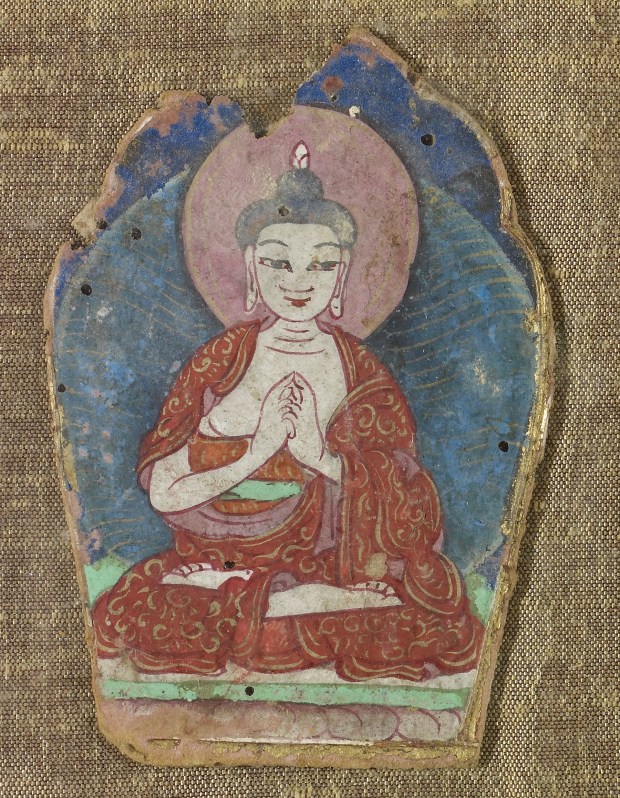
Image is Vairocana, from the Walters Art Museum

    Science and Buddhism VII: Science and Rebirth

    Dalai Lama at 2 (Sirensongs)

    Buddhism at present diverges from science, in incorporating in its worldview various apparently out-of-body experiences, including the possibility of mental processes unlinking from a dying body, and relinking with a growing embryo — i.e. rebirth. See the formidable investigations of Ian Stevenson.[1]  Most schools discuss a period between death and rebirth known in Tibetan as the Bardo. Are these notions accessible to objective study? There is no need to debar science from the phenomena of the psyche, and even the suggestion of karmic links between one’s willed actions and later events should be, to some extent, testable scientifically.

    Rebirth is coherent if the mind is not just physical events.  The mind is certainly very conditioned by the brain and the body.  Consciousness always finds itself in a body, but traditional Buddhism says it might not be a physical body. What would your mind without the vehicle of a physical body be like? It may be unencumbered by the burden of flesh, but it would also be, I guess, lacking in many abilities.  For example, the influence of the senses is quite mysterious.  In the Bardo, one probably can’t do anything to physical things — the body is the interface with a physical world.  One probably can’t think in a linear fashion — no plans, no thinking things out, no deliberate recall etc.  If you are unused to it, you are just swept along in a dreamlike condition — ‘why is all this happening to me?’  Or you are blissed out and thoughtless like the devas.

    There isn’t even a persistent entity, a Self, during life, so there is definitely no soul that persists from one life to another.  But yet the Buddhist view is that the karmic processes that you have set in motion during your life don’t simply vanish at the moment when the body becomes a corpse.  Somehow they are still viable; they can germinate and have an influence over another person, newly conceived.  More than an influence — the view is that a foetus growing in its mother’s womb can’t survive without some non-physical contributions from a previous life.  So it’s not you that survives death, yet processes that have built up during your life do go on to have their own consequences in another future life.

    This is the Dalai Lama on rebirth.  “The various instances of consciousness… come into being because of the presence of preceding instances of consciousness, and since matter and consciousness have totally different natures, the first moment of consciousness of the new being must be preceded by its substantial cause, which must be a moment of consciousness.  In this way, the existence of the previous life is affirmed.”[2]  Traditionally, rebirth is not seen as an issue of faith, but is something that can be verified through rational inference, according to the Dalai Lama, and I would add the testimony of others, and perhaps personal memory.

    In any case, there is no doubt that mental processes influence the physical through karma — and eventually the whole universe will probably be radically affected by the presence in it of self-aware beings.[3]


    [1] E.g. Ian Stevenson, Twenty Cases Suggestive of Reincarnation (University press of Virginia, 1974).

    [2] The Universe in a Single Atom, 141.

    [3] See David Deutsch, The Fabric of Reality (Penguin, 1997).

    Science and Buddhism VI: Buddhist Ethics for Scientists

    The karmic order

    The Buddhist view of karma is that there are universal and discoverable principles that distinguish good behaviour from bad.  This is a radical alternative to theistic sources of ethics:

    • Don’t do what you want, and do what you don’t want to do, because a priest insists that someone you can’t believe in tells you to…

    It is also a radical alternative to the purely rational sources of ethics:

    • Trying to calculate what would bring the greatest happiness to the greatest number.  (But why do this?) 
    • Cause as little interference to others as possible, and let them do whatever doesn’t interfere with others.  (This leads to the ethics of public opinion, which is all many scientists have.)
    • Evolutionary ethics — behave in ways you decide must be programmed in genetically, because you will tend to leave more breeding offspring if you do (a very depressing source of noble human acts).

    Applying the precepts to science

    1.  Not harming and acting from love.

    2.  Not appropriating resources and possessions, and freely sharing.

    3.  Not going for selfish gratifications, and not inducing neediness and dissatisfaction.

    4.  Communicating with integrity and kindness.

    5.  Protecting your consciousness as something precious and vulnerable — what affects it?  Look out for pride, status seeking, professional jealousy, fear of the vastness of truth, and taking refuge in petty egotistical projects, pursuits and obsessions.

     You can apply these to science,   overriding unconsidered pursuit of dazzling results, and the demands of paymasters. Look out for military and profit motives corrupting scientists.

    Thus consider unethical type of science, perhaps fulfilling these criteria corresponding to the five precepts.

    1. It is for benefit, expressing love.

    2. It is exuberant and abundant, freely shared.

    3. It is tranquil and peaceful, not craving-driven.

    4. It is guided by truth, with a strong emphasis on finding effective ways to communicate it.

    5. It is meditative, expanding the scope of awareness, always in an atmosphere of wonder at the beauty of the mind and universe, and knowing there is always more there that is unknown, and with a sense that it can’t all come together within a discursive and divided intellect.

    Science and Buddhism V: The Niyamas

    The primal drives at the centre of the Wheel of Life (Tom Knudsen)

    Instead of a definite personality, and instead of intrinsically existing things interacting with each other, we have the notion of conditional arising (see post Science and Buddhism III).

    To clarify it further, Pali Buddhism says there are a number of orders or categories of conditionality (niyamas) (using a modern re-framing of the terms, as developed by Caroline Rhys Davids[1]):

    1. Inorganic — traditionally seen as heat and cold, and the behaviour of the atmosphere.
    2. Organic –specifically the growth of plants from their seeds.
    3. Mental — basic psychology, covering anything with a mind, including animals.
    4. Karmic — one’s choice comes in, one can make ‘skilful’ or unskilful choices; the former are realistic, the latter try to fight reality for egoistic purposes, and thus cause huge problems, for self and others.
    5. Dharma — can be seen as the substrate of ineffable reality itself, never completely summed up in the ‘laws’ of the four other spheres.[2]

    Inorganic and organic orders

    Science rules in the inorganic order.

    The organic or biological order has been greatly illuminated by science, which has established the fact of evolution, with all life interrelated through historic lineages. Science has investigated genetics and developmental biology; physiological processes and the maintenance and reproduction of life.

    In Buddhism, three of the undetermined questions illuminate the first two niyamas:

    • What is the duration and size of the universe? 
    • Is the life force the same as the body or not?

    Traditional Buddhism asserts that the universe has no beginning. If the big bang is an absolute beginning, then you need a transcendent principle as the cause of universe, some kind of godhead.  Like science, Buddhists do not postulate a transcendent being as the origin of all things.

    But it’s interesting that the Buddhist origin myths include conscious beings from the very ‘beginning’.  It said that consciousnesses are left over from a previous world cycle, and they become attracted by the gradually condensing material universe, longing for some kind of embodiment, and their involvement influences the evolution of the new universe until eventually physically embodied self-aware beings appear.[3]  This is a long way from any scientific view! 

    However in one Buddhist scripture, there is a teaching about particles of pure energy subsisting in the empty period between the destruction of one universe and the beginning of another, from which all the matter in the new universe is formed, which the Dalai Lama thinks could be rather like the origins of the universe in the fluctuations of the quantum vacuum.[4]

    It is certainly true that some ancient Buddhist descriptions of the Cosmos are surprisingly close to modern scientific discoveries.  But so what?  Is this just a coincidence?  If not, does it imply that an advanced and trained introspective mind can have insights into structures far beyond the possibility of its sensory perceiving?

    Mental order

    It is very fruitful to compare Buddhist and scientific psychologies, and allow a synthesised new psychology to emerge.  For example, Daniel Goleman has attempted to do this in his study of the emotions.[5]

    Note the Wheel of Life — the three central animals as the primordial drives (craving, aversion and active ignoring); and consider the six realms.

    Is Buddhist psychology scientific?  It has never used the techniques of performing carefully recorded and repeatable experiments, observing only countable variables and measurable quantities.  Traditional Buddhist writers based their conclusions upon reported experiences (so can be accused of relying on anecdotal evidence).  They tended to give weight to experiences reported a) by practitioners regarded as spiritually advanced, and b) in older, authoritative texts.  Nevertheless, early versions of Buddhist psychology were subjected to criticism by later thinkers, and the discipline (not that it was ever regarded as a field separate from the religion as a whole) progressed.

    We’ll look at the Karmic order in the next post.


    [1] C A F Rhys Davids, Buddhism (1912).

    [2] See Subhuti’s 2010 paper.  http://www.sangharakshita.org/pdfs/revering-and-relying-upon-the-dharma.pdf The dharma-niyama can also be seen as spiral conditionality. The names for 1-3 are based on Caroline Rhys David’s alignment of the niyamas with a western classification of scientific knowledge, and don’t directly translate the Pali terms, utu- bija- and chitta-niyama; and dhamma-niyama is traditionally described quite differently.

    [3] Agañña Sutta, Digha Nikaya 27.

    [4] Dalai Lama, The Universe in a Single Atom, 90.

    [5] Destructive Emotions: A Scientific Dialogue with the Dalai Lama, by Daniel Goleman (Bantam, 2002).

    Science and Buddhism IV: Is the scientific description true?

    • The realist view: science is revealing to us all the components of an ultimately real objective universe completely separate from us.
    • The instrumentalist view: we can say nothing about reality, but we use science for its practical convenience.

    A traditional Buddhist perspective would agree with neither of these. Our experience is indeed experience of reality — it is not a product of our minds — but the categories that we use to make sense of that reality are provisional — they are not ultimate components of reality.

    This labelling and categorisation is a function of human minds, it is influenced by volitional processes of the past and present — human urges, tendencies, weaknesses and so on.  It is our minds that pick out the entities that we experience from the bewildering background of that tangled flow of phenomena. 

    We make decisions to draw boundaries around things in a particular way, or we regard particular ‘shapes’ as being in the foreground.  Once we have done that, then the laws of the interactions between these entities we have picked out are now decided, and science can discover what the laws are. 

    The entities will behave as they do whatever we think about them, once we have picked them out.  They are not all in the mind.  But the choice of what to look at is very significant indeed.  It produces whole sciences — geology, oceanography, animal behaviour — and the entities multiply, and some of them last a long time through the history of science, and some of them are briefly popular and then die away.  Not long ago, most astronomers were convinced that they could see a network of lines on Mars, and a lot of them agreed that they were canals.  But better telescopes showed that there is nothing at all there resembling the maps that people were drawing up until the 1930s.

    The new sciences give rise to their own technologies, and a hint at plans to look for yet more new entities.  For example, once people started thinking of light as being rather like waves on the ocean, they wondered what a much choppier ocean would be like, and X-rays were discovered.  They wondered what a much slower swell would be like, and radio waves were discovered.  But it is no less true to think of light as zooming along like thousands of little pellets, not like waves on the ocean at all.

    Is everything pre-determined?

    Quantum mechanics suffers from the problem of indeterminism — the unpredictability of quantum events.  Is it that chance is ultimate, and any deterministic laws that we find come from the law of large numbers?  Or is it that determinism is ultimate, and apparent randomness comes from the complexity of huge numbers of interacting events, as studied in chaos theory?  A French Buddhist philosopher of science, Michel Bitbol, takes a dependent co-arising-type approach, showing that the causes of any event are not defined in the absolute, but are “relative to the very circumstances of the production of the phenomena”.[1]  Since phenomena arise in dependence upon an enormously complex context, a context which includes the person or instrumentation detecting the phenomena, they are immune to any certain determination.  Relations between things should be seen as being prior to the things that are relating; however, “neither connection, nor connected nor connector exist”, says Nagarjuna.  Buddhism’s radical analysis is needed to cap philosophy of science, since it comes from “direct stabilised experience of a disabused outlook” — i.e., non-conceptual Insight into reality — while the insights of Western philosophy, impressive though they are, are the products of the free play of ideas.

    Is there a self?

    Conditioned arising applied to oneself leads to the realisation that there is no core-self, something which current psychologists, as well as neuroscientists, are insisting on with increasing unanimity.  There are just mental processes.  Already 100 years ago, the founder of scientific psychology, William James, said ‘the thoughts themselves are the thinkers’ — there is no mysterious inner core of selfhood doing the thinking.


    [1] In Buddhism and Science: Breaking New Ground, B. Alan Wallace (editor), Columbia University Press, New York, 2003, 349.

    Science and Buddhism III: Investigating Reality

    How do you find out what is the case?  Consider the criteria of the Kalama Sutta in which the Buddha provides a list of what he regards as unreliable sources of knowledge or advice:

    • something asserted repeatedly
    • tradition
    • hearsay
    • scriptural texts
    • sophistical reasoning
    • logical inference
    • prolonged consideration
    • getting carried away by a view that you identify with
    • indulgence in the pleasure of speculation
    • a person who makes a plausible impression
    • your respect for a spiritual teacher

    None of these are reliable sources of knowledge.  Instead, he says, ‘when you know of yourselves that these teachings are skilful, blameless, recommended by sensible people [viññugarahitā], and that followed through and practised they lead to welfare and happiness, then practise them and stick to them.’[1]

    We can investigate:

    1. Our surroundings — the material world.  Here, science is paramount, and manipulating things using what is learnt leads to technology.
    2. Ourselves — our ‘inner’ experience, character, drives, aspirations, abilities, pathologies; how this state of mind has come about.  What to do about it.  There are some Western insights, but Buddhism is way ahead.
    3. Other ‘selves’. But also,
    4. we can investigate how all these three fit together. 

    Science supremely respects objective investigation, so that only ‘objects’ can be investigated — separable, isolatable things, or at best processes.  So its natural tendency is to reduce 3 and 2 to 1.

    Buddhism makes 2 paramount, but doesn’t reduce 3 and 1 to 2.  Instead, it offers two ways of apprehending the totality of 1-3 — how they fit together in a single nondual universe.

    Direct apprehension

    The first way is said to be direct apprehension, with no mediation of descriptions, or models or framework etc.  You can’t prove this is possible, though you can intuit whether a holistic grasp of the situation (being completely present, with no need for divisions or discriminations — jñana, not vijñana) is in a sense already available, but overlain by rather nervous and insecure habitual colourings, enhancings, ignorings, and mental concepts.

    It seems unlikely that this kind of insight could directly answer questions relevant to the physical sciences.  But when it comes to the mind and human life, Buddhists would tend to privilege their personal insights over the findings of science.  However, as soon as an insight (assuming such a thing to be possible) is reduced to a conceptual explanation, which it presumably has to be to be conveyed to another person, it has switched to the same objective level that science operates on.  This is the reason that the Dalai Lama is prepared to expose the teachings of Buddhism to scientific scrutiny, and to alter them if they are falsified.[2]

    An intimation of the outcome of insight in is valuable to science.  Buddhism tries to gradually accustom one to the fact that there are no things, no essences, nothing ultimately exists, but neither are things nonexistent, and one has no core-self, and so on.  At first, this attitude is rather disturbing — it feeds in to one’s sense of insecurity.  But if a scientist can become accustomed to it, I think that it will help them to ponder the significance of their results more effectively, not distracted by essentialist or dualist assumptions.  Our intellect gives a certain form to the phenomena that we are trying to make sense of; but this is not the form of the things in themselves.

    Conditioned arising

    The second way of apprehending the totality of inner and outer experience is to find what might be the most simple and austere framework for accounting for reality, when conceptual structures first come in — very aesthetic, calm, vivid, elegant.

    This is the way or ways that someone with considerable insight will use to try to give an account of their perspective — attempting to be as helpful as possible for others to achieve insight.  The account is known as pratitya samutpada.

    It starts from the insistence that:

    • Nothing is fixed.
    • There are no independent entities (including oneself).

    So all phenomena are an interconnected flow.  The Buddha put it like this:

    ‘This being, that becomes.  From the arising of this, that arises.  This not being, that does not become.  From the ceasing of this, that ceases.’ 

    Whatever we think of as a thing or event wells up from the past on a wave of supporting conditions, and only remains so long as the conditions remain.  And that thing itself is a factor in other things or events arising.

    The Buddha’s image is of a fast-moving river, with froth and eddies: structures in the water which form and vanish, merge, stay or move swiftly on….  But their formation and evolution and movement and interaction are all completely law-governed.

    The number of factors is too great for exact predictions, in most cases.  And you can’t reduce the number of influences on one entity to a manageable number — other small influences might become appreciable (as in the butterfly effect).  But according to this view, nothing is completely fortuitous.  And there is no need to invoke a supernatural personality who runs the universe, or who decides to bring it into existence.

    The natural laws of conditioned arising apply to the objective world, to one’s own mind, and to other people.

    Is the world made up of things?

    Buddhism has very fully investigated the laws of conditioned arising in human mind and life.  Science has done so in the material world.  Science does take this process approach, but often forgets it, in ‘discovering’ some fixed entity.

    There is a strange contradiction in science.  It is supposed to be about the hard and objective material world.  But nearly everything it talks about is actually invisible — atoms, subatomic particles, pressure and electric current, distant galaxies, black holes and the Big Bang,  continental drift, evolution over millions of years, genes and instincts in animals.  These all have to be inferred using very sophisticated theories working on the data from very sophisticated equipment.

    We tend to believe it all a bit too easily!  We are very respectful and credulous when we hear about genes or atoms, even though we’ve never seen one. The theories are wonderful, and are very fertile ways of understanding the universe, but we should not think that they are true.  We shouldn’t take them too seriously.  They are just very effective models, ways of coming to an understanding of the world for minds that work like ours do.  A different being would have a very different science, and we will have, I suspect, a very different science in 100-200 years.  It’s all a wonderful story, with vividly imagined and extremely weird characters in it.  But don’t be too solemn about it all as if it is some sort of absolute reality. 

    To put this in Buddhist terms, there is a radical consequence of everything being interrelated, mutually conditioned.  Complete mutual conditioning means that there are actually no things being conditioned.  We can provisionally label parts of the tangled flow with names, thinking of them as real entities, but soon they have vanished and turned into something else.  So none of the names we use refer to anything which has the properties that one assumes that things must have.  There is no entity that exists in isolation, and no entity can give rise to or sustain itself, no entity can remain the same.  Conditioned coproduction shows that everything is shunyata, and therefore that every situation is open — it can evolve into something quite different.  You can’t say that all these categories that science talks about are somehow protected from shunyata.  Atoms and genes have no existence of their own; neither does gravity or natural selection.  They are just helpful descriptions that pick out parts of that flowing tangle, so that we can make some kind of sense of it while we wait until we can have insight into the whole thing.


    [1] Ratnaprabha’s translation.

    [2] In Buddhism and Science: Breaking New Ground, B. Alan Wallace (editor), Columbia University Press, New York, 2003, 77.

    Science and Buddhism II: Understanding One’s Mind

    Scientists themselves have increasingly seen the importance of ‘the observer’.  Science is for human beings, so it needs to understand what it is to be human, what self-awareness is, and what the range of human needs are (scientists tend to stop at the survival (medicine), and material (technology) needs.)  But above all because immediate experience is all we have!  All else is inferred, models, theories, assumptions, attempts at communication etc.

    So take mental processes seriously.  And take seriously the mental processes of others — there is a real possibility of empathy.  (Note how primitive Western philosophy and psychology can be here, without ‘contemplative’ disciplines.)

    Can consciousness be studied scientifically (i.e. objectively)?  Of course it can.  But one can miss what it actually is — and think that consciousness is a thing, rather than it being ‘actual awareness’ – a ‘light’ you and I are immersed in now, in a rolling present.  The structures that I use to make sense of the ‘contents’ of this illumination (which ‘I’ think of as partly inner, partly outer) can be studied.

    Real empathetic communication implies different people’s described worlds can be compared.  One can even construct highly simplified circumstances amenable to careful measurement (experimentation) as in brain imaging, and correlate measured variations with reported mental states, and with observable body responses or actions.

    Actual experience and the states of the brain act reciprocally upon one another, so that it is incoherent to say that brain states simply cause mental events.  Perception (says the Buddhist neuroscientist Francisco Varela) can be regarded as subsidiary to the mental function of imagination.  Perception refers to what is present, imagination to what is not present, and the two mix so that in every moment they are emerging into awareness from an unconscious background, as a living present. 

    It is still the case that the dominant view among neuroscientists is, in effect, that processes in the body cause the mind.  But neuroscientists such as Varela have shown that one’s state of mind can access local neural processes, so that neither can be reduced to the other.  The mental state corresponds to a particular neural state, and actively incorporates or discards any contemporary neural activity in the relevant brain region, evaluating many potential neural states, “until a single one is transiently stabilised and expressed behaviourally”[1].  Mental states (says Varela) require both a phenomenological and a biological account.  The neural elements and the global cognitive subject are co-determined; the subject is emergent, not just from the brain, but also from preceding mental states.  Buddhism extends this account by offering its pragmatic consequences, showing how the living present, with imagination active, is a means for human transformation. 


    [1] Varela and Depraz, in Buddhism and Science: Breaking New Ground, B. Alan Wallace (editor), Columbia University Press, New York, 2003. 213.  See also Varela, Thomson, and Rosch, The Embodied Mind (MIT press, 1993), 22.

    Science and Buddhism I: Universes Colliding

    Antennae galaxies colliding. NASA, ESA, SAO, CXC, JPL-Caltech, and STScI, Public domain, via Wikimedia Commons

    In a direct encounter between two massive spiral galaxies…, huge cold clouds of molecules will be compressed, and millions of new stars will burst into life like a string of Christmas lights. As the galaxies first swing by each other, their once orderly skies will become jumbled with dust, gas, and brilliant blue star clusters. Then the galaxies may do a slow, graceful U-turn and plunge into each other. This second encounter will trigger another burst of star formation, which will drive the remaining gas and dust from the combined system.[1]

    Science and Buddhism can be seen as self-contained universes, apparently complete in themselves.  Each is a very extensive, coherent worldview, worked out over many centuries.  They are the greatest collective cultural achievements of the West and of Asia respectively.  Now they are undergoing a historic encounter, and we are still in the early days of it.

    In the 19th century, Westerners encountering Buddhism were very keen to present it as a rationalistic, even scientific approach[2].  But a genuine dialogue between Buddhism and science didn’t really start until the Dalai Lama’s Mind and Life conferences and dialogues began. Their first topic in 1987 was Buddhism & the Cognitive Sciences[3].

    From boyhood, the Dalai Lama has had a very open, inquiring and fascinated response to science.  For example, he says that, if any Buddhist assertion is convincingly refuted by science, it should be abandoned, because freedom comes from knowing reality as it is. (However, though he’d be relaxed about the non-existence of Mt Meru, he might be less quick to abandon ‘suffering arises in dependence on craving’, say, if a study appeared to contradict it.) And generally, scientists rather like Buddhism. 

    Buddhists are fascinated by the torrent of human experience, and what it all means.  Their main priority is to expand the scope of awareness. They are not encumbered by the rather strange doctrines one encounters in ‘Religion’. (The only exception to this is perhaps rebirth. )  Both are concerned with the truth, and are prepared to take it on board, even if it threatens one’s cherished preconceptions. This is the ideal, and of course practising scientists and practising Buddhists both vary a lot.

    The project and attitude of science.

    The project: making systematic records of what is going on, accumulating factual knowledge, but also finding out what the connections are between all the things going on, and between what came before and what comes after — in other words, looking for laws of nature.  Once science has found out how things connect with each other and affect each other, it tries putting them together in new ways.  Sometimes this is just to see what happens — scientific experiments.  Sometimes it is to make things happen in new ways, things that people want to happen — that is technology. 

    The attitude: reality as objective, implying the use of experimental method.  Thus science takes that part of human experience which seems to be outside oneself very seriously, and takes it as primary.

    The project and attitude of Buddhism.

    The project: a path of growing insight and compassion — ethics, meditation, wisdom — each with insight and compassion aspects. Eradicating human suffering.

    The attitude: the possibility and the desirability of complete awareness — being fully present in awareness of reality (insight) and of people (compassion).  This attitude means that it takes consciousness very seriously, and as primary.

    Where Buddhists and scientists agree

    • Curiosity-driven.
    • Interest in knowledge/truth/reality. 
    • Discovering universal laws. 
    • Problem-solving.
    • Reality as process.
    • The recalcitrance of the external world, which challenges ego clinging.
    • To change the results, you need to change the conditions.
    • Vast space and time.  There are probably many inhabited places at inconceivable distances from each other, yet the same patterns can be discovered everywhere in the universe. 
    • No creation, and no end of the world.
    • Relativity.
    • The plenum void: seeing that the void teams with potential, and with coming into being. 
    • Linear time not intrinsic.
    • No self: seeing that the ‘self’ is a convenient fiction — there are just mental processes, which require no ego.
    • Animals are basically like us, and their drives can be found driving us from deep within.
    • Recognition of the barrier of subjectivity.  Seeing that perception is prey to illusion and delusion, and other methods are needed than the conditioned senses to discern what is really going on. 
    • The creation of a cooperating community (the peer-group of scientists, or the Sangha) able to achieve more than any individual can.

    One-sidedness in Buddhism and science?

    Buddhists have neglected the material, and this has influenced the countries where Buddhism has been active.  For example, Joseph Needham claims that Buddhism seriously inhibited the growth of science in China, though I am not convinced by his arguments[4].  Sometimes, this is for the better.  If there is less expectation that ‘things’ can yield happiness, more happiness results.  But two things have been lost:

    • potentials from technology to reduce hardships
    • potentials for understanding the objective pole of experience more fully — and therefore ourselves and others

    Science has neglected immediate experience, which is not trusted because it is so personal, and because it is so hard to come up with standardised results.  Also, the disciplines of introspection and mental cultivation take a long time, so that William James and early psychologists while initially keen, gave up on it.  The current fashion is to call introspection and even meditation itself ‘contemplative science’[5].

    To come: Science and Buddhism II: Understanding One’s Mind


    [1] From the Hubble telescope website. See https://hubblesite.org/science/galaxies

    [2] For the history of this encounter, see Buddhism and Science: a Guide for the Perplexed by Donald S Lopez Jr (University of Chicago Press: Chicago 2008), and my review in the Western Buddhist Review.

    [3] https://www.mindandlife.org/events/mind-and-life-dialogues/

    [4] Joseph Needham, The Shorter Science and Civilisation in China, Volume I (Cambridge University Press, 1978), pages 264, 265, 272.  But an essay by Jose Ignacio Cabezon indicates that the conditioning factors were far more complex, and that when Western science did arrive in Asia, it was treated by Buddhists in an open and welcoming way, in contrast to the responses to science of many European churchmen. (In Buddhism and Science: Breaking New Ground, B. Alan Wallace (editor), Columbia University Press, New York, 2003.)

    [5] See the works of B Alan Wallace.

    A Puja to Manjughosha

    Image by Dh. Aloka

    1. Bowing to Manjughosha’s Mind, Speech and Body

    To you whose wisdom
    Purifies like a cloud-free sun
    The veils of passions and of ignorance,
    Yielding perfect clarity;

    To you who sees all matters as they are,
    And so holds the book
    Of Prajnaparamita to your heart,
    To your mind, Manjughosha, I bow.

    To you whose kindness
    Views each being as your only son,
    Covered in avidya’s darkness,
    Afflicted in the prison of time;

    To you who utters the sixty-four-fold voice,
    Resounding loud as thunder,
    Rousing from passion’s sleep,
    Shattering karma’s prison fetters,
    Dispelling avidya’s darkness;

    To you who grasps the sword of wisdom
    To cut every shoot of duhkha,
    To your speech, Manjughosha, I bow.

    To you whose perfect body-of-virtues,
    Chief among the Buddhas and Bodhisattvas,
    Always pure, yet completing the Bodhisattva path,
    Adorned with one hundred and twelve blazing ornaments,
    Dispersing my mind’s darkness,
    To your body, Manjughosha, I bow.

    • Manjughosha mantra, and offerings

    2. Praise of body

    O Manjughosha, treasure of wisdom,
    Please for one moment consider
    These flowers of verses of praise
    Quivering in the wind of faith,
    O radiant mass of rays of saffron light,
    Like a golden mountain
    Embraced by the rays of the rising sun.

    Your mountain body is tall and stable,
    Your skin is pure and clear
    Like soft dust of gold.

    Your long, lustrous black hair
    Is bound in a knot
    And five gem-adorned crests,
    Above a brow like the waxing moon.

    Your eyes are long, and blue as utpala,
    Your mouth is smiling and well-pleased.
    From your fine ears
    Dangle gem-adorned earrings,
    And you wear many other ornaments.

    Adorned with armlet and bracelet
    Your right hand holds the sword
    That cuts the root of the tree of materialism.
    Your left hand holds to your heart
    The supreme volume
    Of exact and full teachings
    Of the sole doorway to peace.

    Your robe of silk shimmers
    And is hemmed with tinkling bells.
    You sit in vajra posture
    On moon disc, and the saffron centre
    Of a six-petalled lotus.

    Like the thousand rayed sun
    Plunging its seven horses
    Into the golden ocean,
    Your body everywhere shines.

    When I behold your body
    I weary of my long wandering.
    May my erring mind
    Come into the spirit of Enlightenment.

    • Reading
    1. Praise of Speech

    O Manjughosha, Lord of sweet speech
    Your many voices fill all lands
    In every different language
    Like a crystal prisming all colours,
    Satisfying all living beings.

    The melody of your speech
    Is like a sphere of music,
    Outlasting all the Samsara,
    Releasing from sickness, age, and death.

    It is pleasant, gentle, heart-stirring,
    Harmonious, stainlessly clear, and sweet.
    It is not rough, very calm, painless,
    And satisfies body, mind, and heart.

    It is rational, relevant,
    Free of all redundancy,
    All-informing, totally illuminating, enlightening.
    Its rhythm not too fast or slow,
    Its tone sweet, penetrating everywhere.

    Its phrases are complete and confident,
    Pervaded with joy and insight.
    Emerging victorious, it dispels the three times.

    These are some of the qualities
    present in each and every utterance
    Of your Brahma voice.

    Not too loud when near,
    Not too faint when far,
    As if it manifests from the sky
    Like the thunder in the rain-cloud
    Girt with its belt of red lightning.

    Just by hearing your stream of speech,
    The receptive accept it,
    Condemning wrong discourse,
    May I never be parted from hearing your speech!

    1. Manjughosha’s teaching

    O Manjughosha, Lord of Dharma,
    Certain of the true colour
    Of all that can be known
    May you grant superlative wisdom
    As the supreme refuge.

    Not one phenomenon
    Is hidden from you,
    Thus you never exceed just proportion
    In the training of your pupils’ faculties.
    You see how sharp or dull are their abilities,
    In faith, memory, samadhi and so on,
    And so yours is the highest skill
    In teaching Dharma.

    Since you know entirely
    The spiral path
    And the Transcendental path,
    And the way that leads
    To states of misery,
    You are the best spiritual friend
    Of living beings.
    Please grant the supreme instruction
    Of the Buddhas!

    The elephant of my mind
    Is hard to tame,
    As it runs amok
    In the jungle of unconsciousness.
    It is drunk on the liquor of materialism,
    Knowledge of right and wrong forgotten,
    Wrecking the trees of virtue,
    Dragged by the chains of existence’
    Losing the female elephant of success.

    I should bind it with the rope
    Of conscience and mindfulness,
    And guide it with the goad of true reasoning
    Onto the good Aryan path,
    Trodden by millions of supreme sages.

    With tireless effort on that path,
    By meditating again and again
    Without giving up,
    I shall reach the Vajra-like Samadhi,
    And the mountain of extremisms
    Shall be rendered merely a name.

    • Reading: The Song of the four mindfulnesses. (A teaching said to have been received by Tsongkapa from Manjughosha.)

    4. Praise of mind

    O Manjughosha, lord of Wisdom
    Just as the king of eagles
    Soars in the heavens,
    Your mind stays neither in existence
    Nor in peace.
    By praising your mind,
    May I never part from the wisdom
    And love of Manjughosha.

    False appearances entirely conquered,
    You dwell in the chief of all samadhis.
    By your power over appearances,
    And your clear knowledge of all experience,
    You enter the ultimate realm.

    Like a poison tree whose root is destroyed,
    And the seeds of all habits eradicated,
    how could you ever deviate, O refuge,
    From the Dharmakaya?

    Though you never leave the ultimate realm,
    You know individually in every instant
    The vivid appearance of many objects,
    Like a rainbow, or reflections in a mirror.

    Your direct vision, free of all veils,
    Sees the Nirvana that ends defilements,
    And its means, the eightfold path.
    Thus you are the best of all refuges.

    Long you practised the goal of compassion,
    The sole path of all victors,
    The entrance to the battle
    Of the hero Bodhisattvas.

    Loving one, you see the errors
    Of forsaking others’ happiness.
    You never allow suffering to continue,
    And are never content
    With the most alluring of pleasures.

    By your long cultivation of Bodhicitta,
    Seeing the equality of self and others,
    Practising the exchange of self and others,
    You hold all beings as yourself.

    • Svabhavashuddha mantra –

    5. Aspiration

    Though seeking desperately,
    I find no good refuge other than you.
    Turning to you, my mind
    Feels like a sunburnt elephant
    Plunging in the lotus pool!

    Having attained an infinite store
    Of samadhis and doors of liberation,
    May I manifest limitless bodies
    To see the Jinas
    In a million universes.

    Then, having reached the limit of wide learning,
    Satisfying limitless beings
    With the Dharma,
    May I before long attain
    The supreme body
    Of the chief of jinas, Manjughosha!

    Obtaining supreme understanding,
    May I cut off the doubts
    Of all living beings.
    Never transgressing your instructions,
    Through devoted, one-pointed practice,
    May I quickly gain mastery of speech.

    With the vision that belies all extremism,
    And the compassion that sees all
    As my only child,
    May I lead all beings
    Onto the supreme vehicle.

    Remembering all teachings,
    Able to answer all questions,
    May I spread out the feast
    Of eloquent Dharma.

    By the glory of the mind of Manjughosha,
    Who, without calculating,
    Fulfils the hopes of all,
    May I become like you,
    As beautiful as the autumn moon,
    Whose sweetness fills the limitless sky.

    • Concluding mantras

    Ratnaprabha, compiled and re-rendered September 1994, at Guhyaloka retreat Centre, Spain.

    The first part is a revised version of the traditiona Manjughosha Stuti. The rest is all adapted from Tsong Khapa’s ‘Cloud Ocean of Praises of Manjushri’, in Thurman, R., ed., Life & Teachings of Tsong Khapa (Library of Tibetan Works and Archives, Dharamasala, 1982), 188-197.

    The story of Dharma Day: The Buddha starts to teach

    Lotus pond

    Sugawara Mitsushige (1257) (Metropolitan Museum of Art), via Wikimedia Commons

    The Buddha’s decision to teach

    THE BUDDHA:

    [After my enlightenment,] I thought, ‘This Dharma that I have attained is deep, hard to see or realize, it is the highest, most peaceful goal of all. It’s beyond the scope of conjecture, subtle, to be experienced by the wise. But this generation delights in attachment, is excited by attachment and indulges in attachment. It’s hard for the people of this generation to see the truth of dependent arising. It’s hard for people to see the truth of stopping the karma formations, letting go, finishing craving, the fading of addictions, nirvana itself. If I taught, they would not understand me.

    Just then these verses … occurred to me:

    Enough now with teaching
    what, only with difficulty,
    I reached.

    This Dharma is not easily realised
    by those overcome
    with aversion & craving.

    What is abstruse, subtle,
    deep,
    hard to see,
    going against the flow —
    those delighting in craving,
    cloaked in darkness —
    they won’t [be able to] see it.’

    As I reflected like this, my mind inclined to dwelling in comfort, and not to teaching the Dharma.

    Then Sahampati, [a dweller in the sublime Brahma heavens] … thought to himself:

    SAHAMPATI

    ‘The world is lost! The world is utterly lost! The mind of the fully awakened one inclines to [his own comfort], not to teaching the Dharma!’

    THE BUDDHA

    Then, just as a strong man might extend his arm …, Sahampati disappeared from his Brahma-world and reappeared in front of me. He … saluted me with his hands before his heart:

    SAHAMPATI

    ‘Sir, let the abundant one teach the Dharma! Let the One-well-gone teach the Dharma! There are beings with little dust in their eyes who are wasting away because they cannot hear the Dharma. There will be those who will understand the Dharma!’ …

    ‘Throw open the door to the Deathless!
    Let them hear the Dharma
    realized by the Stainless One!

    Just as one standing on a rocky crag
    might see people
    all around below,

    So, O wise one, with panoramic vision,
    ascend the tower
    fashioned of truth.

    Free from sorrow, look at the people
    submerged in sorrow,
    oppressed by birth & aging.

    Rise up, hero, victor in battle!
    O Teacher, travel without debt in the world.

    Teach the Dharma, O Abundant one:
    There will be those who will understand!’

    THE BUDDHA

    Then, having listened to Sahampati’s invitation, out of compassion for beings, I surveyed the world with an enlightened eye. As I did so, I saw beings with little dust in their eyes and those with much, those with keen faculties and those with dull, those with good qualities and those with bad, those easy to teach and those hard…. Just as in a pond of blue or red or white lotuses, some lotuses — born and growing in the water — might flourish while immersed in the water, without rising up from the water; some might stand at the surface of the water; while some might rise up from the water and stand without being wetted by the water — so too, surveying the world with an enlightened eye, I saw [the range of beings].

    Having seen this, I answered Sahampati:

    ‘Open are the doors of the Deathless
    To those who can hear.

    Let them show their confidence.

    O Sahampati,
    If I [had thought I would not tell people]
    the refined,
    sublime Dharma,
    It was because it seemed too troublesome to me.’

    Then Sahampati realised,

    SAHAMPATI

    ‘The Abundant one has decided to teach the Dharma.’

    THE BUDDHA

    He bowed to me, and disappeared.

    The Buddha’s attempts to teach

    THE BUDDHA

    Then I thought, ‘To whom should I teach the Dharma first? Who will quickly understand this Dharma?’

    I thought of [my former teachers], but they had passed away…

    Then I thought: ‘The group of five [friends] who attended to me when I was practising fasting and self-denial, they were very helpful to me. [Now they are] staying near Benares, in the Game Park at Isipatana. What if I were to teach them the Dharma first?’

    Then, having stayed at Bodhgaya as long as I wished, I set out to walk [the long road] to Benares.

    Upaka the sectarian met me on the road between the (place of) awakening and Gaya village, and he said to me,

    UPAKA

    ‘Clear, my friend, are your faculties. Pure your complexion, and bright.

    What made you go forth? Who’s your teacher? In whose Dharma do you delight?’

    THE BUDDHA

    ‘All-vanquishing,
    all-knowing am I,
    with regard to all things,
    unattached.

    All-abandoning,
    freed by ending craving:
    having fully known this on my own,
    whom should I regard as my teacher?

    I have no teacher,
    and one like me can’t be found.
    I have no counterpart in the world with its gods.

    For I am a worthy one in the world;
    an unexcelled teacher.

    I, alone, am fully awakened.
    Cooled am I,             unbound.

    I’m going to Benares
    To set rolling the wheel of the Dharma.

    In a blindfolded world,
    I’ll beat the drum of the Deathless.’

    UPAKA

    ‘From your claims, my friend, you must be a Jina, a universal conqueror.’

    THE BUDDHA

    ‘Conquerors are those like me
    who have reached fermentations’ end.
    I’ve conquered evil qualities,
    and so, [yes], Upaka, I’m a conqueror.’

    UPAKA

    ‘May it be so, my friend,’

    THE BUDDHA

    And — shaking his head and taking a side-road — he left.

    Then, walking in stages, I arrived at Benares, at the Game Park in Isipatana, where the group of five friends were staying. They saw me coming from some way off, and made a pact with one another.

    THE FIVE

    ‘Friends, here comes Gotama the contemplative. [He has given up] our struggle [of self-denial], living luxuriously, straying from his exertion, backsliding into abundance. He doesn’t deserve our bows, or even for us to stand up to greet him. Still, if he wants to, he can sit down with us.’

    THE BUDDHA

    But as I approached, they were unable to keep to their pact. One stood up to greet me, another got me a seat. Another got some water for washing my feet. However, they [still] addressed me as ‘Gotama’ and as ‘friend.’

    So I said to them, ‘Please don’t address the Tathagata, the Thus-gone one, by name and as ‘friend.’ The Tathagata, friends, is a worthy one, fully awakened. Lend ear, friends: the Deathless has been attained. I will instruct you. I will teach you the Dharma. Practising as instructed, you will in no long time reach & remain in the supreme goal of the spiritual life, … knowing & realizing it for yourselves in the here & now.’

    THE FIVE

    ‘You did not attain any superior human states by practising hardship and deprivation, nor any special knowledge & vision worthy of a noble one. So how can you have done so now — living luxuriously, straying from your exertion, backsliding into abundance?’

    THE BUDDHA

    ‘The Tathagata is not living luxuriously, has not strayed from his exertion, has not slid back into abundance. The Tathagata, friends, is a worthy one, fully awakened. [And twice more I repeated my offer to teach them.]’

    [They still doubted, so] I said to the group of five, ‘Do you recall my ever having spoken in this way before?’

    THE FIVE

    ‘No, sir.’

    THE BUDDHA

    ‘The Tathagata, monks, is not living luxuriously, has not strayed from his exertion, has not slid back into abundance. The Tathagata, friends, is a worthy one, fully awakened. Listen, friends: the Deathless has been attained. I will instruct you. I will teach you the Dharma. If you practice as instructed, before long you will reach the supreme goal of the spiritual life and remain there…, knowing & realizing it for yourselves in the here & now.’

    And so I was able to convince them. I would teach two while three went to get food, and we six lived off what the three brought back from their alms round. Then I would teach three of them while two went for food, and we six lived off what the two brought back from their alms round. Then the group of five — thus exhorted and instructed by me — being themselves subject to birth, seeing the drawbacks of birth, seeking the unborn, unexcelled security from oppression, nirvana, reached nirvana. Being subject themselves to aging, illness, death, sorrow and defilement, seeing the drawbacks of aging, illness, death, sorrow and defilement, seeking the aging-less, illness-less, deathless, sorrow-less, undefiled, unexcelled security from oppression, nirvana, they reached nirvana. Complete knowledge & vision arose in them, their liberation was unshakeable, and from the rounds of rebirth they were completely free.

    From the Noble Quest Sutta, Majjhima Nikaya number 26.

    (Edited and adapted for reading aloud by Ratnaprabha from the translation by Thanissaro (1), referring to translations by Bhikkhu Bodhi (2) and Nanamoli (3).)

    Sources

    1. http://www.accesstoinsight.org/tipitaka/mn/mn.026.than.html .
    2. http://www.wisdompubs.org/book/middle-length-discourses-buddha/selections/middle-length-discourses-26-ariyapariyesana-sutta
    3. Ñāṇamoli Bhikkhu, The Life of the Buddha (Buddhist Publication Society, 1972)