religion

The Story of Angulimala

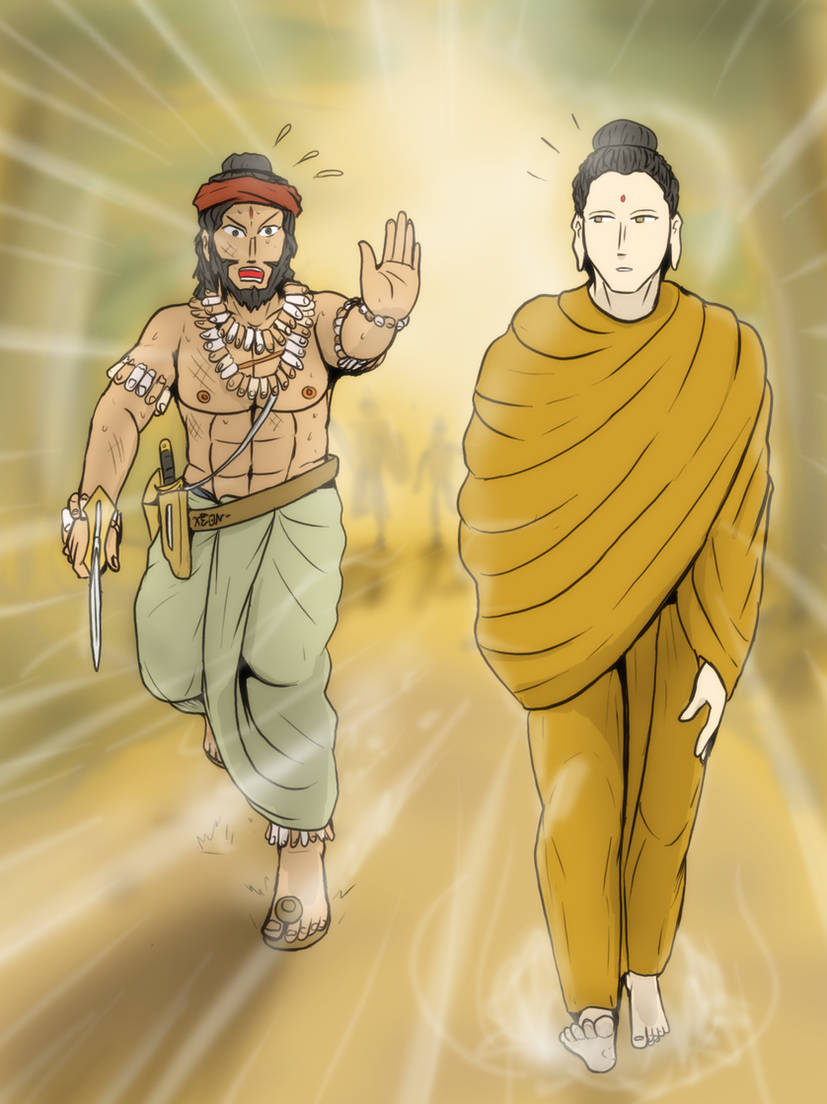
Image by VachalenXEON

The Buddha gained enlightenment under the Bodhi Tree in north-east India, and established a community of followers, many of them monks and nuns who lived a homeless life, meditating, and wandering to teach the basics of Buddhism to whoever they met.

One day the Buddha himself, walking alone, was travelling through the kingdom of Kosala, through the villages on the fringe of a huge dense jungle. One track led through the centre of the jungle, into the neighbouring kingdom of Magadha. As the Buddha started down that road, people came out of their houses. Stop, stop, don’t go down there, O holy man. Nobody who goes down that path into the jungle ever returns. But the Buddha ignored them and continued. In the next village the locals were even more decisive: stop, stop O holy man, don’t go down that track, anyone who goes down into the jungle is sure to be murdered! But the Buddha ignored them and continued. As he came to the edge of the jungle, there were no people, the towns and villages were completely depopulated. But there was one old man in a hut under the trees. He said to the Buddha: stop, stop O holy man, don’t go into the jungle, there lives the murderous bandit Angulimala, he will not let you live.

So the Buddha asked the old man who is this Angulimala, how come he is so dangerous? And the old man told him the story of the most feared bandit in the whole of India.

Angulimala was of the Brahmin caste. He longed for wealth, he longed for pleasure, but most of all he longed for power. He was bullied and looked down on by his fellows, he wished he could get his revenge. His mother said – if you want to be an influential and powerful man, you must go and study with the old priest who lives on that hill. He knows all the Mystic secrets. So Angulimala enrolled in his classes. He learnt the power of speech and how to manipulate others with your words. He learnt the magic spells – the rite of fascination, the rite of destruction. He learnt martial arts and swordsmanship, he became stronger and stronger, so none of the others in the class could withstand him.

The old priest’s young wife gazed on Angulimala, Angulimala gazed on the young woman. But the priest saw. The priest decided that Angulimala was far too dangerous to have in his household. So he devised a plan. He said to Angulimala: do you want power? Do you want influence? Do you want control over others? Yes, said Angulimala I desire these things more than anything in the world. The priest said: who then is the most powerful person? Angulimala replied: I guess O master it is you. No, said the priest, there is one far more powerful than I. Angulimala said: then you must mean the great King Pasenadi with his vast army, never conquered. The priest said, no, there is one far more powerful even than King Pasenadi. Who is that? Said Angulimala. the priest replied: it is God himself. The great Brahma, ruler of the world, feared by gods as well as men is the most powerful being. Yet you can become that being! Would you like that? Yes, said Angulimala but surely that is not possible. The priest said this is the auspicious time, it is the only time when a human being can become Brahma. But it is a very hard path to follow. In order to become Brahma, by the next new moon, with your own hand, you must kill 100 people, no more no less and no later than the new moon. Then you will become the great God Brahma.

The priest’s plan worked, Angulimala set off to find his victims, and the priest knew that he could not possibly survive such a murderous campaign, he would be rid of him forever!

Angulimala plunged into the depths of the great jungle, and haunted the only road that led through it, the track from the kingdom of Kosala to the kingdom of Magadha. A traveller came down the road, Angulimala drew his sword and sprung on the traveller, killing him swiftly. He dragged his body into the ditch, and lay in wait. Then a couple came down the track together, both were soon dispatched, Angulimala dragged them into the ditch. That’s three, he thought. But how do I ensure I kill exactly 100 people? So he cut off the right thumbs of his first three victims, and hung them up in a tree by his lair where he slept each night. The next morning, he found that crows had nibbled the flesh from the thumbs that he hung in the tree, so he threaded them together on a leather thong, and wore them round his neck. That was how he got his name – Angulimala means a necklace of thumbs.

The next day a merchant’s party came through the jungle, 16 people became his victims, but two got away, and spread the news to the surrounding villages of the dangerous bandit. Parties came now with armed guards, but Angulimala’s skill was too good for them, he would spring unexpectedly from the branch of a tree, dispatch the guards, and then kill the members of the party. So all the local people near the jungle, left their houses, their villages, even their towns, and fled the area in fear of the great bandit. Still he found victims, and at last around his neck on the thong there were 99 thumbs. He just needed one more victim, and then, he knew, he would become the most powerful being in the universe, the great God Brahma. But he only had a few hours until the new moon’s little silver Crescent, would appear in the sky. And nobody was coming into the jungle!

Meanwhile, King Pasenadi, he with the vast army, had at last heard about the serial killer plaguing the jungle in his land. He knew that a small party of soldiers would not be enough, he decided to send his army into the jungle to root out Angulimala and bring him to justice. Angulimala’s mother heard the news of the great armed expedition against her son, she thought: I must warn him, he has no chance against the army. She ran into the forest.

Angulimala sat in hiding above the track, hoping that someone would come, when he saw a little figure scurrying along the track towards him. At last, my hundredth victim, all my dreams will come true, he thought. He leapt down and grabbed the frail woman passing along the track. It was his mother! What was he to do? She said Angulimala my son, you must flee! The king’s army is on its way he looked into the sky and he saw that soon the new moon would rise. There is only one thing for it I must kill my own mother for the 100th thumb. She saw what he was planning, and fell sobbing to the ground. But at that moment, another figure appeared coming down the track. Who was that? It was a wandering holy man. It was The Buddha! Walking peacefully, unhurriedly, steadily with no trace of fear straight towards Angulimala. He was so surprised that he let the Buddha pass, but he thought thank goodness I will not have to face the terrible sin of killing my own mother. I will take this holy man, he will give me my hundredth thumb.

So Angulimala left his mother, drew his sword and raced down the track after the Buddha. But something extraordinary happened. Despite his speed and athleticism, he drew no closer to the Buddha. He ran faster, he ran as fast as he could, but the Buddha stayed exactly the same distance in front, though the Buddha was simply walking at a steady pace. Angulimala was exhausted he couldn’t work out what was happening, and at last he stood stock still, and shouted at the top of his voice O holy man, stop stop stop. The Buddha continued walking, but looked over his shoulder and said this:

O Angulimala I have stopped it is you who have not stopped.

Angulimala was puzzled – these holy men were known never to lie, yet this man was moving down the track saying he had stopped, Angulimala was frozen to the spot in bewilderment, yet he was told he had not stopped. What do you mean what you mean, he shouted to the Buddha, and the Buddha turned round and approached him, and said quietly I have stopped. I have given up chasing after selfish desires. I’ve stopped blaming others for my own misfortunes. I’ve stopped resenting the success of other people. I’ve stopped fooling myself with false views. But you, Angulimala, are swirling around and around on the endless wheel of life, like one caught in a whirlpool. Your mind is whirling, your desperation is sweeping you as if over a waterfall. Angulimala was totally shocked. The Buddha was looking at him with compassion in his eyes, and not the slightest trace of fear. Angulimala was silent for some minutes. Neither man said anything. Then Angulimala fell to his knees, and said teach me how to stop, please teach me how to stop.

So the Buddha took Angulimala back to the local Monastery, and asked the monks there to shave his head, give him the ochre cloak to wear, and make him a Buddhist monk.

Angulimala took the precepts of nonviolence, ahimsakha. Angulimala did the meditations on lovingkindness.

Angulimala lived on gifts of leftover food provided by the local people. And he went into the town on his alms round, with his begging bowl walking mindfully from door to door, but soon somebody recognised him – that is Angulimala the bandit, and everybody fled in terror. And Angulimala returned to the monastery with an empty bowl. The next morning he went out again, this time the locals had discussed the case, and realised that he had no weapon, he was now dressed as a monk, he could not harm them. So they plucked up courage, they threw clods of earth at him, they yelled obscenities and imprecations at him, they threw stones; and he limped back to the Monastery with no food in his broken bowl, his cloak in rags, and blood streaming down from a nasty cut on his head.

The Buddha saw him: bear it monk, bear it monk. You are now reaping the fruits of your karma. Your violent action leaves you in a violent world.

At last Angulimala was able to travel safely into the town to beg his alms. One day as he was passing a house he heard a woman screaming in anguish inside. He asked what was the matter – she was pregnant, and in danger of a breach birth. She was in agony, and her baby was unlikely to survive. The doctors could not help her. Angulimala rushed back to the Monastery and asked the Buddha: what can I do, is there any way I can help her? The Buddha said only one thing will save this woman’s life. That is a declaration of utter truth. It has to be the deepest truth that she hears, then her baby will be born safely. You must say to her “I utter this truth, that since the day I was born, I have never harmed any living being.” Angulimala said: but I have killed 99 people, how can I possibly say I have harmed no one? The Buddha said: that, Angulimala, was a different person. Since then you’ve had a new birth, a birth as Ahimsakha, the man without violence. You can make that statement truthfully. Angulimala went straight back to the woman’s house, “I utter this sacred truth, that since the day I was born, I have never harmed any living being.” The baby was delivered safely, and the mother’s pain was gone. A man with a necklace of thumbs had changed his name. He had changed his nature, he had become Ahimsakha, the man without violence. And before long he became one of the awakened ones.

Science and Buddhism V: The Niyamas

The primal drives at the centre of the Wheel of Life (Tom Knudsen)

Instead of a definite personality, and instead of intrinsically existing things interacting with each other, we have the notion of conditional arising (see post Science and Buddhism III).

To clarify it further, Pali Buddhism says there are a number of orders or categories of conditionality (niyamas) (using a modern re-framing of the terms, as developed by Caroline Rhys Davids[1]):

  1. Inorganic — traditionally seen as heat and cold, and the behaviour of the atmosphere.
  2. Organic –specifically the growth of plants from their seeds.
  3. Mental — basic psychology, covering anything with a mind, including animals.
  4. Karmic — one’s choice comes in, one can make ‘skilful’ or unskilful choices; the former are realistic, the latter try to fight reality for egoistic purposes, and thus cause huge problems, for self and others.
  5. Dharma — can be seen as the substrate of ineffable reality itself, never completely summed up in the ‘laws’ of the four other spheres.[2]

Inorganic and organic orders

Science rules in the inorganic order.

The organic or biological order has been greatly illuminated by science, which has established the fact of evolution, with all life interrelated through historic lineages. Science has investigated genetics and developmental biology; physiological processes and the maintenance and reproduction of life.

In Buddhism, three of the undetermined questions illuminate the first two niyamas:

  • What is the duration and size of the universe? 
  • Is the life force the same as the body or not?

Traditional Buddhism asserts that the universe has no beginning. If the big bang is an absolute beginning, then you need a transcendent principle as the cause of universe, some kind of godhead.  Like science, Buddhists do not postulate a transcendent being as the origin of all things.

But it’s interesting that the Buddhist origin myths include conscious beings from the very ‘beginning’.  It said that consciousnesses are left over from a previous world cycle, and they become attracted by the gradually condensing material universe, longing for some kind of embodiment, and their involvement influences the evolution of the new universe until eventually physically embodied self-aware beings appear.[3]  This is a long way from any scientific view! 

However in one Buddhist scripture, there is a teaching about particles of pure energy subsisting in the empty period between the destruction of one universe and the beginning of another, from which all the matter in the new universe is formed, which the Dalai Lama thinks could be rather like the origins of the universe in the fluctuations of the quantum vacuum.[4]

It is certainly true that some ancient Buddhist descriptions of the Cosmos are surprisingly close to modern scientific discoveries.  But so what?  Is this just a coincidence?  If not, does it imply that an advanced and trained introspective mind can have insights into structures far beyond the possibility of its sensory perceiving?

Mental order

It is very fruitful to compare Buddhist and scientific psychologies, and allow a synthesised new psychology to emerge.  For example, Daniel Goleman has attempted to do this in his study of the emotions.[5]

Note the Wheel of Life — the three central animals as the primordial drives (craving, aversion and active ignoring); and consider the six realms.

Is Buddhist psychology scientific?  It has never used the techniques of performing carefully recorded and repeatable experiments, observing only countable variables and measurable quantities.  Traditional Buddhist writers based their conclusions upon reported experiences (so can be accused of relying on anecdotal evidence).  They tended to give weight to experiences reported a) by practitioners regarded as spiritually advanced, and b) in older, authoritative texts.  Nevertheless, early versions of Buddhist psychology were subjected to criticism by later thinkers, and the discipline (not that it was ever regarded as a field separate from the religion as a whole) progressed.

We’ll look at the Karmic order in the next post.


[1] C A F Rhys Davids, Buddhism (1912).

[2] See Subhuti’s 2010 paper.  http://www.sangharakshita.org/pdfs/revering-and-relying-upon-the-dharma.pdf The dharma-niyama can also be seen as spiral conditionality. The names for 1-3 are based on Caroline Rhys David’s alignment of the niyamas with a western classification of scientific knowledge, and don’t directly translate the Pali terms, utu- bija- and chitta-niyama; and dhamma-niyama is traditionally described quite differently.

[3] Agañña Sutta, Digha Nikaya 27.

[4] Dalai Lama, The Universe in a Single Atom, 90.

[5] Destructive Emotions: A Scientific Dialogue with the Dalai Lama, by Daniel Goleman (Bantam, 2002).

Tolerance — ksanti

Kusunoki_masashige

Kusunoki Masashige, photo by Jim Epler https://www.flickr.com/photos/epler/

The Zen master and the general

In the warring period of medieval Japan, one of the most ferocious of the clan generals swept into a peaceful valley with his army. The general was used to the terror his arrival would always cause. The Buddhist monks in the local Zen monastery fled into the mountains – all except one. The general stomped through the monastery buildings, and was very surprised to find one remaining monk, the Abbot, a well known Zen Master, who was calmly sitting in his room. He strode up to him. his sword drawn: ‘Don’t you know who I am? You dare to remain seated in my presence? I have killed scores of men. Do you realise that, without blinking an eyelid, I could run you through with this sword?’ The Zen master did not move. ‘General,’ he said ‘do you realise that, without blinking an eyelid, I could be run through with that sword.’ After a pause, the general put away his sword and bowed, and ordered his army to leave the valley.

I remembered this story as a striking example of a special kind of tolerance which is found in Buddhism, a personal tolerance which includes  the ability not to join in with any games of power. (I will question the Zen Master’s behaviour later.)

Tolerance in Buddhism

It’s tempting to bestow some reassuring but bland declarations of how nice it would be if everyone else were more tolerant. But what of our own personal level of tolerance? I’d like to look at that from a specifically Buddhist angle.

I learnt Buddhist meditation as I was about to start my finals at university (and I certainly needed the effects of meditation then!) So I had some contact with a Buddhist, the meditation teacher, in fact he was the one who told me that story. He impressed me very much, and I decided to investigate Buddhism as a whole, not just the practice of meditation.

Two things, among others, really struck me about Buddhism. One was its emphasis on the individual, and one’s actual experience, here and now. The other was that it does more than tell you that you ought to be kind to people, and tolerant and so on. It recognises that you may not feel kind or tolerant, and so it offers practical methods for developing such qualities, and methods for leaving behind habits that lead to harm and suffering. These two points apply to Buddhist tolerance.Firstly, it is said to be individual tolerance that matters most. So it is not Buddhism that is tolerant, but Buddhists. And it is not other isms that Buddhists tolerate, but real individual people. I think this is quite an important distinction.

However, if you strongly identify with your religion or your ideology, and label other people with their religion or ideology, then it is very tempting to make the label so huge that you can’t see the person behind it. And then it is a label which you tolerate, or don’t tolerate, as the case may be. She is a Moslem, so she must be bloodthirsty and fanatical, say.

The second point was to do with seeing tolerance as a quality to be developed in the individual, using practical methods, not as a pious hope, or something received from outside you by grace. So what is the quality of tolerance like, and how can you develop it?

Well, I’ve been using the word tolerance, which of course is an English word, to translate a traditional Buddhist term which actually has a rather broader meaning. The word in Sanskrit is ksanti, a rather beautiful word, I think. As well as tolerance, it means forbearance, patience, kindness, and maybe the best translation is non-reactivity. Non-reactivity is something the Zen Abbot exemplified, I think. It is the ability to respond with kindness whatever another person does to you. Quite a tall order, but it is something you can gradually strengthen, as we’ll see. It is not something you just have or don’t have, and you just have to put up with it. This is a great mistake, I think, which it is very easy to make. I can believe, ‘well, so I am a bit crabby. But I was born like that, and that’s the way I am.’ .So ksanti is a quality you can develop, the ability to remain cheerful and positive even if people are not treating you as you’d like to be treated.

An old poem ascribed to the Buddha includes the line: ‘Ksanti is the highest form of austerity.’ I think this means that when people get difficult, learning not to react with more of the same is a better form of training than the most impressive feats of self-denial or fasting and so on.

Developing ksanti

So how do you learn ksanti, how do you develop tolerance as a personal quality?

In Buddhism, the first steps for cultivating any inner quality are ethical ones. You apply awareness to your actions, and to your feelings as well. You restrain any impulses that are intolerant, because if those emotional urges turn into words and actions, they get a firmer hold on you, as well as damaging whoever has to bear the brunt. Instead of acting from intolerance, you emulate anyone you know, or know of, who seems to be truly tolerant, and so your habitual behaviours slowly adjust.

But ethics is only a first step, and it is not enough. You need to tackle the intolerant impulses at their roots in the heart, and cause tolerant impulses to sprout there instead. Any method which achieves a direct emotional change is called meditation. Meditations for developing ksanti use the medium of empathy. In a meditation to cultivate kshanti,you would get into a quiet state of mind which is flavoured with confidence. This is because the meditation will not work if you do not have a strong sense of self-worth. You could say that you can’t really tolerate others unless you can be tolerant to yourself: everyone has flaws and makes mistakes, but it is counter-productive to give yourself a hard time about them. In Buddhism, they are called ‘adventitious defilements’ because deep down you are ok, there is a core of inner purity, the potential for Enlightenment.

So with that feeling of being happy about yourself, you than call to mind the people you are intolerant of (whether or not you think the intolerance is justified), and you start to feel what it must be like to be them, as best as you can. You regard them with the same kind of understanding that you have for yourself, and notice that they are the way they are because of all sorts of circumstances, and some of those circumstances can change. Thus you start to empathise with them.

As you empathise more, you may realise that your intolerance of them is based on very superficial characteristics – it’s their tone of voice or their facial expression which really gets up your nose. Alternatively, you may decide that their behaviour is just not on. In Buddhist terms, their behaviour is unskilful, ie it is damaging to themselves or others. This is where your tolerance is really tested – when it seems that you have good reasons for it. William Blake says:

Learn … to distinguish the Eternal Human … from those States or Worlds in which the Spirit travels. This is the only means to FORGIVENESS OF ENEMIES.[i]

In other words, we can recognise that our common humanity is where our regard for each other comes from. On the surface of that humanity, everyone passes through many mental states, some skilful, some unskilful. If our reason for not being tolerant is others’ mistakes and unskilfulness, then we will tolerate no-one.

You can’t ignore unskilfulness. But I think you need a thoroughly tolerant frame of mind in order to be of any real use in helping someone overcome it. And maybe you can’t — maybe you can’t cope with this person, but you have no choice but to cope with your own reactions to them.

There are much more advanced developments of ksanti or tolerance in Buddhism, connected with the very significance of birth and death, but I just wanted to give you some practical ideas about how to make it stronger. There is one more thing I’d like to add about tolerance as a quality. Kshanti has been defined as not expecting anything.[ii] This may seem a bit extreme, because we always, surely, have some expectations. But then we are often being disappointed. And what makes it so difficult to be tolerant is other people not fulfilling our needs and our expectations of them. Expect nothing, and life is full of very pleasant surprises!

So in this talk, I have deliberately focussed on ksanti, tolerance, as a quality for each individual to strengthen in themselves. We may think we are already very tolerant. That may be true when it comes to events in distant countries, or the religious rites of exotic communities. Tolerance is really tested, though, between you and your relatives, the people you work with, or whoever is with you now. Can we really put up with such weird and unreasonable human beings in such close proximity?

One reason for the difficulty of being tolerant is that other people are different from us, and their differences can seem unreasonable, even threatening. Can I accept that someone else is fully human, and deserving of a good and full life, even though they are not like me? One way out of this problem is to regard differences as unreal, but I think that is a cop out.

Religious tolerance

I wanted to concentrate on personal tolerance, so I have not discussed religious tolerance, or the toleration of variant views and beliefs. As you know, this is not really an issue for Buddhism as a tradition, despite very poor behaviour by some Buddhist communities. But ksanti or tolerance as a personal quality is just as much an issue for Buddhists as for anyone else. For a Buddhist, any other person is to be treated as an independent human being, responsible for their own destiny, who is potentially a Buddha, whatever their opinions may be.

But what if their opinions are pernicious? For example, what if they hold tenaciously to an ideology in which a huge section of the community is regarded as untouchable, their very shadows being seen as polluting, as is still the case in large parts of India? If so, then I think the harmful views should be exposed, but in a spirit of personal friendliness. So I am pointing out that you do not have to tolerate everything. Tolerance does not mean blurring the truth and pretending that we all believe the same thing or are really all on the same path. I am convinced that there are  real differences between people, and also real differences between the Buddhist approach and other approaches, and between different people’s priorities and aims. I feel it’s rather intolerant for someone to insist otherwise.

Why is it that (with exceptions such as Northern Myanmar in our own time) Buddhists have as a whole has been quite happy to coexist with other religions and ideologies, while for most of their history, the other world religions have not been tolerant of each other?

I haven’t time to treat the whole issue thoroughly, and I could well be quite wrong about it. But I consider that it is connected with belief in God. Buddhists do not believe in God. Buddhism is a religion of discovery, of discovering the truth by taking full responsibility for the growth of your own wisdom and compassion. The other main world religions are, for most of their followers, religions of revelation. If you believe your truth is revealed from an infallible divine source, then it is difficult to admit the quite different revelations of other religions, or even the different interpretations of the revelation of your own religion.

It is obvious that individual theists can be genuinely tolerant people, but I think that such people have left behind some of the traditional associations with God. Each theistic religion as a whole, as a tradition or an institution, seems to militate against many forms of tolerance, and will carry on doing so unless there are some big changes. For example, I very cheekily asked a priest why the church did not simply repudiate the Old Testament, but he wasn’t having it!

So, if you are a believer in God, however you conceive of him, a non-theist might really test your tolerance by saying: ‘I am convinced that God does not exist, and that belief in God can in itself explain why there is more active intolerance in the theistic religions than outside them.’

Conclusion

I was thinking some more about the story of the Zen Abbot and the general. It is an impressive story, and he must have been a very impressive man. But I am not sure he was setting a very good example. In fact, I am sure he had no intention of setting an example, he was just being himself. If I had been there, I am certain I would have scampered off into the mountains with the other monks.

When I have told such stories before, some people usually respond by saying: ‘If everyone acted like that, society would fall apart!’ or ‘Someone has got to resist the tyranny and oppression of the strong over the weak’, or they think he was just lucky.

I sympathise with these responses, but I think they miss the point. The Abbot was not writing a list of recommended behaviours to suit all situations. He was just being himself, and each of us is different. For a start, we have probably not developed anything like his imperturbable kshanti, and that is not something you can pretend about.

Another Japanese master was lucky enough to die in his bed. As he lay dying, his devoted disciples gathered round, and asked him for his last words of wisdom. He just croaked: ‘I don’t want to die!’ ‘But master’, they said, ‘we want some final advice that posterity will remember you for’. ‘No really,’ he said ‘I don’t want to die.’ So I am sort of heartened by that. Maybe we can develop tolerance, tolerance for each of our fellow human beings, not imposing our expectations on them. But maybe we can keep one or two aspects of this world untolerated, as that last Zen master did with the expectations of his own pupils; maybe we can even refuse to tolerate the finality of death, and discover for ourselves what  it is all really about.


Based on lecture to a United Nations Association interfaith meeting in 1995

[i] William Blake, Jerusalem, 49: 72-5. His capitals.

[ii] Chogyam Trungpa, Cutting Through Spiritual Materialism, 174.