Mind in Buddhism: Finding the Mind interview
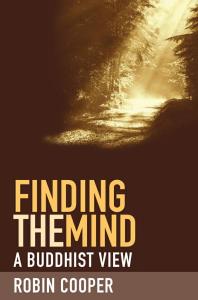 How would you introduce Finding the Mind in just a few words?
Being aware is the most important part of our experience as human beings, so in Finding the Mind I wanted to explore what it means to be aware, and what you can do with this awareness. Buddhists have been looking into the issue for over two and a half thousand years so my book draws on the whole of the Buddhist tradition, as well as looking at some modern ideas.
I also put a few exercises in the book so that readers can do some of the things that Buddhist meditators have been doing down the ages and see what results they come up with themselves. I wanted to make the book accessible and also quite interactive because ultimately what is important is your own experience, not what somebody else says your experience ought to be. So I hope that Finding the Mind will give people a few avenues into exploring their own minds.
Why is the project of finding our minds so important?
In a way, experiences are all that we have got, so exploring the nature of experience is, I think, basic to our humanity. Also basic to our humanity are our unwelcome experiences – we suffer, we experience pain, and we wish things were different – and Buddhism has some very effective strategies for coping with these unwelcome experiences. Not just coping with them, in fact, but actually seeing through the issues that cause them in the first place.
The Buddha taught that suffering springs from our own minds, and mostly from the fact that we don’t know our own minds, so we end up making the same mistakes in life, over and over again. This is why I think that finding our minds is such an important project. We become familiar with the way our minds normally work, firstly so that we can then work out how to change our minds, and secondly so that we can also empathize with the experience of other people. Because people’s minds do work in very similar ways, and if we can understand our own minds, we can understand more about what it’s like to be a human being in general.
So finding our minds is not only important but also quite fascinating and exciting – lots of unexpected insights emerge when we start to look at our minds. Imagine that you didn’t have repeated disappointments with life and that you’d found the confidence to engage with the world and leave it a better place! This is what I think engaging with the Buddhist view of the mind can offer.
You dedicate a whole chapter to the subject of compassion. What relevance does compassion have as far as finding the mind is concerned?
Well firstly I think that it’s very important that any discussions of Buddhism include the subject of compassion because compassion is such a crucial part of Buddhism in general. Obviously meditation is also crucial – it allows us to make our experience as simple and straightforward as possible so that we can notice what’s actually going on in our minds and make subtle little adjustments. However, what is equally important is what happens during the rest of the day: how we go to sleep, how we eat, how we behave at work, how we deal with the people we live with. All of this stuff is real – it’s our mind actually responding. So finding the mind is not just about self-discovery, it’s also about connecting with our capacity to respond to life in a more compassionate way.
And as I mentioned earlier, our experience of suffering is something that we share with all human beings. More specifically, it’s a common human experience to feel embattled, for example, or needy, or that there’s something missing. One way through these experiences is through awareness of others – in other words through compassion – because compassion expands our awareness from the narrow perspective of the self, leaving us more relaxed and happier. So, even from a selfish point of view, compassion really works! But of course it is also about something much bigger than that. Other people are just as real as we are, they are just as important. So not to care about other people I think is running away from something.
Does Buddhism point to objective and universal laws that govern the workings of our minds, or does it simply encourage us to explore our own subjective experience?
I think it’s definitely best if our exploration of Buddhism starts from our own experience – from basic mindfulness – but of course with mindfulness we start to notice patterns in our experience and patterns between people as well. We discover that there are universal laws that govern the lives of conscious beings – all beings with a mind – because there’s something about mind which is, in a way, universal. When we see ourselves as a distinct subject in here, for example, we are inevitably going to experience problems with the separation between ourselves and the world around us.
So all conscious beings face similar problems, and finding solutions to these common problems is exactly what Buddhism is about. It’s something that ultimately we have to do for ourselves, but Buddhism gives us maps of the patterns that we’re likely to find in our experience to help us on our way.
In fact the Buddhist tradition has come up with a number of different maps because the underlying truths of life can never be fully summed up in one single conceptual way. And I think it’s helpful to be exposed to the widest possible range of approaches, so in my book I include visual images like the Tibetan wheel of life, along with Buddhist philosophical teachings, and I also recount stories – some narratives and some more mythic stories. I think that once you’ve found an approach or a map that works for you it means that you can change your mental responses by using the understanding that’s come through from other people, as well as from your own mindfulness and self-understanding.
Are there many individual minds or is there just one universal Mind?
Well usually we have a sense of some kind of division between an outer world that we share with others and an inner world that is ours alone. However, I do know that some people have had wonderful panoramic experiences of unity where they feel a very strong connection with everything outside them as well. I think those are really valuable experiences, but I would be very hesitant to turn them into an ideology and to insist that there is only one Mind because quite a lot of the time we experience ourselves very much as individuals – I’m sure that there is truth in both views.
In the author biography on the back of the book it says that you curtailed your career in science to train for ordination into the Triratna Order. Can you talk a bit about this process and the place that Finding the Mind has in the context of your own experience?
I’ve always had a lot of curiosity about the world around me, as well as curiosity about myself. I can remember when I was very young, at that time when self-awareness starts to dawn, just looking around me and finding it incredibly weird and wonderful to think that I was in the present moment which wasn’t ever going to happen again. It was this fascination with my own awareness which led me into science, I think.
Then I got quite stressed while I was studying science at university so I started to meditate, and meditation took me to Buddhism. And Buddhism led me back to that same fascination with awareness! So in Finding the Mind I really wanted, at least for my own satisfaction, to explore what it means to be an aware human being, and to do so with fidelity to both Buddhism as a personal path and to science as an objective discipline. I find it very interesting to try and bring Buddhism and science together, and in some ways Finding the Mind is an outcome of that.
So is Buddhism a science?
Buddhism is certainly like science in some ways. Both Buddhism and science are explorations of what is going on in life, but the big difference between them is that Buddhism deals specifically with human experience rather than the outside world. Science is very interested in the outside, so even when it looks at the mind it views it as an outside phenomenon – science is not an exploration of the mind of the scientist, but the mind of the person she or he is putting into the MRI scanner. Buddhism is interested primarily in exploring the scientist’s own mind – our own minds – how they produce suffering, and how they can free us from suffering. So I would say that Buddhism is scientific, but it’s not the same as science.
You say that ‘the results of neuroscience and of Buddhist insight are being compared, and there are signs of an exciting synthesis emerging.’ Can you expand on this statement?
This is something that I discuss in the last chapter of my book – I talk a bit about the interesting insights that came out of the Mind and Life conferences where a number of top-notch scientists engaged in dialogue with Tibetan teachers including the Dalai Lama. These conferences were really productive, to the extent that a large number of American neuroscientists now also have some kind of Buddhist training or background, which is fantastic.
Since both neuroscientists and Buddhists are trying to find the mind, there is much that they can learn from each other. One of the things that science can learn from Buddhism is the value of introspection – the value of looking at your own experience with a quiet mind and not assuming that that must be completely untrustworthy because it’s subjective. Through introspection you can work from the inside, not just from the outside.
There are also many things that Buddhism can learn from science. It can learn, for example, not to be too bound by the specific teachings of particular Buddhist traditions but to look at them all together in the light of modern findings. To take a rather crude example, until recently the Tibetans still believed that the earth was flat and that there was a great mountain called mount Meru right in the middle of it. Science has enabled them to realize that although the teaching may have great symbolic value, it shouldn’t be taken literally. So I think that Buddhism and science can be friends with each other – they definitely don’t need to attack each other.
Lastly, can we really find our minds?
I feel as if I’m giving it all away here, but I think the answer is no – you can’t find your mind. Still, you’ve got to look! Buddhism is all about looking for our minds and not finding them, and then turning to the centre of our experience to realize that we can’t tie anything down when we look at it. We tend to have quite a lot of views about our subjective experience – we say ‘I’m like this’, ‘I have this identity’, ‘I associate with this’, ‘I call myself this’, and they’re all just stories that we tell ourselves which, in one way or another, cause us suffering.
So the funny thing is that the more you look for the mind and don’t find it, the happier you become – you find a sort of liberation of the mind. I mean, I don’t really know what enlightenment would be like, but I get a sense that even a liberated mind wouldn’t think that it had tied everything down. It would still carry on looking – looking really, really openly.
Buy Finding the Mind here.
Interview by Hannah Atkinson of Windhorse Publications, August 2012


 Ratnaprabha = Robin Cooper